
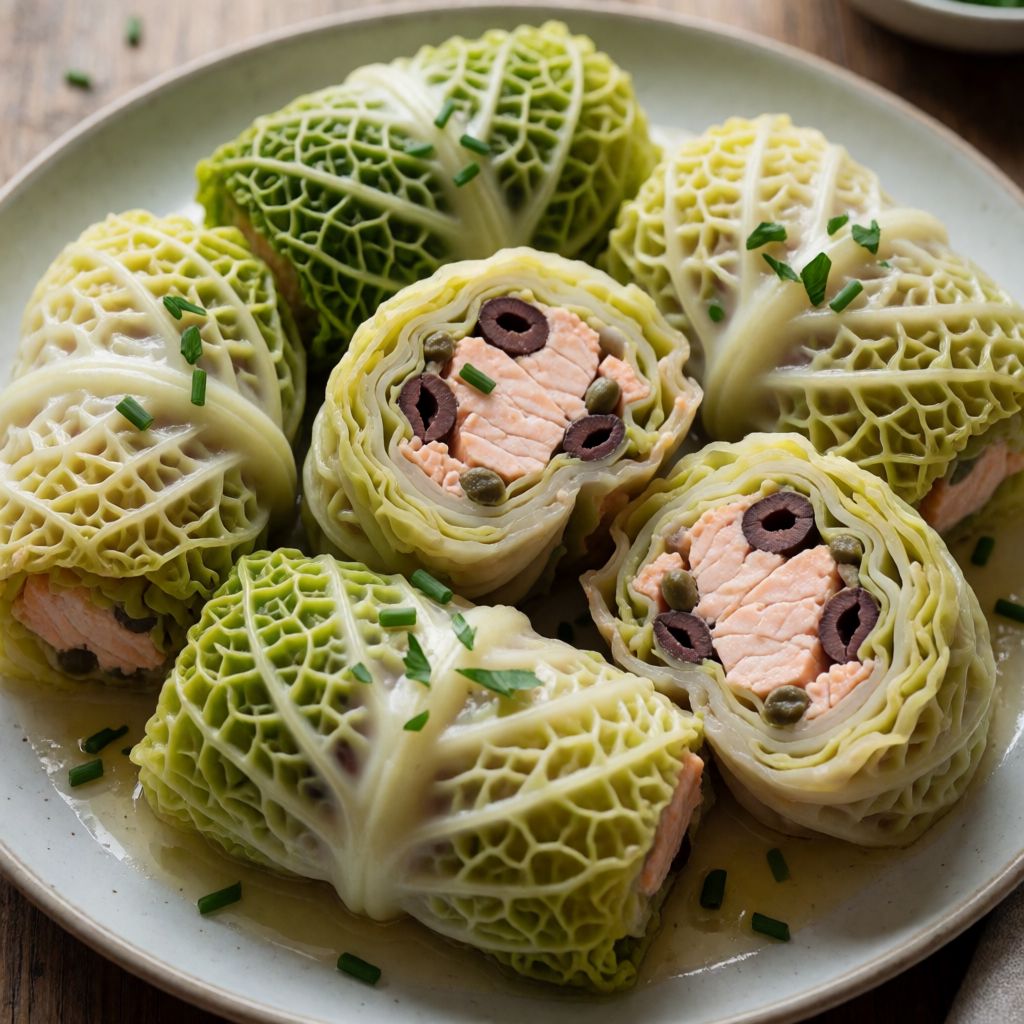
 AI photo
Savoy Cabbage Rolls with Salmon
Savoy cabbage leaves rolled around pan-seared salmon, olives, capers and fresh herbs, then baked until golden.
Labels are worked out automatically from the ingredients and can be wrong. Check the packaging if it matters to you.
Ingredients












Steps
Wash the Savoy cabbage leaves thoroughly and blanch them in lightly salted water
5 minQuickly rinse the leaves under cold water and pat dry with paper towels
Spread the leaves on a work surface and cut out the thick central vein
Pour olive oil into a non-stick pan, add the salmon, season with salt and black pepper and fry on both sides
Remove the salmon from the pan and let it cool slightly
Place the salmon on the cabbage leaves, add olives, capers, garlic and herbs
Roll the leaves into parcels, making sure the filling does not fall out
Coat the rolls in breadcrumbs and place them in a baking dish
Bake the rolls at 200°C for at least 15 minutes, switching on the grill for the last few minutes. Doneness: 63°C at the thickest point.
15 minServe the rolls hot
What was changed
clarifies that 200°C is the oven temperature for baking, while 63°C is kept as the salmon's internal doneness target.
A cabbage leaf here isn't decoration — it's the only pot you have that can go into a 200°C oven without the fish drying out before it's ready. Salmon gets fried, then wrapped, then baked: three separate heats doing three separate jobs. The fry gives a crust and lets off a bit of fat so the parcel doesn't end up swimming in oil. The wrap traps the steam the fish throws off as it finishes, so the oven minutes are really steam-and-roast, not plain roast. The breadcrumb coat is there to catch the grill at the end and go brown and dry on the outside while the inside stays wet — skip it and the parcel just goes matte and sad under the heat.
What decides whether this works isn't how long anything cooks, it's whether the leaf survives being folded. Savoy cabbage, not the tight ordinary green kind, because its leaf is looser and more crinkled, with more give — you can bend it round a fillet without it splitting down the spine. Blanch it only until it goes from stiff and pale to limp and bright; five minutes is the outside limit, not a target. Leave it a beat too long and it turns slimy and tears exactly where you need it to hold.
Some say you need string to keep the rolls shut in the oven. No — parcels burst because the filling goes in hot and wet, sweats inside the leaf, and pushes the seam apart from within. Let the salmon cool a little before you wrap it, fold the leaf tight with the seam tucked underneath, and the first firm fold does the string's job for free.
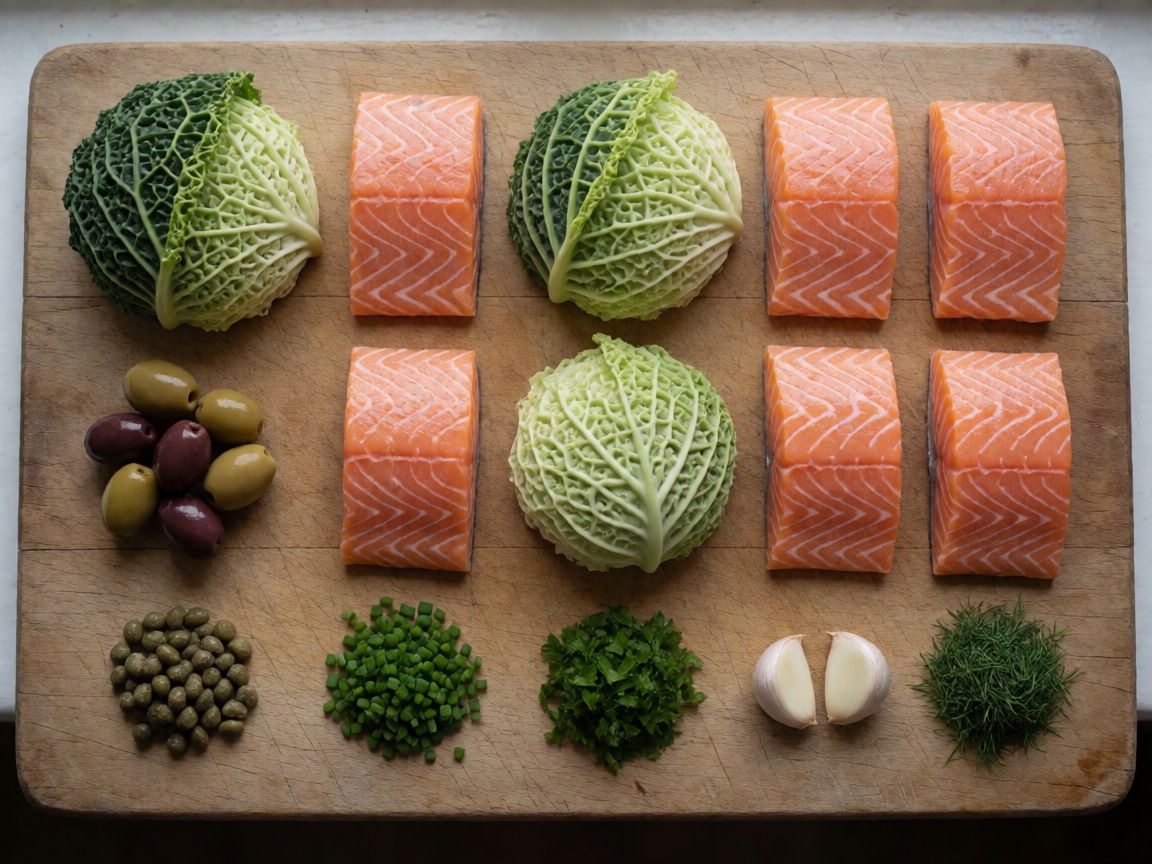
Salmon: pick a fillet thick enough to survive being fried, wrapped and baked without drying to cardboard — fat is what buys you that margin, which is why salmon works here and a lean white fish wouldn't. Count roughly 100g a roll, two rolls a person for four people, eight rolls total. No salmon to hand — any fatty fillet that holds together when fried, trout or mackerel, will do the same job.
Savoy cabbage earns its place by economics as much as texture: it's a winter crop, cheap through the cold months when little else is growing in a British garden, which is exactly why it turns up in so many British kitchens rather than something more fragile. The leaf you want is pliable without being wet-weak — if you've only got hardier greens, chard leaves fold the same way and won't let you down; a crisp lettuce leaf, by contrast, will crack the second you try to bend it round anything.
Olives and capers aren't garnish, they're the acid and salt that oily fish needs instead of the lemon wedge you'd normally reach for — salmon on its own, wrapped and baked, has nowhere to shed its richness, so something sharp has to be built in. Don't swap them for anything sweet; the point is cut, not addition.
Chives, parsley and dill are the classic fish herbs for a reason that has nothing to do with tradition for tradition's sake: dill specifically cuts oiliness, parsley brings green freshness without weight, chives give a mild onion note that doesn't bully a fillet this delicate the way raw onion would. Use what's growing or what's fresh in the shop rather than chasing all three if you've only got two.
Garlic goes in raw, inside the parcel, not fried first — the enclosed heat of the bake mellows it gently instead of letting it scorch bitter in a hot pan, which is the usual way garlic gets ruined.
Breadcrumbs need to be dry, because everything else going into this parcel is already wet — a dry crumb's whole job is to crisp under the grill without adding moisture of its own; any dried crumb that holds no water works, panko or blitzed stale bread both do the job the shop packet does. For frying the salmon, the oil just needs to carry heat evenly into the fillet and not smoke before the crust forms — olive oil does that at a domestic hob's usual fry heat, but any plain oil with no smell of its own will behave the same way if that's what's in the cupboard. And patience belongs on the list too, quietly: the ten minutes you give the salmon to cool before wrapping is the whole reason the seam holds in the oven — skip it to save time and you'll be mopping filling off the baking dish instead.