
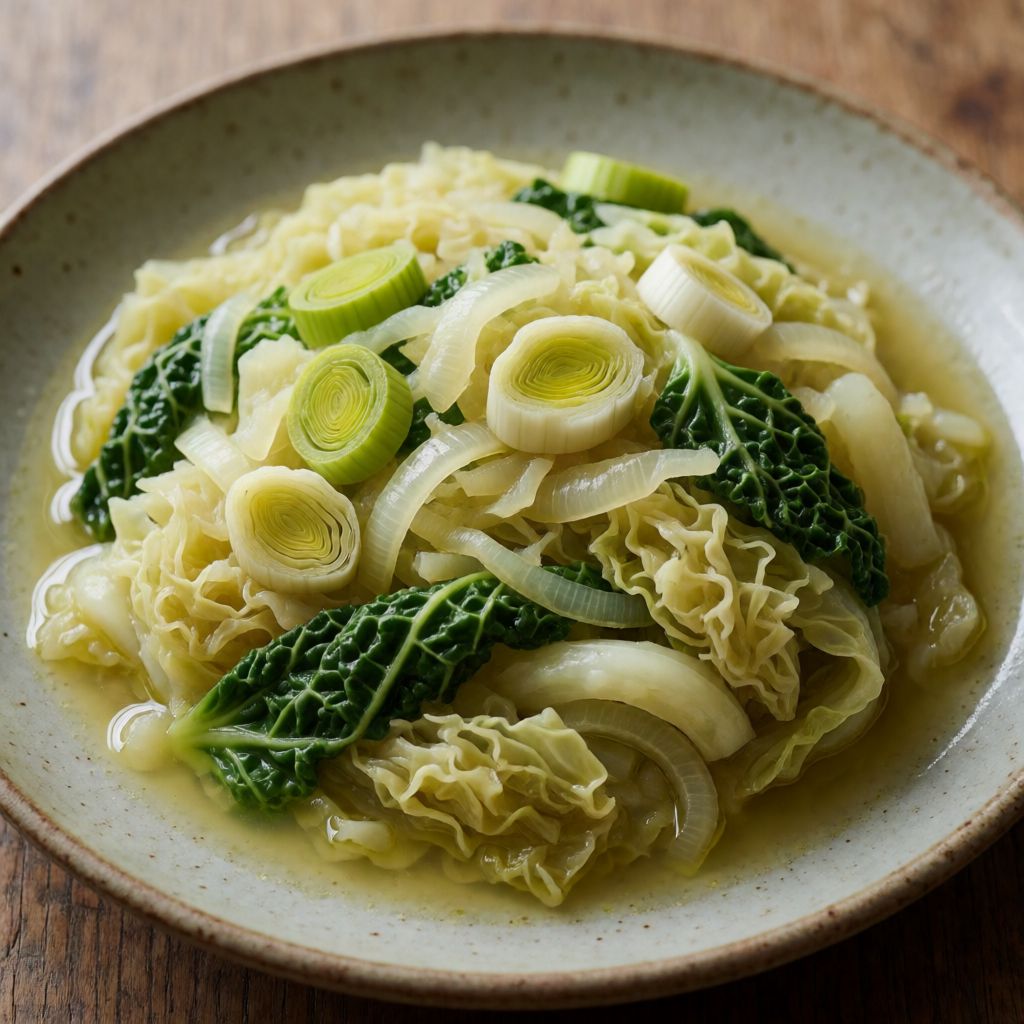
 AI photo
Savoy Cabbage Stew
A simple, comforting side dish of savoy cabbage braised in a light vegetable broth.
Labels are worked out automatically from the ingredients and can be wrong. Check the packaging if it matters to you.
Ingredients











Steps
Make a vegetable broth with the onion, leek, carrot, celery stick, courgette, parsley, black peppercorns and a good pinch of salt.
Cut the savoy cabbage into strips and rinse well.
Heat the olive oil in a frying pan, add the cabbage and cook for a few minutes.
Season with salt and gradually pour in the hot vegetable broth.
Cover with a lid and simmer gently for about 25 minutes.
25 minWhen the cabbage is tender, remove from the heat and let it rest for 10 minutes before serving.
10 min
This is cabbage cooked the way poor kitchens have always cooked cabbage when they had no meat to spare: build a broth first, then let the main vegetable drink it up until it's soft enough to need no knife. What decides whether it works isn't the cabbage at all — it's the broth, and whether you have the patience to make it properly before you touch the cabbage.
Savoy is the right cabbage for this because its leaves are crinkled, not flat and tight like a white cabbage. That crinkle holds liquid instead of shedding it, so when you pour the hot broth over the strips, they take it in rather than just sitting in a puddle. Use a flat cabbage and you'll get cabbage boiled in liquid, not cabbage stewed by it — a different, blander dish.
Some say you can skip the broth and just use water with a stock cube. No — because the whole point of this dish is that the cabbage finishes cooking in something that already tastes of vegetables, so the final result isn't "cabbage" plus "seasoning" but one taste built in layers. Water does the opposite: it dilutes whatever flavour the cabbage has left, instead of adding to it.
The resting ten minutes at the end is not laziness, it's physics: the cabbage keeps absorbing broth and settling as it cools slightly, and if you serve it the second it stops simmering, you'll get a watery plate with cabbage floating in it rather than cabbage that's actually taken up the liquid.
Start with the broth, because it is doing more work than the recipe name admits. Onion, leek, carrot, celery, courgette, parsley, a few peppercorns, a pinch of salt, a litre of water — that's not a shopping list, it's a slow extraction. Each vegetable gives something different: onion and leek give sweetness and body, celery gives a green backbone note, carrot gives a little sugar, courgette softens the whole thing without adding much of its own. Simmer it gently rather than boil it hard — a hard boil breaks the vegetables apart and clouds the broth with starch and foam, and you end up straining out grit instead of flavour. Gentle means small bubbles breaking the surface here and there, not a rolling boil.
The cabbage: 1 kg of Savoy, which in a British kitchen is usually one decent-sized head, maybe a bit more. Cut it into strips, not fine shreds — it needs enough body to hold shape through 25 minutes of simmering without turning to mush. Rinse it well, and this isn't fussiness: Savoy's crinkled leaves trap grit and the odd insect in a way smooth cabbages don't, and no amount of cooking later hides a mouthful of soil.
Olive oil here is doing a small job: coating the cabbage strips before the broth goes in, so they start to soften and take on a little flavour of their own rather than going straight into liquid and essentially boiling. Any oil without a strong smell of its own will do the same job — sunflower oil, a mild rapeseed oil. You lose nothing of the structure of the dish by swapping it; you'd lose something if you used a strongly flavoured oil, because then you'd taste the oil instead of the vegetables.
Salt is used twice for a reason, not by accident — once in the broth, once on the cabbage before the liquid goes in. Salting only at the end means the salt sits on the surface and never gets carried into the cabbage as it softens; salting early, in layers, means it seasons the vegetable from the inside as it cooks, which is the whole reason stews taste better than things boiled and salted afterwards.
Nutmeg is a pinch, not a flavour you should ever notice directly. Its job with cabbage and brassicas generally is old and practical — a tiny amount rounds off the slightly sulphurous, bitter edge that cabbage can have, especially as it cooks longer. You're not trying to taste nutmeg in the final dish; you're trying to not taste the thing nutmeg is quietly removing.
On the hob: you don't have a pan with a proper tight lid, you have a lid or a plate that mostly covers. That's fine here, because this isn't a dish that needs to trap steam under pressure — it needs the broth kept hot and the cabbage kept moist, and a loose cover does that well enough. What you're watching for isn't a clock but the leaves: raw Savoy is stiff and holds its shape when you push it with a spoon; cooked, it folds without resistance, the way a boiled carrot bends instead of snapping. Twenty-five minutes is where that usually happens, but it's a floor, not a deadline — check the leaf, not the timer.