
 AI photo
Scotch Eggs
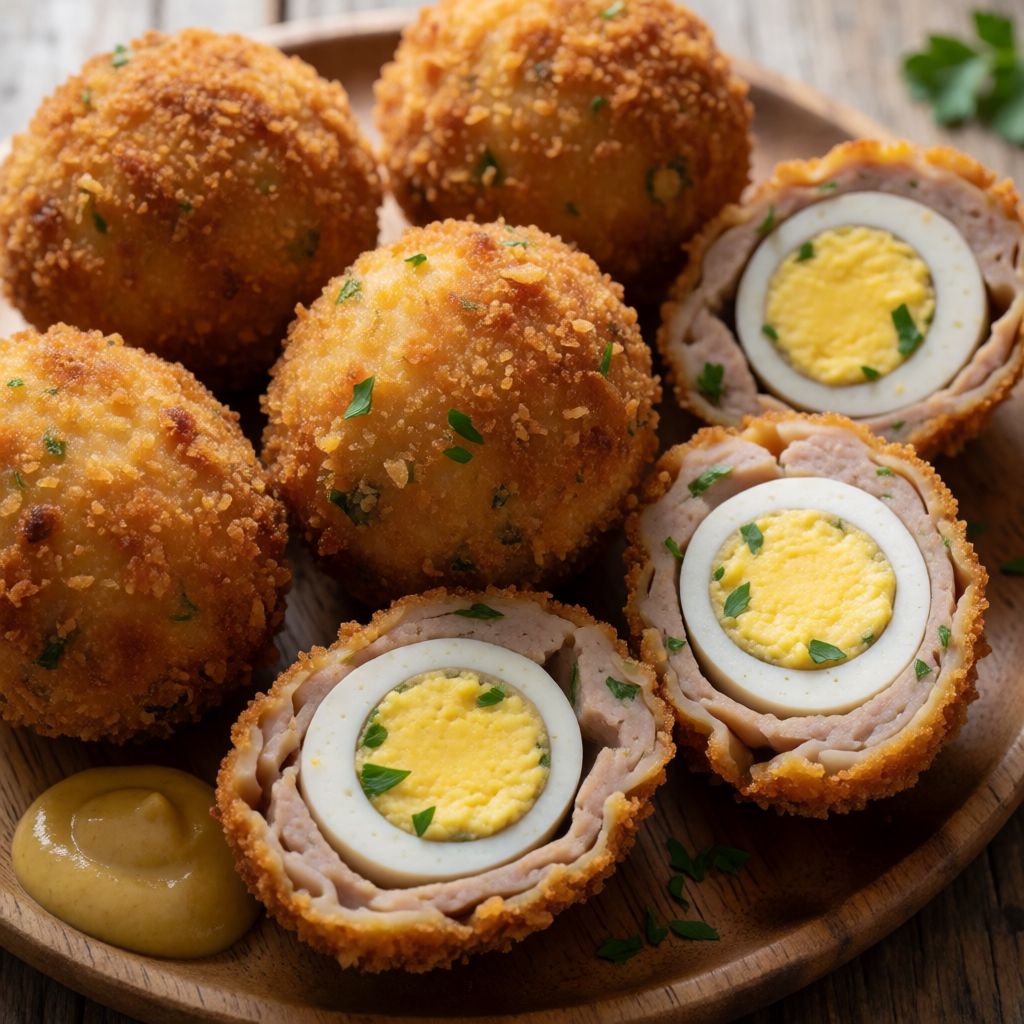
A classic Scotch egg: soft-boiled eggs wrapped in seasoned sausage meat, breaded and fried until golden.
Labels are worked out automatically from the ingredients and can be wrong. Check the packaging if it matters to you.
Ingredients
- 4 pcs Eggs
- 150 g Pork mince
- 150 g Sausage meat
- 1 tbsp Parsley
- 1 tsp Mustard
- 1 tbsp Worcestershire sauce
- Salt to taste
- Black pepper to taste
- 2 pcs Eggs for coating
- Plain flour for coating
- Breadcrumbs for coating
- Peanut oil for frying











Steps
Combine the pork mince with the sausage meat, parsley, Worcestershire sauce, mustard, salt and black pepper. Mix until smooth.
Boil the eggs for 4-5 minutes, cool in cold water and peel.
5 minCoat the boiled eggs in flour.
Lay out the meat mixture on cling film, place a boiled egg in the centre and shape the meat so it covers the egg on all sides.
Coat the Scotch eggs in flour, then in beaten egg and finally in breadcrumbs.
Heat the peanut oil to 170°C.
Fry 2 eggs at a time, browning evenly on all sides, about 5 minutes, until the meat reaches an internal temperature of 71°C.
5 minPlace on paper towels and serve warm.
What was changed
Pork mince to make the mince easy to find in a British supermarket.
A Scotch egg is a boiled egg wrapped in minced meat, crumbed, then fried — and the whole dish lives or dies on what happens inside that yolk. Cut one open: if the centre is pale, dry, chalky, somebody boiled the egg too long out of nervousness. The point of this dish, the only reason it's worth the mess of three bowls for coating, is the contrast — crisp crumb, dense meat, and a yolk that's still soft, almost flowing. Four to five minutes in boiling water gets you there. Any longer and you've made a meatball with a hard-boiled egg hiding inside it, which is a perfectly fine thing to eat, just not this thing.
Some say a Scotch egg needs a fully hard yolk, because a soft one seems unsafe or unfinished once it's wrapped in raw meat and fried. No — the meat gets its heat check with a thermometer, 71°C in the thickest part, which is well past safe for pork. The egg doesn't need to cook again; it's already cooked, gently, before it ever meets the mince. The two timings are separate jobs and nobody needs to sacrifice the yolk to protect the meat.
On the mince itself: pork mince alone is often too lean and falls apart when you try to form it round an egg — no fat, no cohesion. Sausage meat brings back the fat and, usually, a seasoning base already built in, which is why older versions of this dish just use sausage meat on its own. Mixing the two gives you body from the mince and binding fat from the sausage meat. If you can only get one, use fattier sausage meat and accept a richer, looser casing, or use pure mince and add a spoon of melted butter or a splash of cream to stop it cracking.
Mustard and Worcestershire sauce aren't flavour for flavour's sake — they're there because mince and sausage meat, cooked through at 71°C, lose a lot of their own savour on the way, and these two bring back sharpness and depth that heat otherwise flattens. Parsley is freshness against all that fried crumb and fat; use any soft herb you have — chives, a little dill even — the rule is tender leaves, not woody ones that won't soften in the short cook.
The eggs for boiling want to be a few days old if you can manage it — very fresh eggs cling to their shells and you'll tear the white peeling them, which then shows under the crumb. The coating eggs are a different job entirely: beaten smooth, they just need to be wet enough to hold flour on one side and breadcrumbs on the other. Flour first catches on the meat's surface moisture; beaten egg then catches on that flour; breadcrumbs catch on the egg. Skip a layer and the crumb slides off in the oil — that's the usual reason for a scotch egg losing its jacket halfway through frying.
Breadcrumbs: dried, fine ones give an even, close crust. Fresh breadcrumbs work too but soak up more oil and brown less predictably, since they carry moisture into the fryer with them. Panko, if that's what's in your cupboard, gives a craggier, crunchier shell — not traditional, not wrong either, just a different texture.
Peanut oil is specified because it takes high heat without smoking or tasting of itself, which matters when you're holding 170°C for several minutes with meat releasing its own fat into the pot. The real criterion is any oil with a high smoke point and no flavour of its own — sunflower, a plain vegetable oil, refined rapeseed all do the job. Don't reach for olive oil here; it smokes too early at this temperature and brings a taste that has nothing to do with this dish.
On equipment: you don't need a deep-fat fryer. A wide, heavy pan with oil a few centimetres deep and a cheap probe thermometer clipped to the side does the same work — you're watching a number, not guessing by eye. Fry two eggs at a time deliberately, not from caution but because adding cold meat drops the oil's temperature, and a crowded pan never recovers that heat fast enough; you end up with the soggy crust problem all over again. This dish doesn't reward hurry anywhere — not in the wrapping, not in the oil. Give the eggs time to cool fully before you peel them, give the pan time to come back to temperature between batches, and the dish does the rest on its own.