
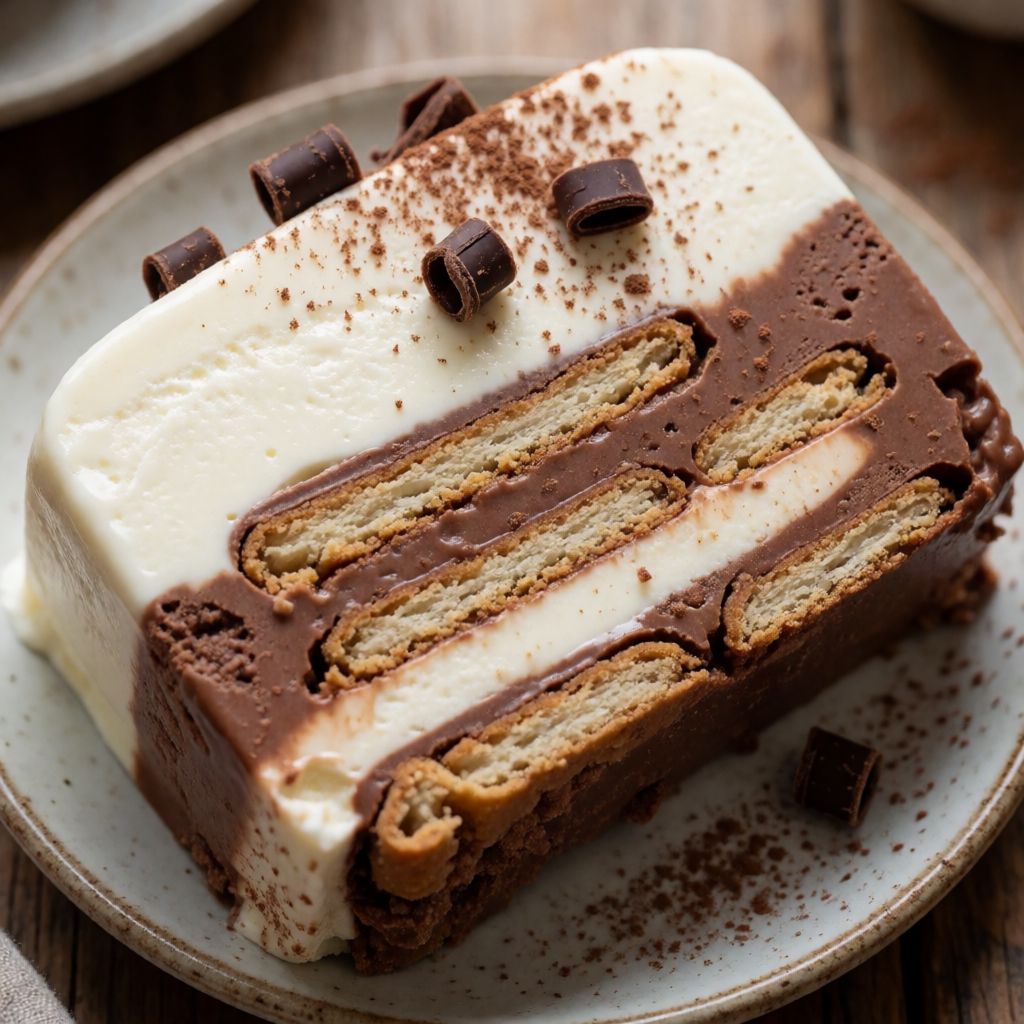
 AI photo
Chocolate and Cream Semifreddo
A light, no-churn frozen dessert of whipped cream and chocolate set in a mould.
Labels are worked out automatically from the ingredients and can be wrong. Check the packaging if it matters to you.
Ingredients
- 150 g Dark chocolate
- 500 ml Double cream
- 1 tbsp Icing sugar
- 200 ml Condensed milk
- 12 pcs Sponge finger biscuits
- 250 ml Strong brewed coffee, cooled
- 50 g Walnuts chopped







Steps
Melt the dark chocolate over a bain-marie and leave it to cool.
Whip the double cream with a spoon of icing sugar.
Add the condensed milk and keep whipping until smooth.
Divide the mixture in half, stirring the melted chocolate into one half until well combined.
Line a loaf tin with cling film and spread the chocolate mixture as the first layer.
Add a second layer of sponge finger biscuits soaked in coffee.
Spread the plain whipped cream as the third layer.
Finish with a final layer of coffee-soaked sponge fingers.
Freeze the semifreddo for at least 8 hours.
480 minTurn the dessert out of the tin, decorate with melted chocolate and chopped walnuts, and serve.
What was changed
We used Sponge finger biscuits in place of plain crackers, as they're the biscuit British cooks reach for to soak in coffee for layered puddings like this.
This is not ice cream, and that's the whole trick of it. Semifreddo means half-cold — the dessert never goes through a machine that beats air into it as it freezes, because the air is already folded in beforehand, by hand, in the whipped cream. What freezes afterwards only has to hold that air in place, not create it. So the whole dish stands or falls on the whip, not the freezer.
What decides whether it works: how well you whip the cream (soft peaks, not stiff — stiff cream splits when frozen and gives you butter flecks, not silk), and how patiently you let it actually freeze solid before you try to turn it out. Eight hours is the floor, not a promise. Your freezer at home is not a blast chiller in a gelateria — it is a small box that opens every time someone wants ice for their tea, and the temperature wobbles each time. Give it the night, not the clock.
Some say you need an ice cream maker for anything frozen and creamy — no, because churning exists to fight ice crystals forming in a liquid base. Here there is no liquid base. The cream is already a foam before it goes in the freezer, and a foam full of fat and sugar doesn't crystallise the same way water does. That's the whole reason this recipe exists in ordinary kitchens with no machine in sight — it's essentially frozen tiramisu, built from the same economics: coffee, biscuit, cream, no custard to cook, no churn to own.
Chocolate: melt it over a bain-marie, not direct heat, because chocolate has almost no tolerance for its own sugar and cocoa solids scorching — direct heat seizes it into a grainy paste before you'd even notice the smell change. Let it cool before folding it in; warm chocolate meeting cold whipped cream just deflates the foam you worked to build. Use a dark chocolate you'd eat on its own — if it's bland before melting, it's bland frozen too, only colder.
Double cream is the engine of the whole thing. UK double cream sits around 48% fat, which is exactly why it whips to a stable foam without needing eggs or a cooked custard base the way old-fashioned semifreddo recipes do. Whip to soft peaks — the point where it holds a shape but still looks a little wet. Go further, to stiff dry peaks, and you've started making butter; freeze that and it turns grainy instead of silky. The icing sugar isn't there for sweetness so much as to stabilise the foam while you whip — caster sugar works but dissolves slower, so icing sugar is the kinder choice here.
Condensed milk does two jobs at once: it sweetens, and because it's thick with sugar it lowers the freezing point of the mix, which is exactly why this dessert stays soft and spoonable at freezer temperature instead of setting like a brick of ice. This is the ingredient standing in for the egg yolks and sugar syrup of a classical semifreddo — cheaper, no cooking, no risk of scrambling eggs over heat. Don't substitute it with ordinary milk; you'll lose both the sweetness and the soft set.
Sponge fingers need to be genuinely dry and a bit stale-feeling before they go anywhere near the coffee — that dryness is exactly what lets them drink liquid without collapsing into paste. Dip them, don't drown them: a quick pass through the coffee, turn, out. Linger and they go to mush, and mush is what tears apart when you try to slice the finished loaf. If you can't find sponge fingers, any plain, dry biscuit that isn't swimming in fat will do the same scaffolding job — just know a shortbread or digestive brings its own flavour along with it.
The coffee should be properly made and properly cooled — hot coffee melts whatever cream it touches on contact, and that's how you get a grey puddle at the bottom of the tin instead of a clean layer. The cling film lining the tin isn't fussiness either: without it the cream mixture bonds to the metal as it freezes, and turning the loaf out tears the top layer rather than releasing it. Lift by the film, invert onto your serving plate, and if it won't drop free, a warm cloth pressed against the tin's outside for a few seconds does the work heat always does to frozen fat — a small release, nothing dramatic.
Walnuts at the end are for crunch against all that soft cream — toast them briefly in a dry pan first if you want the oil in them to actually smell of something, raw walnuts can taste a little flat and waxy by comparison. Any nut with a bit of bitterness to balance the sweetness works here; this part is yours to adjust.