
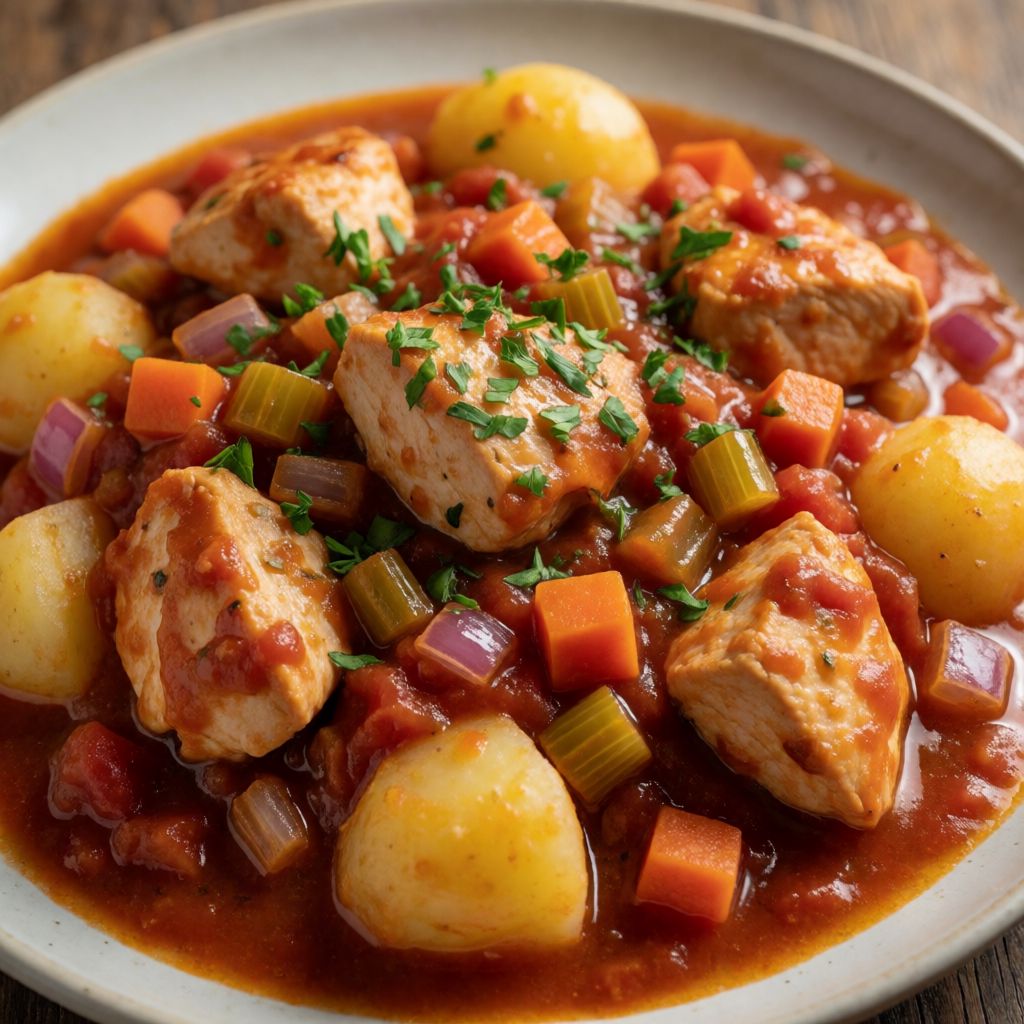
 AI photo
Chicken Pieces in Tomato Sauce with Potatoes
A hearty, slow-cooked dish of chicken breast braised with vegetables, tomato and potatoes.
Labels are worked out automatically from the ingredients and can be wrong. Check the packaging if it matters to you.
Ingredients
- 500 g Chicken breast
- 1 pcs Celery stalk
- 1 pcs Carrot
- 1/2 pcs Red onion
- 1 bunch Parsley
- Olive oil to taste
- Salt to taste
- Black pepper to taste
- 1 tbsp Plain flour
- 200 ml Passata
- 100 ml White wine
- 3 pcs Potato











Steps
Finely chop the celery stalk, carrot, parsley and red onion.
Put the vegetables in a pan with olive oil and sauté gently over a low heat.
Cut the chicken breast into 2 cm cubes, put into a bag, add the flour, close and shake.
Tip the meat into a colander and remove the excess flour.
Fry the chicken breast in the vegetable base, stirring often.
Pour in the white wine and cook on a high heat until it has evaporated.
Add the passata and hot water or stock.
Cook for 15-20 minutes.
17 minAdd the potatoes, cut into 2 cm cubes.
Cook for a further 20-25 minutes until the chicken is cooked through. Internal temperature: 74°C.
Season with salt and black pepper and serve, garnished with parsley.
What was changed
The sauce base is Passata, and the doneness check is marked as Chicken breast.
This is a braise dressed up as a stew — chicken breast, which has no business being cooked long and slow, gets away with it because it's cut small, floured, and surrounded by liquid that never lets it dry out. The potatoes go in late, the chicken stays tender, and the whole thing hinges on one quiet decision: cubes, not strips, and a pan wide enough that the meat browns instead of steams.
What decides whether this works is the soffritto — celery, carrot, onion, parsley, chopped fine and softened in oil before anything else touches the pan. That base is not seasoning, it's the engine. It's what makes the sauce taste like it simmered for hours when really it's had forty-five minutes. Skip it or rush it and you have tomato soup with chicken floating in it.
The flour on the chicken is doing two jobs, not one. It stops the breast — a dry, lean cut — from seizing into rubber the moment it hits a hot pan, by giving the surface something to brown and the juices somewhere to be trapped. And later, in the sauce, that same flour thickens things slightly as it cooks out, so you're not left with a watery passata round rubbery meat. Shaking off the excess in a colander matters: too much flour and you get gluey sauce, paste instead of silk.
The wine is not for flavour alone — pouring it in and boiling it hard, uncovered, until it's gone burns off the raw alcohol smell that would otherwise sit on top of the dish like a smell of nail varnish. That's why step six says high heat: you want it to evaporate fast, not simmer gently and stay. Any dry white does the job; what you're after is acid, not character. No wine in the house — a splash of vinegar loosened with water, or just skip it and lean on the passata's own acidity.
Passata rather than tinned chopped tomatoes because you want a sauce that coats, not one you have to crush with a spoon for twenty minutes. If passata's not to hand, blitz tinned tomatoes smooth yourself — the texture is the whole reason for choosing it.
The potatoes go in nine steps after the chicken starts cooking because they take roughly the same time to soften as the chicken takes to cook through from raw cubes — put them in with everything else at the start and they'd collapse into the sauce before the chicken caught up. Cut them to the same 2 cm as the meat and they finish together. Any potato that holds its shape under simmering works — a waxy one is safer than a floury one, which wants to fall apart and thicken your sauce into mash by accident.
Olive oil here is doing nothing fancy — it's there to carry heat to the vegetables without burning at the temperature a domestic hob gives you, and "to taste" really means "enough to coat the pan, not drown it." Any oil with no strong smell of its own will do the sautéing fine; save a good extra-virgin, if you have one, for drizzling at the end rather than cooking it away.
On an ordinary UK hob there's no kazan-wide surface and no roaring flame — your pan is probably narrower and your heat gentler than a professional range, which is exactly why "gently" and "stirring often" in steps two and five matter more than any clock. Low heat for the vegetables means soft and sweet, not coloured and bitter; a pan too small crowds the chicken so it steams in its own moisture instead of browning, and browning is where the flavour actually starts.
Doneness isn't a timer going off — it's the chicken no longer resisting a knife, the potato giving way without crumbling, and if you want certainty rather than a guess, 74°C in the thickest cube. Fifteen minutes of patience with the sauce before the potatoes go in, and another twenty-odd after, are not padding — that's the time the vegetables and tomato actually need to stop tasting separate and start tasting like one thing.