
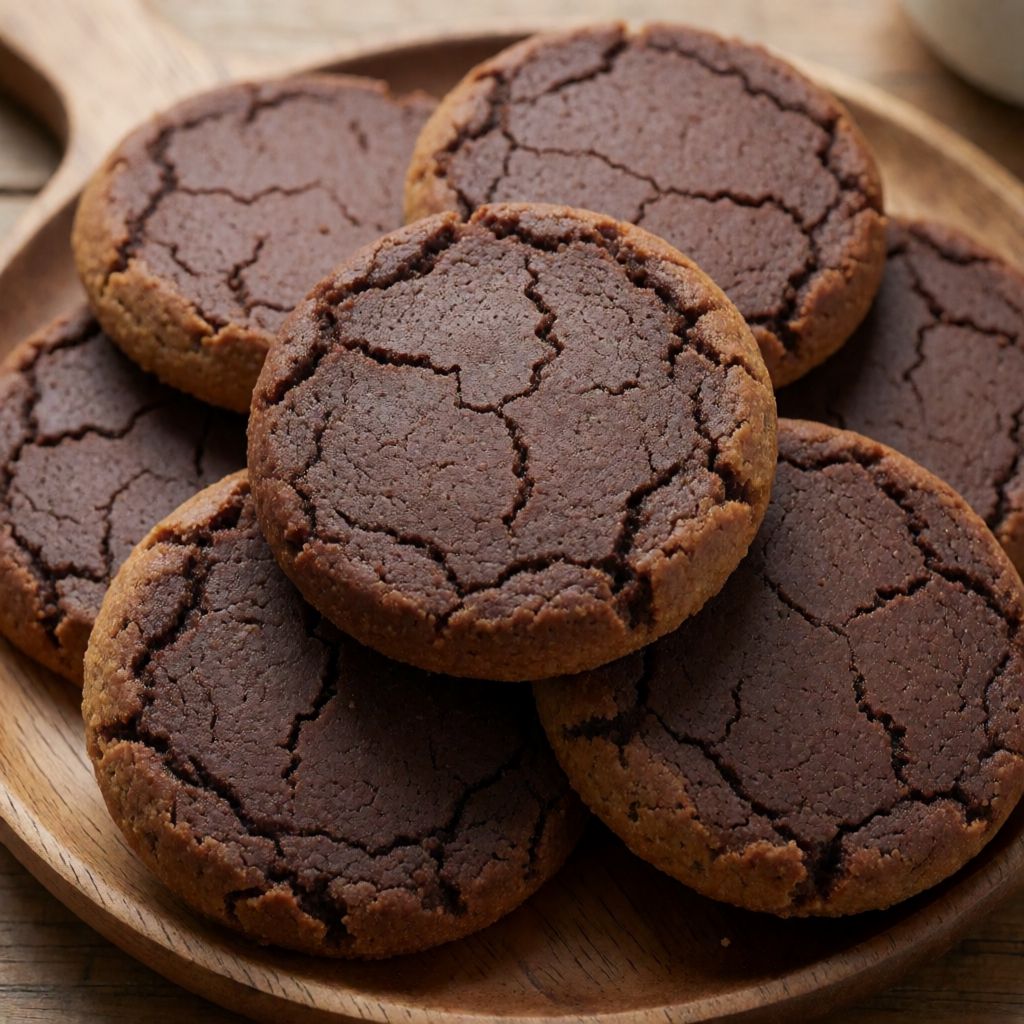
 AI photo
Chocolate Rice Flour Biscuits
Crisp cocoa biscuits made with rice and almond flour, perfect for a gluten-free treat with tea.
Labels are worked out automatically from the ingredients and can be wrong. Check the packaging if it matters to you.
Ingredients
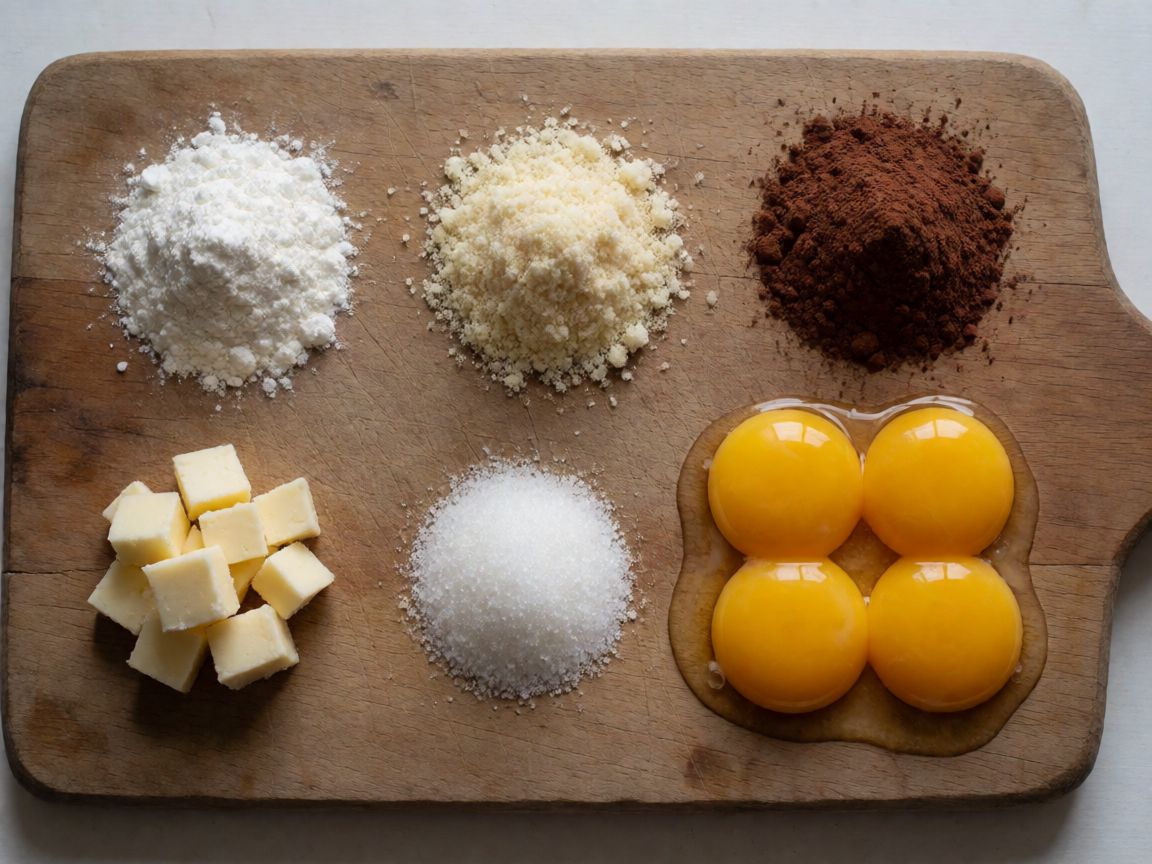
- 320 g Rice Flour
- 50 g Almond Flour
- 30 g Cocoa Powder sifted
- 180 g Butter cold, cut into pieces
- 180 g Sugar
- 4 pcs Egg Yolks beaten
- Salt to taste






Steps
Sift the rice flour, almond flour, sugar, salt and cocoa powder into a bowl and mix the dry ingredients together.
Add the beaten egg yolks and cold butter, and quickly work the dough together by hand until smooth.
Wrap the dough in cling film and chill in the fridge.
60 minDust the work surface with flour and roll out the dough to about 4cm thick.
Cut out biscuits using cutters.
Transfer the biscuits onto a baking tray lined with baking paper.
Bake in a preheated oven at 200°C until small cracks appear on the surface.
10 minTransfer the finished biscuits to a wire rack and let them cool completely.
This is a short, crumbly chocolate biscuit built on rice flour instead of wheat — gluten-free not because someone is dieting, but because rice flour simply has none of the protein that makes wheat dough elastic. No gluten to develop means no chewing resistance to fight, and that changes everything about how you handle the dough.
What decides whether it works is timing of one single event: does the fat get between the flour grains while it's still cold and solid, or does it melt into the flour too early and turn the whole thing greasy and flat. That's why the butter goes in cold and cut, and why you work the dough "quickly" — your hands are warm, butter is not, and every extra minute of kneading is a minute of butter softening in your palms instead of staying as tiny separate lumps coating flour particles. Once those lumps melt into the mix rather than sitting between the grains, the biscuit loses its short, sandy bite and bakes out thin and oily at the edges.
The chill in the fridge is not a formality, it's the dough recovering from your hands. Sixty minutes lets the butter re-set hard, so when the biscuits hit a 200°C oven, the fat melts in place rather than spreading the whole shape sideways before it's set. Some say rice flour biscuits are always a bit gritty, can't be helped, it's just the flour — no, because grit comes from coarse milling, not from the absence of gluten. Fine rice flour, properly coated in fat before it ever meets liquid, bakes just as smooth as a wheat shortbread; the fat is what stops it drinking in moisture and swelling into grains you can feel.
Rice flour is the whole point, so don't dilute it with the idea that "any gluten-free blend will do" — those blends usually carry xanthan gum or similar, added precisely to fake the stretch that gluten gives, which is the one thing you don't want here. Plain white rice flour, finely milled, is what gives the short bite without any elasticity getting in the way. If you can only find a coarser rice flour, the biscuit will still work, just with a slightly more granular crumb — not a flaw, a different biscuit.
Almond flour is there for fat and flavour, not structure — it's the richest, most reliable way to get a nutty depth into a flour that, on its own, tastes of very little. Ground hazelnuts do the same job with a different accent, if that's what's in the cupboard. Don't swap it for more rice flour thinking you're simplifying the recipe; you'd lose both the fat content and the flavour it was carrying.
Cocoa powder is sifted for the same reason the other flours are — lumps of cocoa don't dissolve in a dough that never meets much liquid, they just sit there as bitter specks. Treat it as a dry ingredient, because that's what it is here: no melted chocolate going in, because melted chocolate adds fat and sets hard as it cools, which would fight the butter's job of staying in discrete, flour-coating pieces rather than becoming one continuous greasy mass.
Butter should be cold enough that you feel resistance cutting it, and any fat that does the same — stays solid at fridge temperature, has little smell of its own — will substitute: a firm block coconut oil is the usual stand-in for a dairy-free version, though it softens at a lower temperature than butter, so chill it harder and work faster. The point of "cold, cut into pieces" is never decorative — those small cold chunks are what coat the flour grains individually before anything melts, and that's the entire mechanism behind why the biscuit is short rather than cakey.
Egg yolks bind the dough and add richness and colour, with none of the white's protein to toughen the crumb — this is why whole eggs aren't used. If you only have whole eggs, use roughly the same weight of yolk and set the white aside for something else; adding the white in would push the biscuit toward chewy rather than short.
Sugar at 180g against 500g of combined flours is a tenderiser as much as a sweetener — it keeps the dough soft enough to roll and gives the edges a faint crispness as it caramelises slightly in the oven. Caster sugar dissolves a touch more evenly through a dough this dry; granulated works fine too, just with slightly more bite at the edge. This batch, rolled and cut, makes enough for eight people with tea — not a Sunday roast pudding, this is a teatime biscuit, the kind meant to sit by a cup with milk in it rather than at the end of a big dinner.