
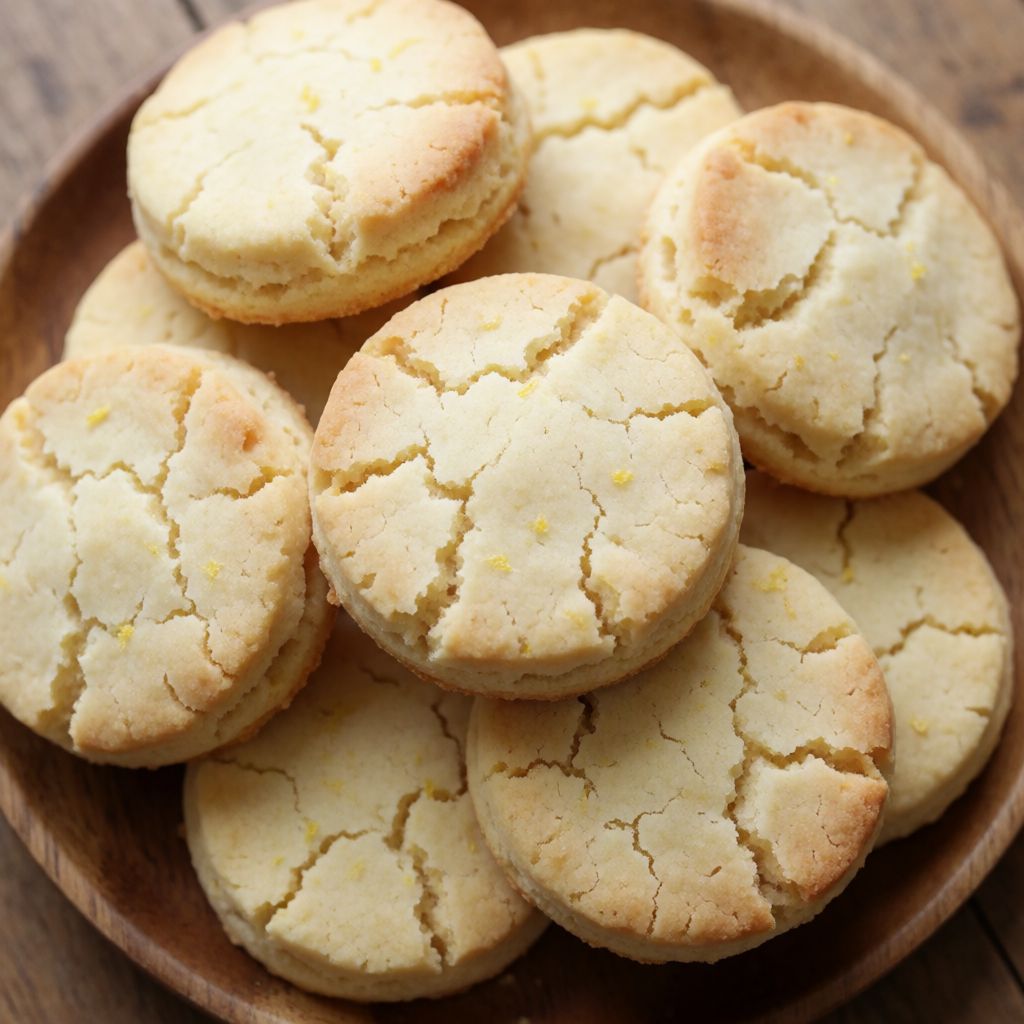
 AI photo
Vegetarian Biscuits: Egg-Free and Dairy-Free
A simple vegetarian biscuit recipe made without eggs or dairy products.
Labels are worked out automatically from the ingredients and can be wrong. Check the packaging if it matters to you.
Ingredients
- 90 g Brown sugar
- 50 ml Vegetable oil
- 50 ml Oat milk
- 150 g Plain flour
- 1 pcs Lemon or orange zest
- 10 g Baking powder
- 50 g Dark chocolate roughly chopped






Steps
Pour the vegetable oil into a bowl, add the brown sugar, oat milk and lemon or orange zest, and mix.
Add the sieved flour together with the baking powder, mixing in gradually.
Add the roughly chopped dark chocolate and knead.
Knead by hand until the dough is smooth, soft and not sticky, adjusting with extra oat milk or flour if needed.
Shape the dough into small balls, rolling them between your palms.
Place the balls on baking paper and flatten them slightly with your palm to shape the biscuits.
Bake in the oven at 170°C without fan (conventional) until lightly golden.
9 minLeave the biscuits to cool completely on the tray or on a wire rack.
What was changed
Replaced dairy milk with Oat milk to keep the biscuits dairy-free.
This is a drop cookie built on oil, not butter, and bound by flour and baking powder, not egg. Sugar, oil, oat milk and zest get beaten into a wet paste first; flour and raising agent go in after. That order is not fussy ritual — it's so the fat coats the flour before the flour has a chance to grab water and start building gluten. Coat first, hydrate second: that's the whole trick of a tender, non-chewy biscuit.
What decides whether these work is how far you knead once the flour's in. You're told to work it until smooth and not sticky — stop there. Gluten in a yeasted dough is something you want; in a biscuit dough it's something you're trying to keep down, because stretched gluten means a chewy, bread-like bite instead of a short, crumbly one. Oil does the suppressing — it slicks each flour particle so strands can't link up easily. Knead past 'smooth' into 'elastic' and you've undone that work with your own hands.
Some say biscuits need egg to hold together — no, because egg's job in baking is binding water and giving lift through trapped air, and a small flat dough like this doesn't need either: the fat already binds it, and the raising here comes entirely from baking powder reacting with the oat milk's moisture and then with oven heat. Egg would actually fight the shortness you're after by adding protein structure you didn't ask for.
On the flour: plain flour is chosen because it's low enough in protein that even the small amount of gluten it can form stays weak once the oil's coated it. Reach for a 'strong' or bread flour and you'd fight the fat for control of the dough — more protein, more structure, a tougher bite. If plain flour isn't what's in the cupboard, any general-purpose flour with no claim to strength on the bag will do the same job.
Oil instead of butter is the real engine of the texture, and it's worth knowing why. Butter is roughly a fifth water and goes solid in the fridge; as it melts in the oven it leaves tiny gaps where that water flashed to steam — that's what makes butter-based biscuits flake and spread unevenly. Oil is already liquid, has no water to lose, and spreads itself evenly through the flour from the first stir. The trade is butter's dairy flavour for a more even crumb — which is exactly the trade this recipe wants, since there's no dairy flavour to miss once chocolate and zest are doing the talking. Any oil with no smell of its own works: sunflower, rapeseed, a light groundnut oil. Skip extra-virgin olive oil and coconut oil unless you actually want their flavour sitting in the cookie.
Oat milk's role is just moisture with a touch of body — it's not there for any chemistry you can't get from other milk. Any milk, dairy or plant, with no strong flavour of its own will hydrate the flour the same way; thinner milks like rice milk may need a spoon less, since there's less to thicken the mix.
Brown sugar isn't only sweetness — it carries molasses, which holds onto moisture and keeps the inside from drying to sand once baked. Swap in white sugar and the biscuits will still rise and set, but they'll come out paler and drier, because you've taken away the one ingredient actively fighting moisture loss.
Baking powder is doing all the lifting here that egg would normally help with. It's a chemical raising agent, working partly on contact with the oat milk's liquid and mostly once the oven heat triggers the second reaction — which is why the dough doesn't need resting or proving, only mixing and shaping. Zest isn't decoration; it's there because oil, unlike butter, brings no flavour of its own to the party, so something aromatic has to fill that gap — citrus zest here, though a vanilla pod's seeds or a pinch of cardamom would do the same job of waking the dough up.
The chocolate wants roughly chopped, not chips, because irregular lumps melt unevenly — some edges dissolving into the dough, some staying as pockets — which is more interesting in the mouth than a uniform chip sitting whole. Use a bar with enough cocoa solids to hold its shape through the bake; a milk chocolate with high sugar and fat content will slump and bleed grease into the dough instead of staying put.
On the oven: 'no fan' matters more than it looks. A fan oven moves hot air across the biscuit constantly, drying and colouring the surface fast — fine for a thick loaf, risky for something this thin, because the outside can set and brown before the inside's cooked through. A conventional, still oven heats mainly by radiation from the top and bottom elements, more gently, giving the inside time to catch up with the outside. Most UK ovens default to fan — if yours has no 'conventional' setting, drop the temperature by about fifteen to twenty degrees and watch the colour even more closely than the clock.
Last thing, and it's the one people skip: let them cool fully before you touch them. Sugar inside a hot biscuit is still liquid — the thing that makes it a solid, snappable biscuit is cooling, not baking. Move them warm and you're not transporting a biscuit, you're transporting warm syrup with ambitions. Fifteen minutes of patience here is cheaper than a tray of crumbs.