
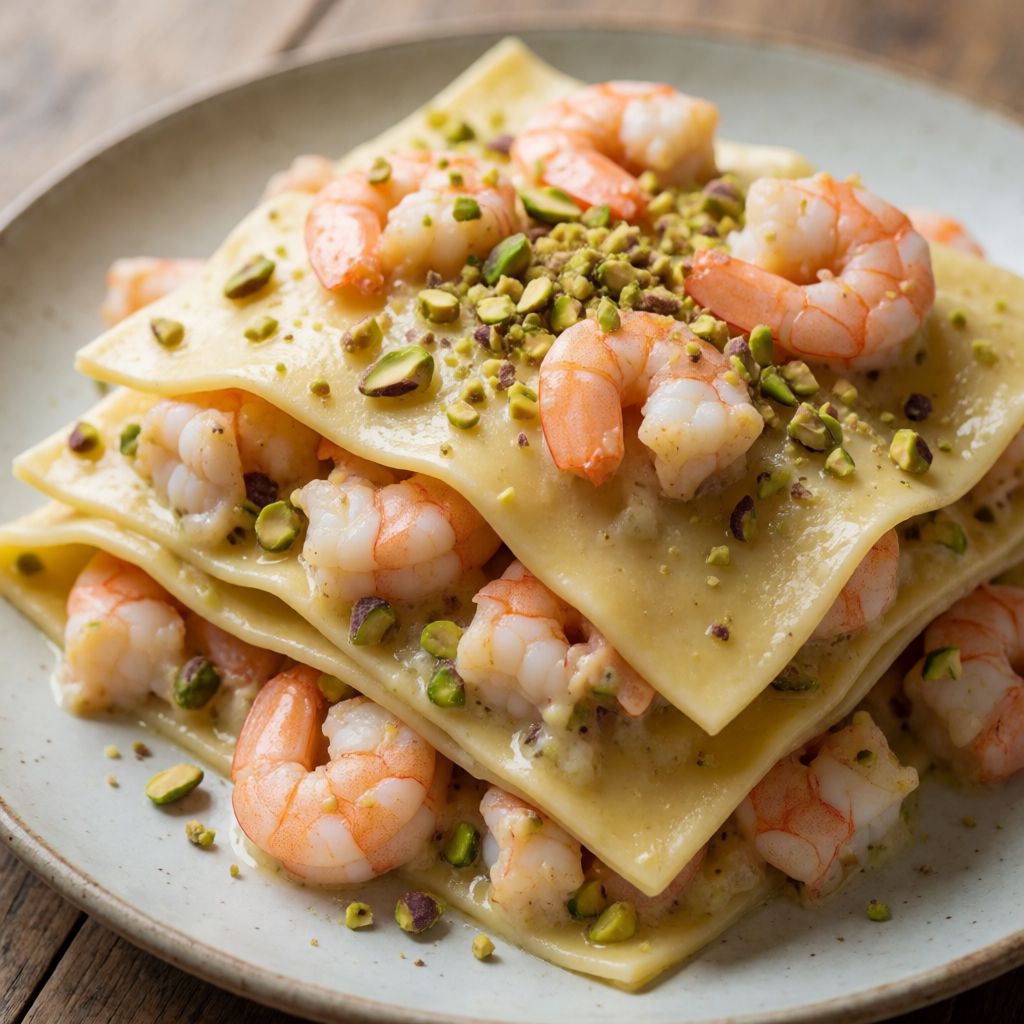
 AI photo
Prawn and Pistachio Lasagne
A rich pasta bake layering sweet prawns, a pistachio pesto and béchamel between sheets of egg pasta.
Labels are worked out automatically from the ingredients and can be wrong. Check the packaging if it matters to you.
Ingredients
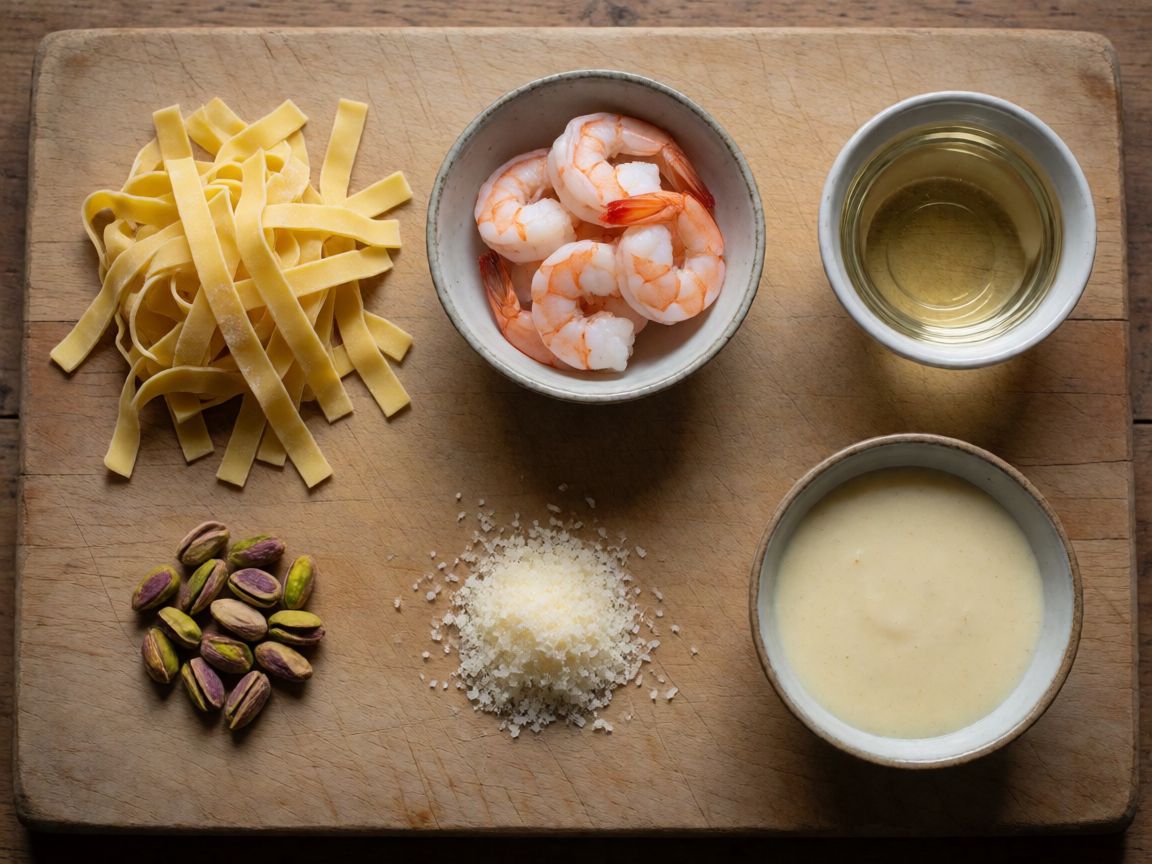
- 500 g fresh egg pasta sheets
- 1 kg Prawns
- 100 g Olive oil
- Salt to taste
- Black pepper to taste
- 25 ml White wine
- 500 ml Béchamel sauce
- 150 g Pistachios
- 30 g Pecorino Romano









Steps
Rinse the prawns and pat them dry with a paper towel.
Heat the olive oil in a pan and fry the prawns over high heat until cooked through (63°C). Add the white wine and season with salt.
Blend the pistachios with olive oil and Pecorino Romano into a thick pesto paste.
Mix the béchamel with the pistachio pesto, setting a few spoonfuls aside.
Roughly chop the prawns with a knife.
Assemble the lasagne in layers: pistachio béchamel, a pasta sheet, more béchamel, prawns, pesto, a pasta sheet. Repeat until the ingredients are used up.
Cover the final layer with béchamel and pistachios, then add the Pecorino Romano.
Bake at 200°C.
20 minServe hot.
This isn't the lasagne your nan made on Sunday, the one that sat in the oven next to the roast for an hour while everyone had a nap. This is a lasagne built on the logic of a seafood dish that happens to use pasta sheets as a structural idea, not as the point. The whole thing turns on two things staying separate until the very last moment: the sweetness of the prawn, and the fat-and-salt weight of the pistachio béchamel. If you let the prawn sit in heat too long, you lose the dish. If the béchamel is thin, you lose it too, just more slowly and more sadly, in a watery pool on the plate.
Some say prawns need a long cook to be "safe" — no, because a prawn is a small, fast-cooking muscle, almost all water and protein, and it goes from translucent to opaque in the time it takes to say "medium heat" twice. Push it past that point and you're not cooking it any safer, you're just squeezing the moisture out, the way you'd wring a flannel. What you want is 63°C at the centre — that's the number where the proteins have set and the texture turns from glassy to firm, not the number where the prawn starts fighting back. Everything after that is the oven finishing the job on reheating, so your frying pan work is really a sear, not a full cook.
Start with the prawns, because they're the ingredient most likely to go wrong and the one recipes talk about least honestly. A kilo sounds like a lot until you remember shell and head, if you're buying them whole, can be half that weight gone before you start cooking — so if your prawns come pre-peeled from a UK supermarket, weigh raw and peeled, not "a kilo of prawns" as a box ticked off a shelf. Fresh is better than frozen only if "fresh" genuinely means landed that morning — otherwise buy good frozen and thaw it slowly in the fridge, because flash-frozen prawns are often better handled than prawns that sat on ice in a van for two days calling themselves fresh. Pat them dry properly, not a token dab — a wet prawn in a hot pan steams before it sears, and a steamed prawn gives up water and goes tough exactly the way you didn't want.
The olive oil in the frying step and the olive oil in the pesto are doing different jobs, so don't economise on both with the same bottle. For frying, any oil with no flavour of its own and a reasonably high smoke tolerance works — a light olive oil, a neutral vegetable oil, even clarified butter if that's what's in your cupboard, because you're searing, not finishing. For the pistachio paste, you want oil with actual character, because it's carrying flavour, not just heat — a proper extra virgin, something that tastes faintly of itself. If you haven't got good olive oil for the pesto, a nut oil will do more for you than a cheap "olive oil" that tastes of nothing, because at least it picks a lane.
The white wine's job is small but specific: it deglazes the pan, picking up the browned bits the prawns left behind, and that acidity cuts through what would otherwise be a one-note richness of béchamel and pistachio. Any dry white does this — you're not drinking it, you're borrowing its acid. No wine in the house, a spoon of lemon juice with a splash of water gets you most of the way, though you lose a little of the aromatic lift.
Pistachios: buy them shelled and unsalted if you can find them, because salted pistachios will fight the Pecorino for control of the seasoning and you'll end up either over-salting the béchamel to compensate or under-seasoning it out of caution. If all you've got is salted, just go lighter with salt everywhere else and taste as you build. Pecorino Romano is sharp and salty in a way Parmesan isn't quite — it's a sheep's cheese with more bite — but Parmesan will stand in without collapsing the dish, you'll just lose some of that faint gaminess underneath the sweetness of the prawn.
Fresh egg pasta sheets are listed because they cook fast and stay supple under a thick sauce — dried lasagne sheets, the kind that need pre-boiling or a lot of extra liquid to soften in the oven, will fight the béchamel for moisture in a 20-minute bake and you'll either have crunchy edges or a soggier centre than you wanted. If fresh isn't available, buy "no pre-cook" dried sheets and add a touch more béchamel than the recipe calls for, since they'll drink some of it before they soften.
On the oven: 200°C here isn't about cooking anything raw — everything inside is already cooked or close to it — it's about colouring the top, melting the cheese into the béchamel skin, and warming the layers through evenly. A domestic oven runs ±10-15°C from what the dial says, and fan ovens run hotter than they claim, so if your top is catching before 20 minutes is up, that's your oven telling you its own truth, not the recipe being wrong — pull it a touch earlier or drop the shelf down.
Last thing: build this in a wide pan or dish, not a deep narrow one. You want more surface area touching the heat, more edges going golden, because a lasagne that's too tall just steams itself in the middle while the top burns trying to compensate — a problem the kazan-shaped dishes of tradition never had to think about, and one your kitchen will, if you let it.