
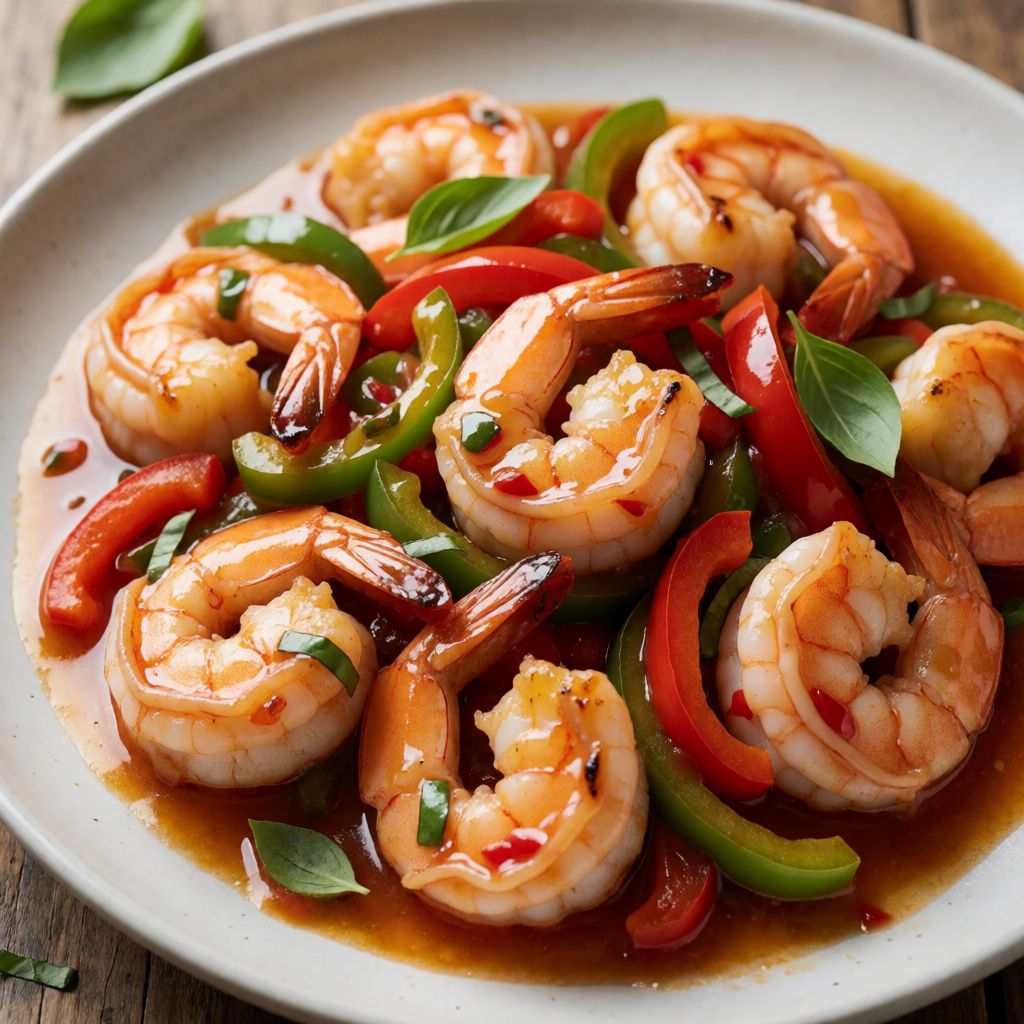
 AI photo
King Prawn Sweet-and-Sour Sauté
A quick stovetop dish of king prawns and sweet peppers simmered in a tangy sweet-and-sour sauce.
Labels are worked out automatically from the ingredients and can be wrong. Check the packaging if it matters to you.
Ingredients
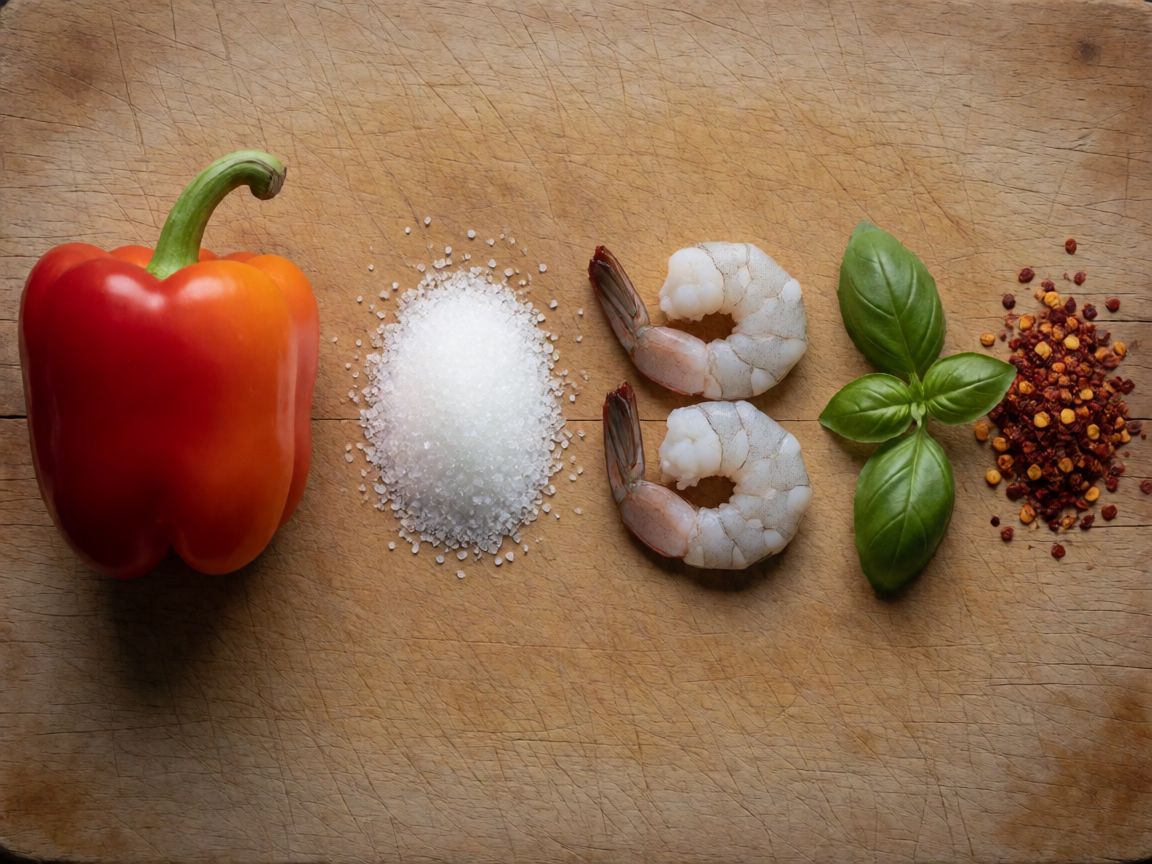
- 410 g Peppers in sweet-and-sour marinade jarred, liquid reserved
- 2 tbsp Sugar
- 400 g King prawns
- 5 pcs Basil leaves a few leaves
- 1 pcs Chilli flakes
- Salt to taste
- Black pepper to taste







Steps
Drain the liquid from the jar of peppers in sweet-and-sour marinade and set the peppers aside.
Pour the sweet-and-sour liquid into a frying pan, add the sugar and heat through.
2 minWhen the liquid starts to simmer gently, add the king prawns, basil leaves and chilli flakes. Doneness: 63°C at the thickest point.
5 minSeason with salt and black pepper to taste.
1 minAdd the drained peppers, cut into pieces.
2 minLet the dish rest briefly so the flavours settle, then serve.
3 min
This is not a sweet-and-sour sauce you build — it's one you borrow. Somebody has already done the vinegar-and-sugar balancing act for you, sealed it in a jar with peppers sitting in it, and your job is just to warm that liquid back up, thicken it a little with extra sugar, and use it as a poaching bath for the prawns. That's the whole mechanism: brine becomes glaze, glaze coats prawn and pepper, done. No reduction from scratch, no ketchup-and-vinegar paste simmered for twenty minutes — the jar did that already, which is exactly why this takes thirty minutes and not two hours.
What decides whether it works is entirely about the prawns, because everything else in this pan is forgiving. Prawns are a short window of good texture bracketed by raw on one side and rubber on the other. Push too much heat or too much time through them and the muscle fibre tightens and squeezes its own moisture out — that's the rubbery bite everyone blames on 'cheap prawns' when really it's just overcooked prawns. The fix is gentle: the liquid should be simmering, not boiling, when they go in, and you watch the prawn itself, not the clock. It goes from a translucent grey-pink to an opaque white-pink, and it curls into a loose C. A tight, tense O is the shape of a prawn that's gone past the point of return.
Start with the jar, because it's doing more work than its ingredient line suggests. 'Peppers in sweet-and-sour marinade' means the peppers are already fully cooked and the liquid around them is already a balanced acid-sugar mix — somebody has tasted and adjusted that balance before you ever opened the lid. That's why the peppers go in last, cut into pieces, only to warm through: they don't need cooking, they need heating, and if you put them in with the raw prawns at the start they'll turn to mush and water down your glaze before it's had a chance to form. If you can't get that exact jarred product, the criterion to match is simple — something sweet, something sharp, something already soft. Roasted red peppers from a jar plus a splash of white wine vinegar and a spoon of sugar will get you close enough.
The sugar added on top of the jar liquid isn't there for sweetness alone — the jar is already sweet. It's there to push the liquid toward a glaze faster, so that by the time the prawns are poached, what's left in the pan is thick enough to cling rather than pool. Any plain granulated white sugar does this job; there's no flavour complexity to protect here, just a reduction to speed along.
The prawns are the one ingredient where quality actually shows. Raw, peeled, deveined, tail-on or off as you like — fresh if your fishmonger has them, frozen-and-defrosted if that's what's realistic in an ordinary flat with no fish counter nearby, and frozen won't let you down here because the poaching method is forgiving on that front. What it won't forgive is inattention near the end: 400g is a generous single serving, closer to two if you're stretching it with rice, and that's more prawn than most people think to buy for one — which tells you this dish was built to be a proper meal, not a garnish.
Basil and chilli flakes go in with the prawns, into the simmering liquid, not scattered on top at the end — because their job here is to perfume the liquid as it works, not to decorate the plate. The chilli flake quantity in this recipe reads oddly as '1 piece' — read that as a pinch, not a whole chilli. Any dried chilli flake will do; what matters is that it's dry, so it doesn't add its own water to a liquid you're trying to concentrate.
Salt and pepper come after the prawns are in and nearly done, not before, because the jar liquid already carries salt from its own brine — season too early and you're guessing at a seasoning that's already partly there. Taste first, then adjust.
The rest at the end — three minutes, off the heat — is the one step people are tempted to skip, and it's the one that costs nothing and fixes the most. The glaze keeps tightening as it cools slightly, the prawns finish through on carryover heat without any more direct cooking, and the chilli and basil settle into the liquid instead of sitting raw on the surface. Patience here isn't about effort, it's about not touching the pan for a few minutes you've already saved everywhere else in this recipe.