
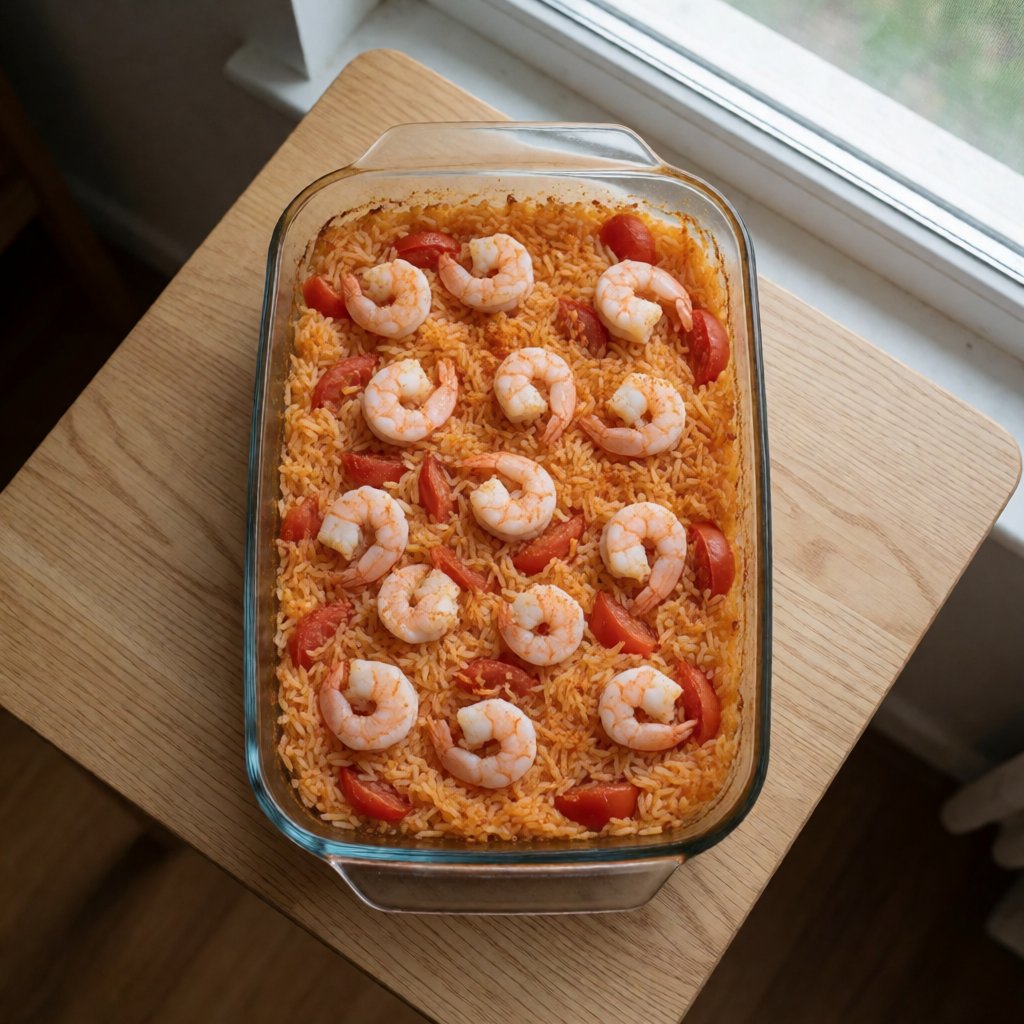
 AI photo
Prawns with Rice and Tomatoes
A simple oven-baked dish of rice, tinned tomatoes and prawns, ready with minimal prep.
Labels are worked out automatically from the ingredients and can be wrong. Check the packaging if it matters to you.
Ingredients
- 140 g Rice
- 180 ml Boiling water
- 200 g Chopped tomatoes, tinned in their own juice
- 250 g Peeled prawns patted dry
- 2 clove Garlic
- 1 tbsp Sunflower oil
- 1 pinch Paprika to taste
- 1 pinch Salt to taste








Steps
Mix the rice, tomatoes, garlic, oil, spices and boiling water in a baking dish, then cover with foil.
Put the dish in the oven at 200°C for 35 minutes.
35 minRemove the foil.
Pat the prawns dry and arrange them over the rice.
Cover with foil again and bake for a further 10 minutes, until pink (63°C inside).
10 minTake the dish out of the oven.
This is baked rice under tomato, with prawns laid on top at the very end — not a pilaf, not a paella, something that borrows from both but asks far less of you. The whole first stage is really about one thing: can the rice find enough trapped steam, in a closed space, to finish cooking without you touching it. The oven does what a kazan lid usually does — holds heat evenly, from all sides, so the grains at the edge of the dish don't scorch while the ones in the middle are still hard. Foil does the sealing. Some say foil isn't a real lid, it's too thin, it'll let everything escape. No — a lid's only job is to stop steam leaving, and tight foil does that as well as a heavy one, because steam doesn't care what it's pressed against, only whether there's a gap.
What decides whether this works is the liquid. Boiling water goes in already hot, so the rice starts absorbing and swelling from the first minute instead of wasting oven time bringing cold water up to a simmer — that's the whole reason it's boiling water and not tap water. The tomatoes add their own juice on top of that measured water, and their acidity is part of the mechanism too: a little acid slows down how fast the starch on the rice's surface breaks open, which is why the ratio here is tighter than you'd use for rice cooked in plain water on the hob. Get the seal wrong, or peek too early and let steam out, and the rice stays chalky in the centre no matter how long you leave it after that — more time won't fix a broken seal, it'll just dry the top layer out.
Rice: you want a grain that holds its shape while it drinks up liquid, not one bred to fall apart into creaminess — so a long grain or basmati, not arborio or any other risotto rice, which is grown specifically to release starch and go sticky. If you rinse rice out of habit before cooking it loose on the hob, that habit doesn't apply the same way here: this is a sealed, measured method, where the water that goes in is the water the rice gets, full stop, so stripping surface starch changes how much of that measured liquid actually gets absorbed versus left sitting at the bottom.
Tomatoes, tinned in their own juice: tinned exists because it lets you cook a dish like this in any month, with consistent acidity and a reliable amount of liquid every time — fresh tomatoes vary wildly in water content depending on ripeness and season, which is exactly the kind of variable you don't want in a dish where the rice's liquid ratio is already doing precise work. If you only have fresh, fine — chop them fine or blitz them, but hold back a little of the measured water, because fresh tomatoes will give up moisture as they cook and you don't want to flood the rice.
Prawns, 250g peeled for two people: that's a generous main course, not a garnish, so this is built to be the whole meal with maybe bread alongside, nothing more. If you're using frozen prawns — most peeled prawns sold in the UK are — thaw them properly in the fridge first, not under a hot tap, because a hot thaw starts cooking the outside before the dish even goes in the oven, and then your 10-minute window at the end is working against prawns that are already partly done.
Garlic, whole cloves rather than crushed: left whole, the cloves sit in the liquid for the full 35 minutes and come out mellow, almost sweet, because that's what sustained gentle heat in liquid does to garlic — it's the same reason a long-simmered stew never tastes sharp of garlic the way a quick stir-fry does. Crushed garlic in that same time would mostly dissolve into the sauce and lose the bite-sized pockets of sweetness. Garlic powder will work in a pinch, but you lose that transformation entirely — it's seasoning, not the same ingredient doing the same job.
Oil: any oil with no smell of its own, so the tomato and the prawn stay the two flavours you taste. Sunflower is the default for exactly that reason; olive oil would bring its own character into a dish built around two fairly delicate things, prawn and tomato, that don't need competition. Paprika is doing the same supporting work — a pinch, to taste, there to round the tomato out, not to announce itself.
Patience, here, isn't really about long hours — the whole dish is under an hour — it's about not opening the oven door in that first 35 minutes out of curiosity. Every time you lift the foil to check, you let out steam the rice needed, and you can't put it back. The one moment that rewards watching closely is the last ten minutes, once the prawns are in — that's when you actually want your eyes on the colour, because that's the only stage in this dish where timing alone won't tell you anything useful.
·