
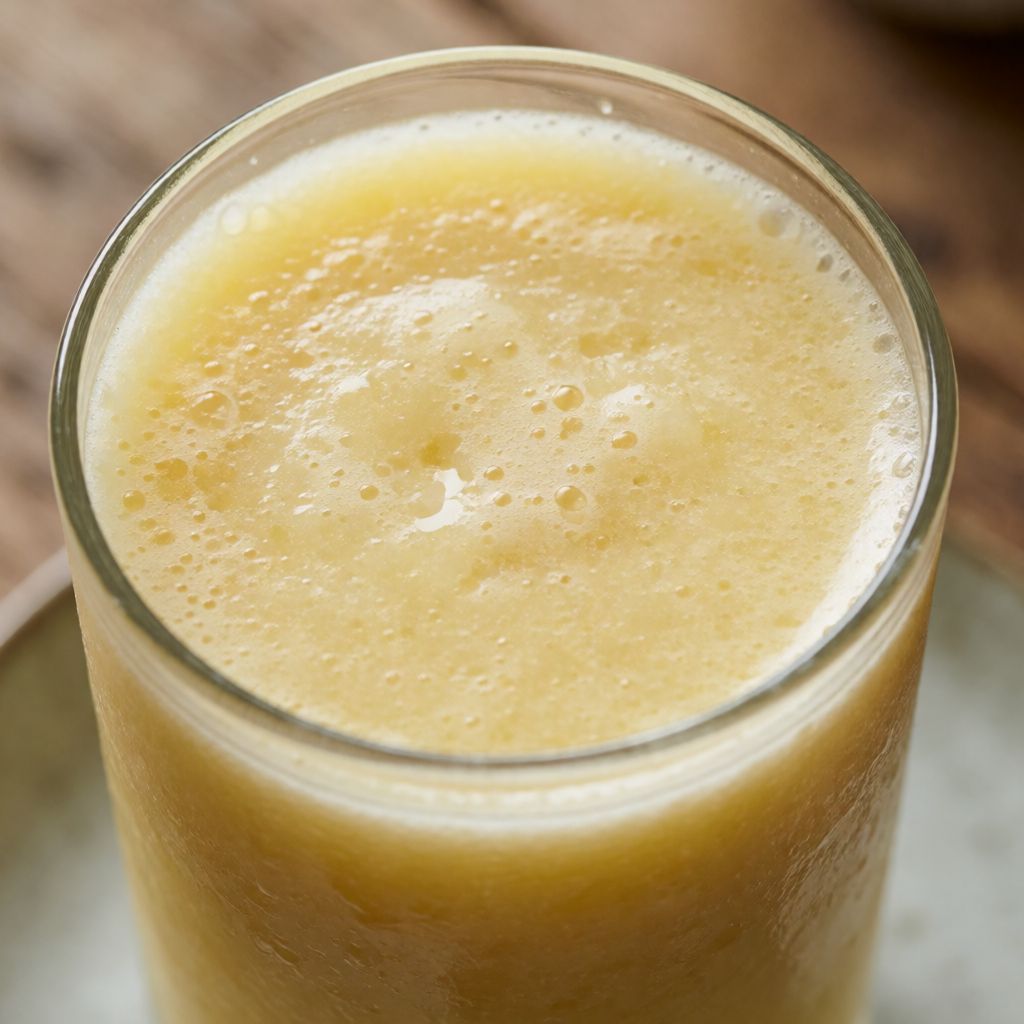
 AI photo
Pineapple and Ginger Smoothie
A refreshing smoothie made with pineapple, ginger and water, ready in minutes.
Labels are worked out automatically from the ingredients and can be wrong. Check the packaging if it matters to you.
Ingredients



Steps
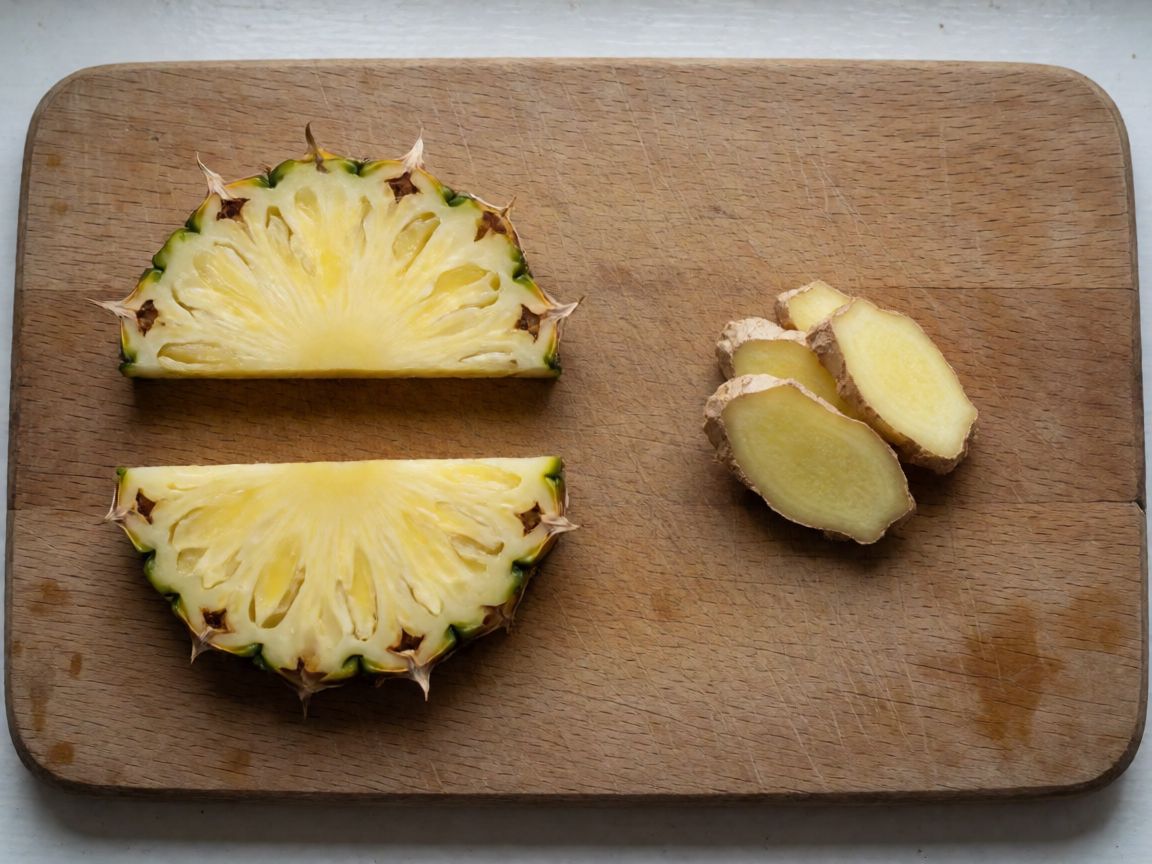
Clean the pineapple: trim both ends, stand it upright and peel it with a sharp knife.
Cut the pineapple into slices and remove the tough core from each slice.
Cut two pineapple slices into small pieces and place them in the blender jug.
Add 200 ml of water and blend for a few seconds.
Peel the ginger root and grate a small piece to get about 1 tbsp of grated ginger.
Add the grated ginger to the blender jug and turn on the blender.
Blend all the ingredients for a few seconds until the drink becomes smooth and even.
Pour the finished smoothie into a glass and serve immediately, adding ice if you like.
This is not a recipe so much as a five-minute mechanical operation: you break pineapple fibre down with a blade instead of a knife, and you use ginger's own sharpness to cut the sweetness. Nothing is cooked, nothing waits to rise or rest, so what decides whether it works isn't skill, it's two small physical facts.
First: pineapple has a woody core running through every slice — that's stem tissue, built to be tough, and no blender on a kitchen worktop will turn it into silk. Cut it out before it goes in, or you'll be drinking a smoothie with grit in it and wondering why.
Second: a blender needs something to grip. Chuck dry fruit chunks in on their own and the blade just carves a tunnel through them, spinning uselessly while the pieces sit untouched at the edges — that's the usual complaint of "my blender's rubbish." It isn't. Put the water in with the fruit from the start, not after, and the blade has something to throw the pieces against.
Doneness here isn't a clock question — ten minutes of prep, a few seconds of blending, done. It's a texture question: smooth and even, no little flecks of fibre catching on your tongue, no separation. Some people think pineapple is hard on the stomach and shouldn't be drunk neat like this. No — that tingling on your tongue is bromelain, an enzyme in the fruit that breaks down protein, which is exactly what it's doing to the inside of your cheek for a second. It's not a warning sign, it's the enzyme doing its job, and it's the same reason a little raw pineapple can tenderise meat if you ever bother.
Pineapple: you want ripe, not soft. Press near the base — a little give, not a dent that stays. Smell the bottom, where it was cut from the plant — sweet, not sour or alcoholic, which means fermentation has already started and your smoothie will taste faintly boozy and flat rather than fresh. Colour on the skin tells you less than smell does; a green pineapple can still ripen on the counter, it just won't get sweeter inside once it's cut, so don't buy on looks alone. If all you've got is canned pineapple in juice, use it — but it's wetter and less acidic than fresh, so cut the water down, otherwise the drink turns thin and one-note. Worth knowing: pineapple was once a show-off fruit in Britain, grown in heated pits by the rich just to sit on a sideboard and be admired, never eaten — half the stone pineapples on Georgian gateposts are a memory of that. Now it's £1 in any supermarket. Cheapness changes what a dish is allowed to be; this smoothie only exists because the fruit stopped being precious.
Ginger: the criterion is firm and heavy for its size, skin tight with no give, no shrivel at the cut end — that's a root drying out and losing the oils that make it sharp. Grate it rather than chop it: grating tears the fibre apart and lets the juice out immediately, where a knife just slices along the fibre and traps most of the bite inside the pieces. Fifteen grams is a piece about the size of your thumb from the first knuckle up — go much past that and you've made a ginger shot with fruit in it, not a smoothie; go under and the ginger just sits in the background doing nothing useful. No fresh root at all, use a small pinch of ground ginger as a stopgap — but expect less lift, because the volatile part of ginger's heat fades fast once it's dried and ground, and ground ginger reads as warm and a bit dusty rather than sharp and bright.
Water: plain, room temperature or straight from the tap, no mechanism to it beyond making the mixture thin enough to pour and giving the blade grip, as already said. Less water gives you something closer to a thick purée you'd eat with a spoon; more gives you juice. Both are fine — it's not written in stone, it's a dial you can turn to taste. If you want extra sweetness without added sugar, coconut water does the same diluting job and brings its own flavour, though then it stops being quite this drink.
Ice is optional and it's a trade-off, not an upgrade: it chills the drink fast, which matters more in a British kitchen where nothing's been sitting in a fridge at a controlled low temperature all day, but as it melts it waters down exactly the flavours you just built. If you want it cold without dilution, chill the pineapple itself in the fridge for an hour before you start, rather than drowning the finished drink in cubes.
The one patience this needs is upstream of the blender: don't rush to a hard, underripe pineapple because it was the one on top of the pile. Everything after that — the peeling, the core, the blending — takes less time than making tea. Serve it the moment it's blended; it separates and the froth drops within a few minutes, and reblending a settled smoothie never quite gets back what it had the first time.