
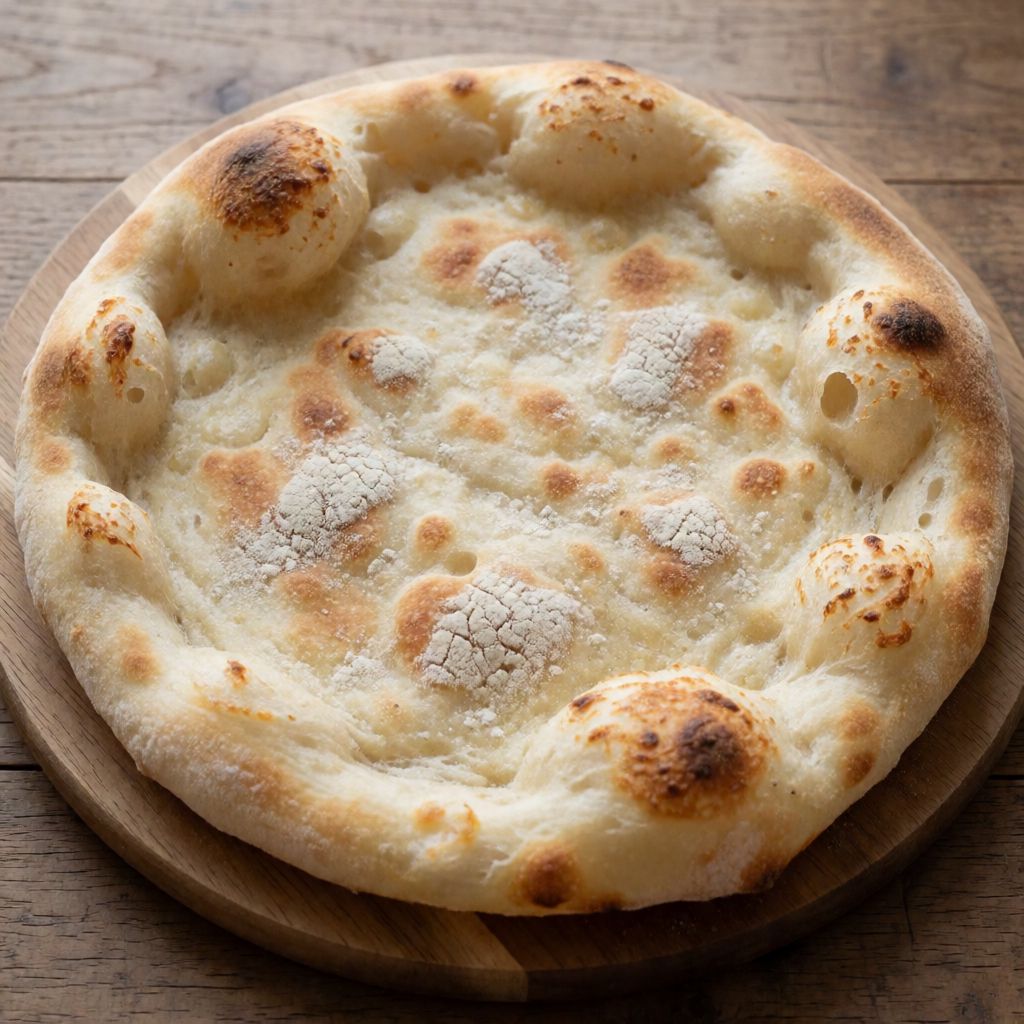
 AI photo
Sourdough Pizza
A crisp sourdough pizza base made from a refreshed starter, topped with tomato, mozzarella and basil.
Labels are worked out automatically from the ingredients and can be wrong. Check the packaging if it matters to you.
Ingredients
- 80 g Sourdough starter
- 80 g Plain flour
- 35 ml Water
- 600 ml Water
- 2 g Caster sugar
- 290 g Plain flour
- 200 ml Water
- 85 g Sourdough starter
- 7 g Salt
- Semolina or rice flour to taste
- Canned chopped tomatoes to taste
- Mozzarella to taste
- Oregano to taste
- Olive oil to taste









Steps
Refresh the starter: take 80 g of starter, add 80 g of plain flour and 35 ml of water, stir with a spoon, then knead by hand.
Roll out the dough with a rolling pin and fold it into a roll several times, shape it into a small log, cut two crosses into it and transfer it to a jar.
Cover loosely with a lid and leave until the starter has doubled in size.
Slice the starter and transfer it to a bowl with 600 ml of water and 2 g of caster sugar for about 1 hour.
60 minDrain the starter and weigh out 85 g.
In a large bowl combine 290 g of plain flour and 200 ml of water, mix, add the starter and finally the salt.
Cover the bowl with cling film and leave the dough to rise at room temperature for about 30 minutes.
30 minDo strengthening folds: stretch an edge of the dough, fold in half, turn 90 degrees, and repeat on all sides.
Tuck the edges under the ball of dough, return it to the bowl, cover with film and leave to rise for 20-30 minutes.
25 minRepeat the folding process three times, with an interval of 20-30 minutes between each round.
Grease the bowl with olive oil, dust the dough ball with flour and leave to rise until doubled in size.
Place the dough on a surface dusted with semolina or rice flour, and stretch it with your fingers, starting from the edges then the centre.
Transfer the dough to a 30x40 cm tray greased with olive oil, pressing it gently to the edges.
Scatter oregano over the surface, then add the canned chopped tomatoes in pieces.
Heat the oven and bake the pizza at 225°C for about 10 minutes.
10 minTake the pizza out, add the mozzarella and olive oil, and return it to the oven for another 5-10 minutes.
7 minBefore serving, garnish the pizza with fresh basil.
What was changed
The dusting flour was replaced with Semolina or rice flour, as semolina is the more familiar choice in UK kitchens.
This isn't really pizza-the-dish, it's flour and water and time pretending to be a quick dinner. A sourdough pizza like this has two separate lives: first you have to wake a starter from nothing, feed it, watch it double — then, almost as an afterthought, you make and bake the actual pizza. Most of what decides whether this works happens hours before you touch tomatoes.
The thing that trips people up is the word "pizza" itself. We hear it and think "fast food" — thin base, hot oven, twenty minutes, done. Forget that here. What you're building is closer to good bread that happens to end up flat, with sauce on top. The dough goes through four separate rests and folds, not because tradition says so, but because gluten needs to be coaxed, not forced — stretch it too hard too soon and it tears instead of holding gas; leave it alone in short bursts and it relaxes enough to take the next stretch without a fight.
Some say you can skip the folding and just knead hard once. No — because kneading develops strength by brute force and tires the dough out, while folding builds the same structure while the dough is resting, so it keeps its lightness instead of turning dense and chewy. The whole point of a wet, barely-touched dough is a crust with big irregular holes, not a flat bready slab.
Start with the starter. Eighty grams of old starter fed with equal flour and a splash of water is just restocking a living culture — it's flour, water and wild yeast that's been kept going, sometimes for years, because baker's yeast is a twentieth-century shortcut and sourdough is simply what bread was before that shortcut existed. Shaping it into a log and cutting crosses isn't decoration: it opens surface area so you can actually watch it rise and judge "doubled" by eye, which is the only reliable signal — a clock tells you nothing about a living thing that speeds up in a warm kitchen and crawls in a cold one.
The float step — slicing the starter into sugared water for about an hour — is a crude but honest test. An active starter traps enough gas to float or at least loosen from the water; a tired, under-fed one sinks and stays sunk. If yours sinks, don't force it into the dough anyway — it means feed it again and wait, because a weak starter gives you a flat, dense base no amount of oven heat will fix later. Any plain white flour works for feeding; nothing fancy earns its keep here, the starter just wants food, not flavour.
For the dough itself, plain flour and water in that ratio give you a wet, slack mix on purpose — this is not a dough you can pick up and toss. The salt goes in last, deliberately after the starter has had a moment in the wet flour, because salt tightens gluten and slows yeast activity; add it too early and you fight the dough's own rise. Seven grams for this batch is a seasoning amount, not a preservative amount — don't be tempted to add more for "flavour," it'll just slow fermentation down further.
The repeated 20–30 minute folds are where the dough actually becomes bread-like. Each fold stretches and relaxes the gluten network a little further without deflating all the gas the starter is producing. Skip folds and rush to baking, and you get a pizza that's flat and tears when you lift a slice; respect them, and the base holds air pockets that puff at the edges in the oven — that's your "pizza crust" look, earned, not bought.
When you finally shape it, stretching from the edges toward the centre with your fingers (never a rolling pin at this stage) keeps those air pockets intact instead of crushing them flat — a rolling pin is for the laminated log earlier, not for the risen dough. Dust with semolina or rice flour under the dough, not regular flour: it's coarser, doesn't gum up, and lets the base slide rather than stick — in an ordinary flat, without a pizza stone, this is what stands in for the "bottom crisp" a stone would otherwise give you.
On toppings: canned chopped tomatoes work because they're already broken down and consistent — a fresh tomato brings unpredictable water content that can turn your careful dough soggy. Mozzarella goes on after the first ten minutes in the oven, not before, because cheese put in from the start just weeps water and fat into the crust while the base is still setting; added late, it melts without drowning everything underneath. Basil goes on at the very end, off the heat, because its aroma is volatile oil that cooks away to nothing if it meets 225°C for even a few minutes — treat it like a garnish, not an ingredient. For four people, one 30x40 tray is a reasonable, fair share — nobody's fighting over the last slice, nobody's left still hungry.
A domestic oven here is doing its honest best at 225°C, well short of a wood-fired 400°C+, so don't expect leopard-spotted char — expect an evenly coloured, well-risen base, which is its own reward and not a consolation prize.