
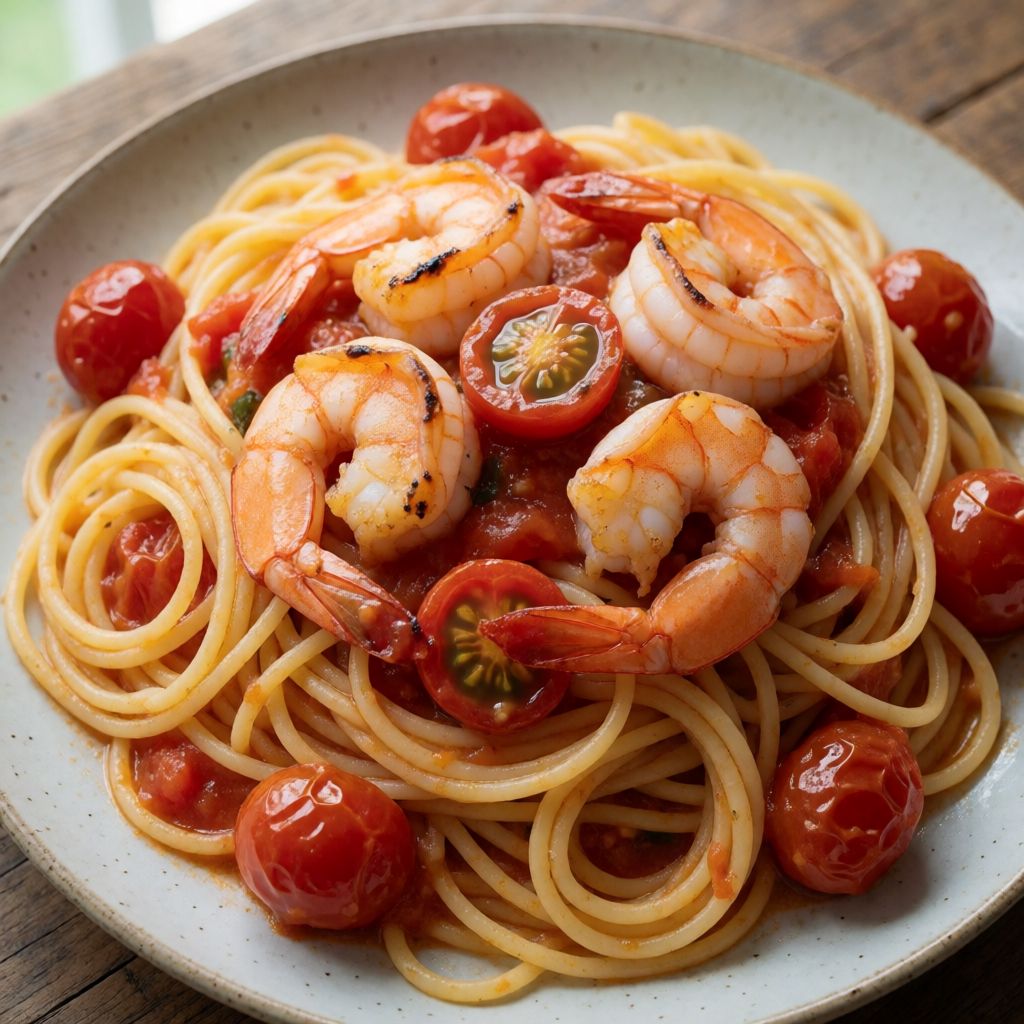
 AI photo
Spaghetti with Cherry Tomatoes and Tiger Prawn Tails
A quick coastal-style pasta with cherry tomatoes, anchovies and tiger prawn tails.
Labels are worked out automatically from the ingredients and can be wrong. Check the packaging if it matters to you.
Ingredients
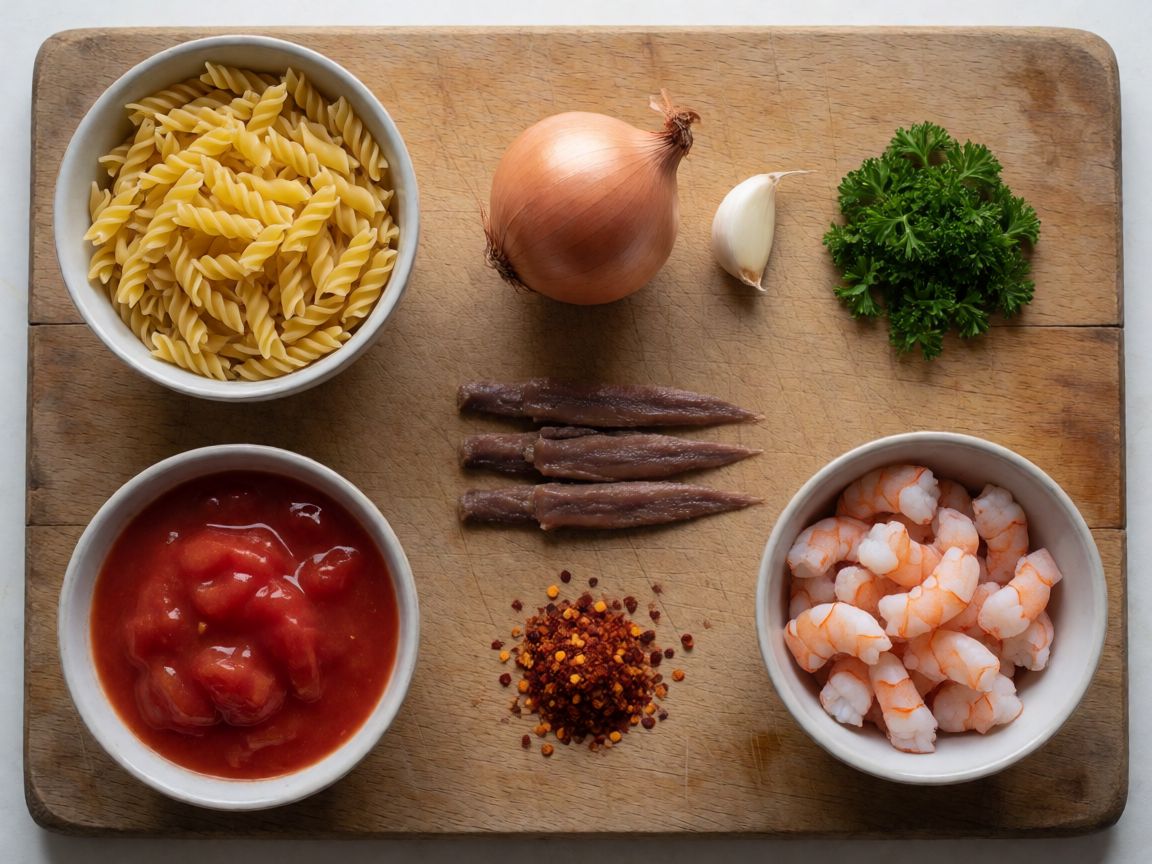
- 400 g Spaghetti
- 1 pcs Onion
- 1 clove Garlic
- Parsley to taste
- 250 g Cherry tomatoes
- 4 pcs Anchovies in oil
- Chilli flakes to taste
- Salt to taste
- Olive oil for frying
- 400 g Tiger prawn tails
- 1 tbsp Taggiasca olives
- White wine to taste












Steps
Heat the olive oil in a pan and sauté the onion, garlic, parsley and chilli flakes.
Add the anchovies in oil and let them melt into a creamy base.
Add the tiger prawn tails, fry until golden, pour in the white wine and let it evaporate.
Add the cherry tomatoes and simmer gently for 10 minutes.
10 minCook the spaghetti until al dente and drain.
Toss the pasta into the pan, mix well and heat through for a couple of minutes.
Serve sprinkled with fresh parsley.
This is a sauce built on a trick fishmongers and cooks in Liguria figured out generations ago: anchovies disappear. Fry them gently and they don't stay anchovies, they melt into the oil and become savouriness itself — salt with a backbone, not a fish flavour. That's the whole engine of the dish. Everything after is built on that foundation: prawns for sweetness, tomatoes for acid, wine to lift the pan and tie it together.
What decides whether this works isn't the prawns, it's whether you let the anchovies actually melt before anything else goes in. Push them too hard on high heat and they just fry and go bitter and stringy — you'll see fish, not taste depth. Keep the heat low enough that the oil barely moves, and give them a minute or two of patience; they'll go from solid fillets to a kind of paste on their own. That transformation is not optional, it's the recipe.
Some say prawns in the shell give more flavour than tails alone — no, because the flavour you actually taste comes from the shells sitting *in the pan*, not sitting on the plate. If you've got shell-on tails, fry the shells first in the oil for a minute and pull them out before the anchovies go in — free stock, no extra step really, just five seconds of thinking ahead. If your tails are already peeled and headless, don't worry, you lose a little but not the dish.
A word on your hob: you don't have a wide shallow kazan-style pan unless you've bought one specifically, and that's fine. Use the widest frying pan you own — the point is surface area, so the wine and tomato juice reduce by evaporation rather than stewing in a deep puddle. A narrow saucepan here just means a wetter, blander result because the liquid never gets the chance to concentrate.
Onion and garlic: these aren't flavour in their own right here, they're a base note under the anchovy and prawn — so slice them thin and let them go soft and translucent, not browned. Browning would add a sweetness that fights with the salt-forward anchovy base. If the onion smell turns sharp and sweet rather than just softening, you've gone too far, turn the heat down.
Anchovies in oil, not salt-packed, matter for a reason: salt-packed ones need rinsing and boning first, extra fuss for a home cook who isn't running a restaurant line. The tinned-in-oil kind are already clean, already soft, and melt faster because they're already partly cured in fat. If you genuinely can't get anchovies — some people won't touch them on principle, which is their business — a teaspoon of fish sauce does the same job of adding savoury depth without you having to explain fish to anyone at the table; it won't dissolve into the oil the same way, but it dissolves into the sauce overall, which is the point.
Tiger prawns specifically because their size holds up to frying — fry until they go from grey-translucent to opaque pink-orange, that's your doneness marker, not a clock. Overcook prawns and they turn rubbery because the proteins seize up past a certain point and there's no bringing that back, so pull them the second they firm up and change colour, you can always let residual heat finish them in the sauce later.
White wine here isn't for flavour you'll taste directly — most of it evaporates — it's for lifting the fond, the browned bits stuck to the pan from frying prawns and anchovies, back into the sauce. Any dry white does this. If you don't cook with wine, a splash of water with a squeeze of lemon added at the tomato stage does a similar deglazing job, though you lose a little complexity — that's an honest trade, not a disaster.
Taggiasca olives are small, mild, barely bitter — they're a seasoning, not a vegetable, so a tablespoon chopped roughly is plenty; a bigger, sharper olive like Kalamata will shout over the anchovies rather than sit alongside them. If you can't find Taggiasca, use any black olive you'd actually enjoy eating on its own in small amount, and use less of it.
Spaghetti needs to come out al dente and go straight into that pan while both are hot — this is the "couple of minutes" stage, and it's not just warming through, it's the starch on the pasta surface binding with the oil and tomato juice to make something that coats rather than sits in a puddle. Some say you should rinse pasta before saucing it — no, because rinsing washes off exactly the starch that makes the sauce cling. Keep a cup of the pasta water back before you drain; a splash of it loosens the sauce if it's gone tight and oily by the time the spaghetti joins in.