
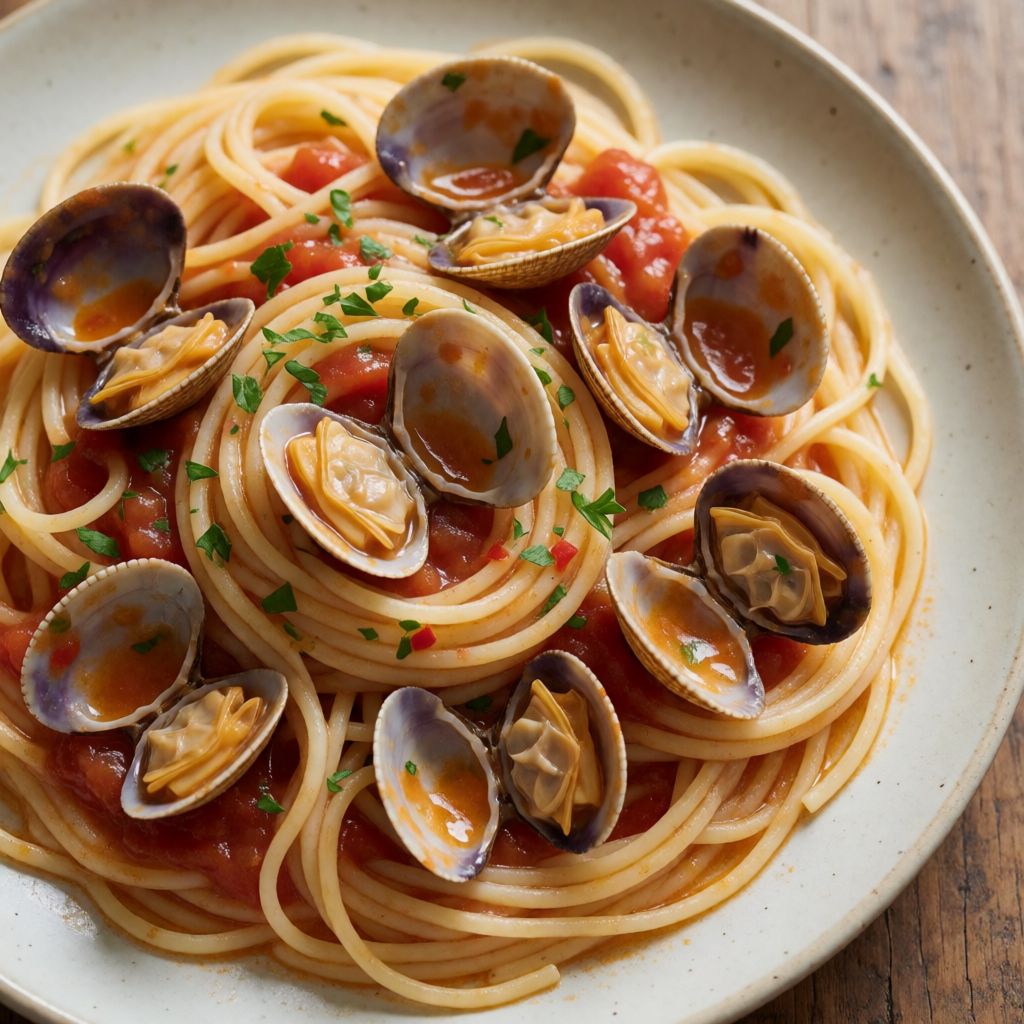
 AI photo
Spaghettini with Clams in Tomato Sauce
A classic pasta dish with fresh clams in a light tomato sauce.
Labels are worked out automatically from the ingredients and can be wrong. Check the packaging if it matters to you.
Ingredients
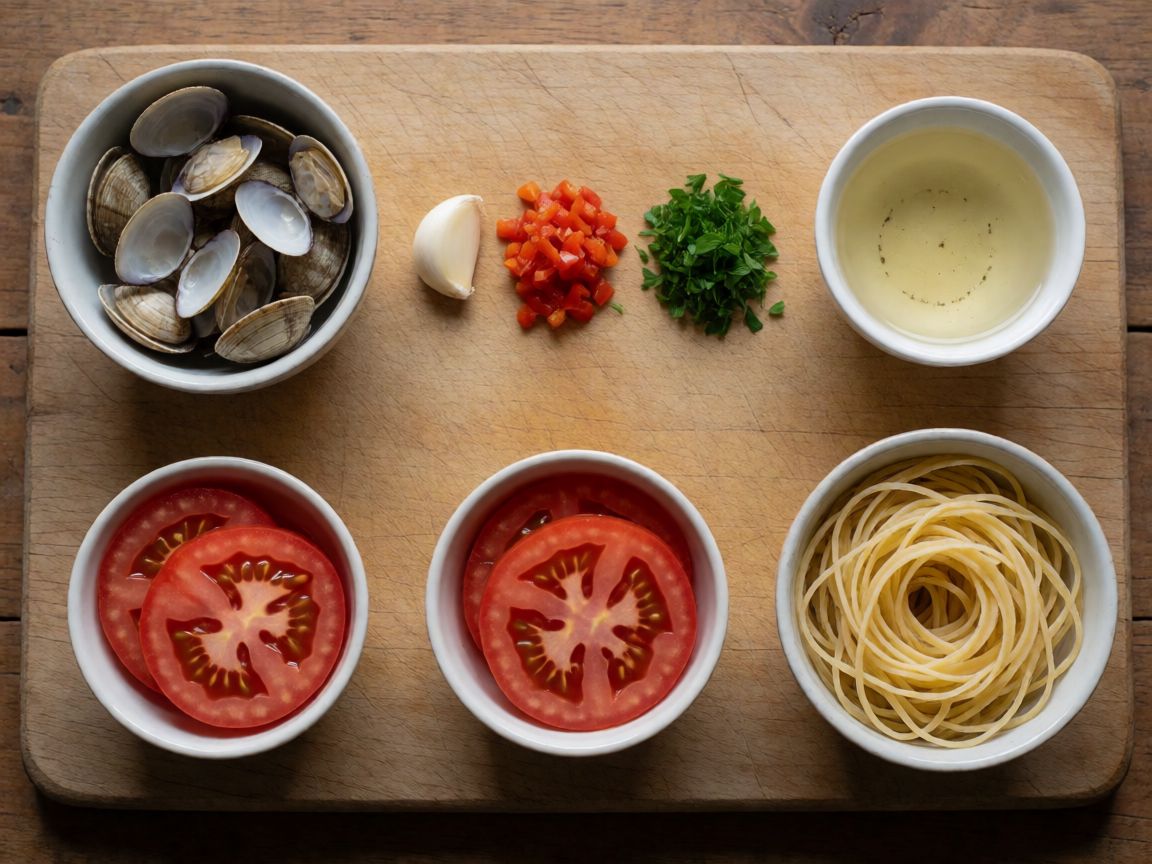
- 1 kg Clams
- 1 clove Garlic
- Olive oil to taste
- 1 pcs Chopped chilli pepper chopped
- Salt to taste
- Parsley to taste
- 120 ml White wine
- 200 g Cherry tomatoes chopped
- 400 g Spaghettini









Steps
Soak the clams in salted water, open them in a pan over high heat, strain the liquid, and remove some from their shells.
Heat the olive oil in a pan, fry the garlic, then remove it.
Add the chopped chilli pepper and the shelled clams.
Pour in the white wine, let it evaporate, then add the chopped cherry tomatoes.
Season with salt to taste and cook.
10 minAdd the remaining clams and sprinkle with chopped parsley.
Cook the spaghettini in salted boiling water until al dente, drain and add to the pan.
Mix well and fry for a few more minutes.
Serve immediately, sprinkled with chopped parsley if desired.
This is a sauce built on salt water, not on stock cubes or fish sauce or any of the shortcuts people reach for when they don't trust shellfish to season themselves. Clams carry seawater inside their shells, and that water is the whole point of the dish. Everything else — garlic, chilli, wine, tomato — exists to carry that brine through the pasta without drowning it.
What decides whether this works is restraint at two moments: how hard you cook the clams open, and how long you let the tomato sit on the heat afterwards. Clams go from tender to rubbery in the same stretch of heat that opens them, so the pan that opens them should be hot and brief, not a slow simmer. And the tomato is there to thicken the clam liquid into something that clings to spaghettini, not to make a separate tomato sauce with clams dropped in as a garnish — if you let it reduce too far you've made the second thing by accident.
Some say you need a kazan-sized pan and a fishmonger who knows your name. You don't. A wide domestic frying pan does the job better than a narrow saucepan, because you need surface area for the wine and tomato liquid to actually reduce rather than stew. What you can't fake on a home hob is a continuous wall of heat under a wide pan — your burner has one ring of flame under the centre, so the sauce reduces unevenly unless you shift the pan or stir more than a professional kitchen would need to.
Start with the clams, because they are not an ingredient you season — they are the seasoning. Soaking them in salted water before cooking isn't tradition for tradition's sake: it makes the clams expel grit and sand they've been sitting in, so you're not serving your dinner guests a mouthful of seabed. Skip this and the defect you get isn't a mild one — it's crunch where there shouldn't be any, and no amount of garlic fixes that after the fact. If your clams come pre-cleaned and farmed (common in UK supermarkets, labelled "palourdes" or just "clams"), a short rinse is enough; wild or loose ones from a fishmonger need the full soak.
Opening them in a dry hot pan and keeping the liquid is the second non-negotiable move. That liquid is seawater reduced and flavoured by the clam itself — it's your stock, and you didn't need to buy one. Shelling most of the clams and leaving a few in-shell isn't decorative fussiness either: it's so the dish still reads as "clams" on the plate, not just "clam-flavoured pasta," while the bulk of the meat is actually easy to eat with a fork instead of a shell in your way.
Garlic goes in to flavour the oil, then comes out. This is the opposite of a stew where garlic cooks down into the sauce — here it's used like a tea bag, giving its oil and then leaving before it burns and turns bitter. Chilli replaces it in the pan for a reason: chilli can sit in hot oil far longer than garlic without turning acrid, so it's the thing you leave cooking while garlic would've already ruined the batch.
The wine isn't there for taste of wine — it's there to deglaze and to carry fat-soluble flavour that water alone won't lift off the pan. "Let it evaporate" is doing real work as an instruction: you're burning off the alcohol's sharpness, and you'll know it's done by smell, not a clock. Any dry white with no noticeable sweetness works; you don't need the bottle you'd pour at the table, you need one without sugar fighting the salt of the clams.
Cherry tomatoes, chopped rather than puréed, are chosen for how fast they break down — small tomatoes collapse into a sauce in minutes, which matters because this whole dish moves fast once the clams are in. If you only have large tomatoes, chop them finer and expect a slightly longer wait for the same softness; you're watching for the tomato going from firm pieces to a sauce that coats the back of a spoon, not for a timer.
Spaghettini — the thinner cousin of spaghetti — matters because clam sauce is thin and clings poorly to a thick noodle; a slim strand picks up more sauce per bite relative to its surface. If spaghettini isn't in your cupboard, spaghetti works, but don't reach for anything short and tubular — this is a dish built around length and surface, not around trapping sauce in a hollow shape. Finishing the pasta by frying it briefly in the sauce, rather than just pouring sauce over cooked pasta, is what makes the two taste like one dish instead of two things that met on a plate — the starch on the pasta's surface grabs the sauce and thickens it slightly as they cook together those last few minutes.