
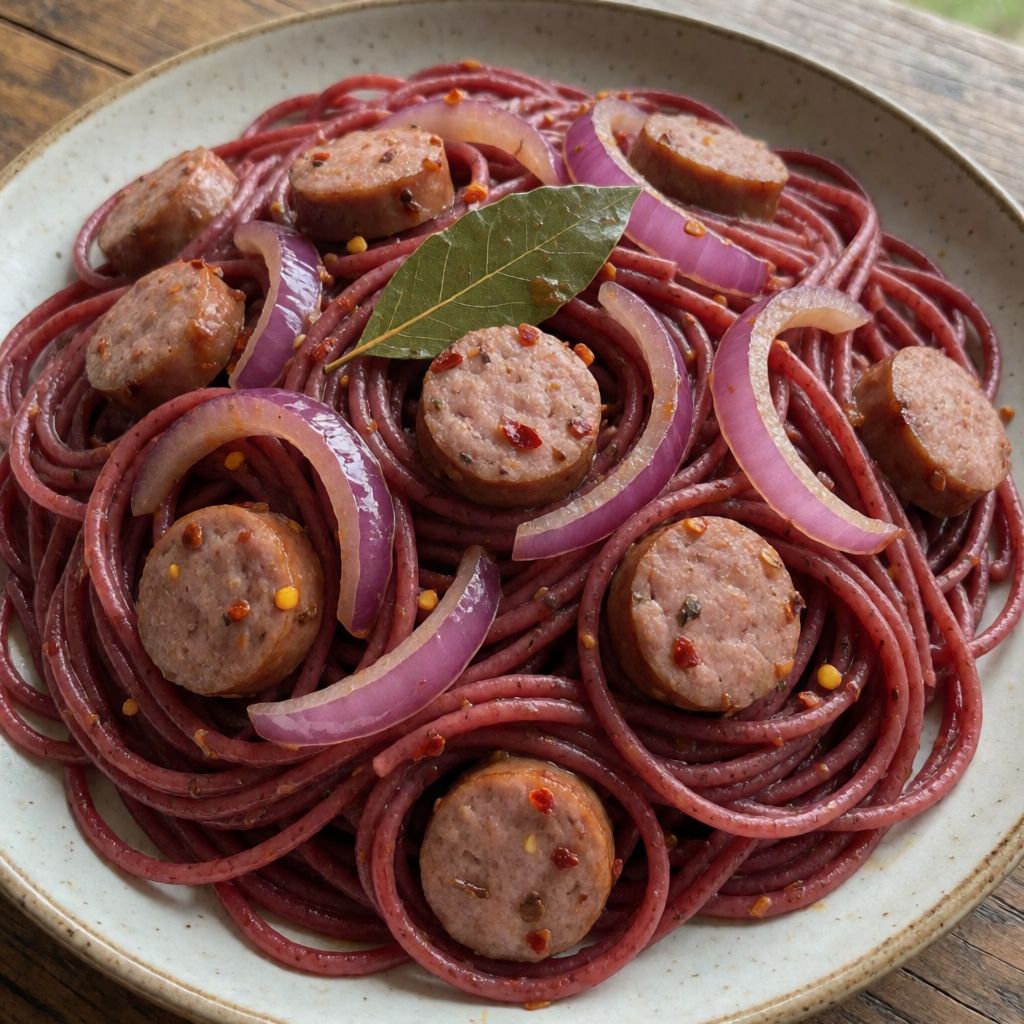
 AI photo
Drunken Spaghetti with Sausage and Red Onion
A hearty pasta dish combining spaghetti, sausage and red onion in a red wine sauce.
Labels are worked out automatically from the ingredients and can be wrong. Check the packaging if it matters to you.
Ingredients
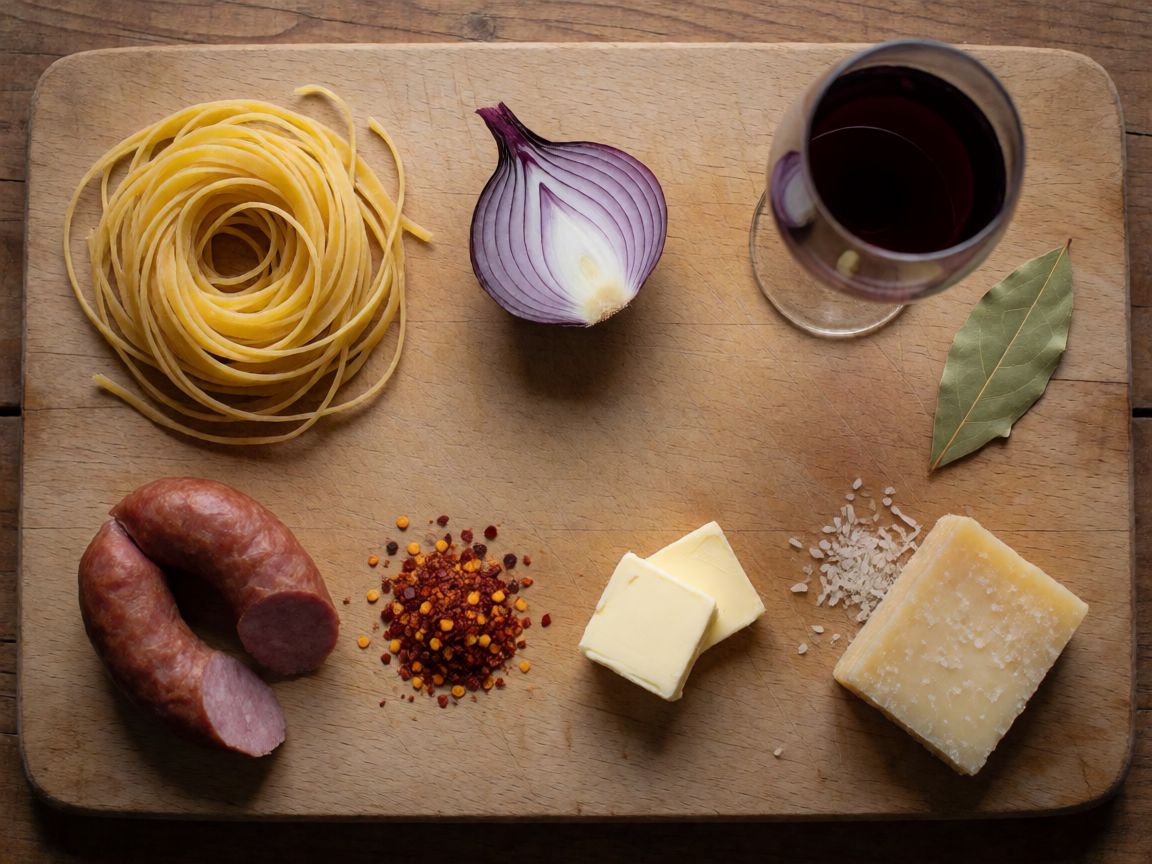
- 400 g Spaghetti
- 1 pcs Red onion
- 500 ml Red wine
- 150 g Italian sausage
- 1 pcs Bay leaf
- 1 pcs Fresh red chilli
- 30 g Butter
- 2 tbsp Olive oil
- Salt to taste
- Pecorino Romano to taste










Steps
Heat the olive oil and butter in a frying pan, sauté the finely chopped red onion, then add the bay leaf and chilli.
Add the sausage, cut into pieces, and fry until golden and cooked through, with an internal temperature of 70°C.
Pour in the red wine, let it reduce, and cook until the sauce thickens.
Cook the spaghetti separately in salted water until al dente.
Drain the pasta and transfer it to the pan, stirring for a few minutes while sprinkling with pecorino.
This isn't a creamy pasta, it's a glazed one. The whole dish succeeds or fails at one moment: the wine reduction. Pour it in too early, over a pan that's not hot enough, and it stays thin and sour — the spaghetti just sits in a purple puddle instead of wearing a coat of it. Let it go properly — the bubbles slow down, the liquid stops looking watery and starts looking like it has weight, clings to the back of a spoon — and you've got a sauce, not a soup.
The onion goes in first because it needs the longest run at low heat to give up its sugar without catching. You're watching for a colour change, not a clock: pale and sharp-smelling to soft and faintly sweet, translucent at the edges. Only then does the sausage go in, because sausage fat needs somewhere soft to land — raw onion straight into hot fat just seizes and goes leathery.
Sausage doneness isn't really about a thermometer reading, useful as 70°C is as a backstop. You're looking for no pink showing when you break a piece open, and a firmness under the spoon that wasn't there raw. The fat it renders is doing real work — it's the base the wine reduces into, carrying flavour the onion alone can't.
Some say you need a good bottle for this. No — because the alcohol cooks off in the pan, and what's left behind is acidity and tannin, not vintage. Put your good Chianti in a glass next to the stove, not in the pan. A cheap, dry, drinkable red does the job; what it can't fix is bad timing.
Red onion specifically, not because white onion is wrong, but because red carries more sugar and breaks down faster — it was bred for salads and sauces, not for the long slow cook a French soubise needs. If all you've got is a white or yellow onion, use it, just give it a few extra minutes before the sausage goes in, since it's slower to soften.
The sausage should be the kind with fennel seed and a loose, coarse grind — that's the Tuscan model this dish leans on. If you can't find "Italian sausage" on a UK shelf, buy any fresh pork sausage with decent fat content and squeeze the meat out of the casing into the pan. The casing itself isn't flavour, it's just packaging; you don't need it here.
Butter and olive oil together isn't indecision, it's division of labour. Butter alone burns and blackens before the onion softens — its milk solids scorch at a relatively low temperature. Olive oil raises the ceiling before that happens and lets the butter's flavour survive the heat instead of turning bitter. Any neutral-tasting oil can stand in for the olive oil if that's what's in the cupboard — the rule is no smell of its own, so sunflower or a mild vegetable oil work, but a strong rapeseed or anything cold-pressed will fight the wine.
Bay leaf and chilli are there for contrast, not heat as such — the bay gives a low, resinous background note that wine reduction tends to flatten out on its own, and the fresh chilli cuts through the sweetness the sugars develop as the wine cooks down. Dried chilli flake would work differently, more of a slow burn than a bright one; fresh is what gives that top note. Fish the bay leaf out before serving — nobody wants to bite into cardboard.
The wine itself explains the dish's name and its economics in one go. This is a peasant habit from wine country: you always had a bottle going a bit flat or a bit rough, and throwing it into the pan was cheaper than throwing it away. No need for anything you'd be proud to decant — dry, medium-bodied, drinkable is the whole spec.
Pecorino at the end isn't just garnish, it's doing a structural job alongside a splash of the pasta's starchy cooking water, which you should save some of before draining. The starch and the melting cheese are what actually bind the wine glaze to the strands instead of leaving it pooled at the bottom of the bowl — that stirring-off-the-heat step is the dish's equivalent of mantecatura, and rushing it is the single most common way to end up with a watery sauce sitting under dry pasta. If pecorino's not in the shop, Parmesan will do the same job — the criterion is a hard, aged, salty cheese that melts into strands rather than clumps; a soft or young cheese just turns greasy and separates.