
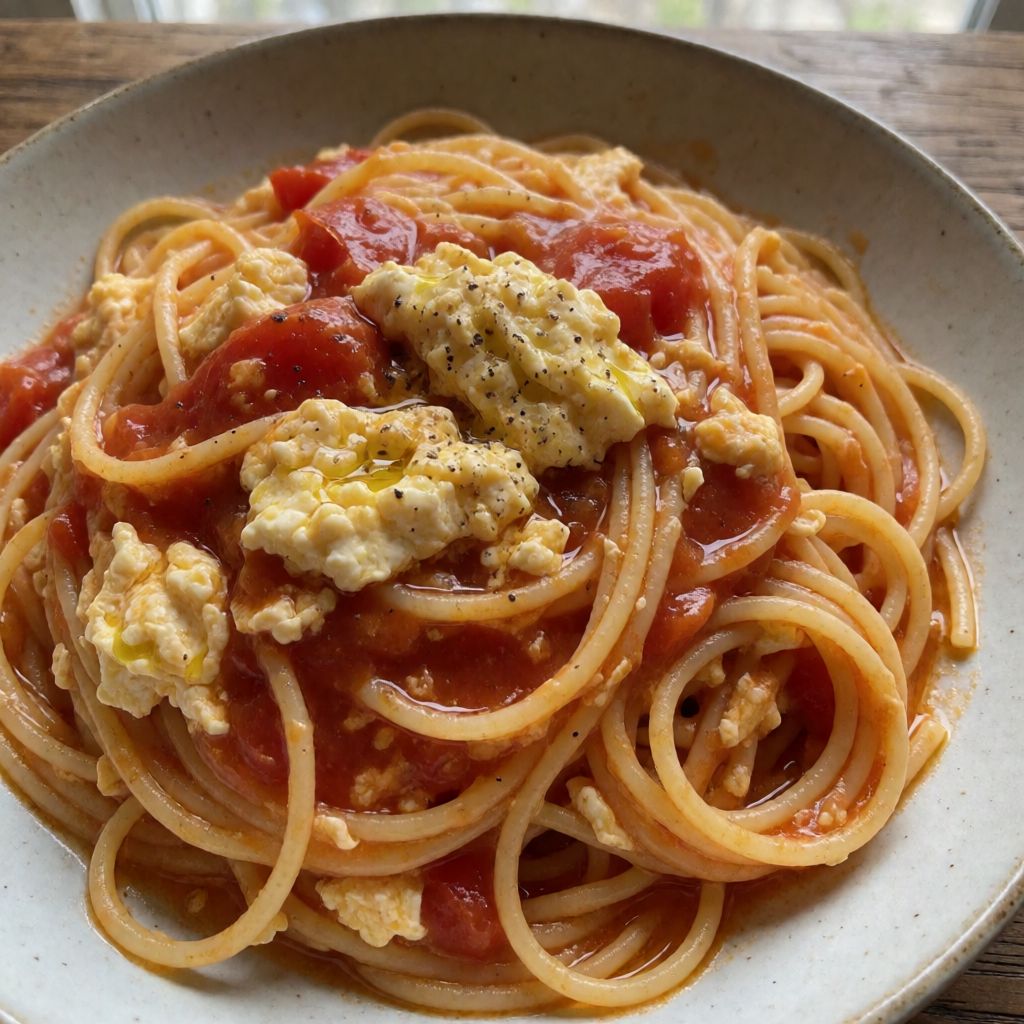
 AI photo
Spaghetti with Tomatoes and Eggs
A quick skillet pasta with a saucy tomato base and soft-cooked eggs, finished with grated pecorino.
Labels are worked out automatically from the ingredients and can be wrong. Check the packaging if it matters to you.
Ingredients








Steps
Heat 2 tablespoons of olive oil in a frying pan.
Pour in the tomato passata and cook for a few minutes.
Add the eggs, season with salt and pepper, and cook with the lid on.
10 minSprinkle with chopped basil or parsley.
Cook the spaghetti until al dente, then drain.
Tip the spaghetti into the pan with 1 tablespoon of grated Pecorino Romano.
Toss together, fry briefly, and serve sprinkled with grated Pecorino Romano.
Forget the picture of a fried egg laid proudly on top of a plate of pasta — that's a different dish, built on a different mechanism, and it isn't this one. Here the eggs go into the tomato while it's still soft and barely bubbling, and they cook inside the sauce, not on top of it. The passata does two jobs: it's the fat's extension into a liquid, and it's a cushion so the egg white doesn't hit a bare hot pan and scorch underneath while staying glassy on top.
What decides whether this works is the lid. Under a lid, steam collects and sets the top of the egg gently while the bottom sets from the sauce's heat — without one, you get a white that's rubbery below and runny above, because only one side is actually cooking properly. A plate turned upside-down over the pan does the same job as a lid in a flat that doesn't have one that fits; the mechanism is trapped steam, not the specific object.
Doneness is not a clock question. Lift the plate, and look: the white should have gone from glassy-translucent to matte and opaque, holding its shape when you nudge it with a spoon edge. The ten minutes given is the earliest you should check, not the moment you're guaranteed to be done — a thinner layer of sauce, a colder hob, a bigger pan all push that number around.
Spaghetti: cook it properly al dente and don't rinse it. Rinsing washes off the surface starch, and that starch is exactly what lets the sauce grip the strand instead of sliding off into a puddle at the bottom of the bowl — some say rinse to stop sticking, but sticking to itself in the colander and clinging to a sauce in the pan are two different kinds of sticking, solved two different ways.
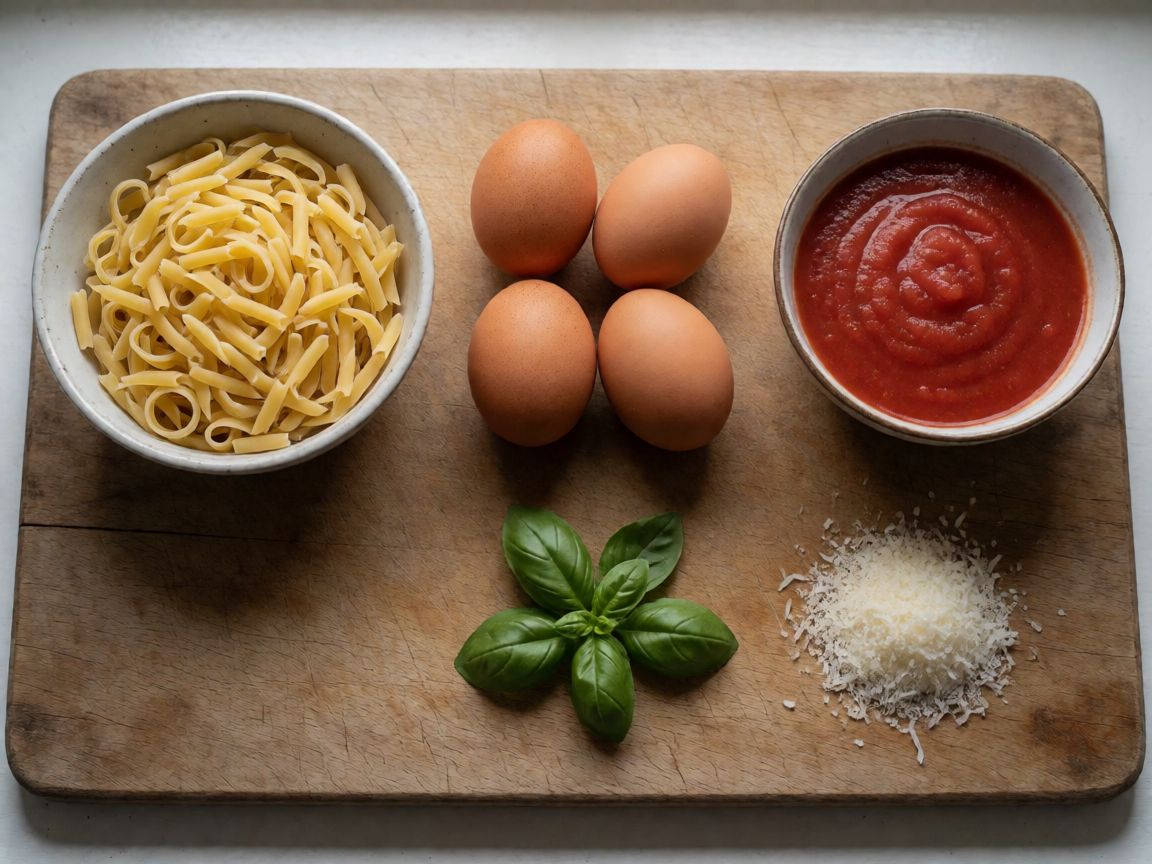
Eggs: one per person is the whole logic of this dish — it's a way of making four eggs and a splash of tomato feed four people, the same economics behind every "eggs stretched with starch" dish from any poor kitchen, British beans-on-toast included. Crack them in rather than beating them; you want distinct yolks so you can judge each one's doneness, and whole eggs set into a soft curtain rather than a flat scramble. Salt them only once they're in the pan, not before — salt on raw egg pulls water out of the protein by osmosis and toughens it, which is the real reason a pre-salted fried egg can go rubbery at the edges.
Tomato passata: you want a smooth, already-cooked tomato pulp, not chunks, because chunks mean pockets of raw tomato acidity that never softened and lumps the egg has to set around unevenly. No passata in the cupboard — tinned chopped tomatoes blitzed smooth do the same job; diluted ketchup will technically hold eggs but it's sweeter and thinner, and you'll taste the difference. Give it those first few minutes alone in the pan before the eggs go in — that's not padding, that's cooking off the tinny raw edge and some of the water, so the eggs poach in something with body instead of swimming.
Olive oil: here it's not a seasoning, it's the medium the heat travels through and the thing the sauce's flavour dissolves into — fat carries aroma that water can't. Any oil with no smell of its own will cook the eggs fine; it's olive oil specifically because its own flavour is part of the dish, not incidental to it. Heat it until it moves like water in the pan but isn't smoking — smoke means it's already breaking down and will taste bitter in the sauce.
Pecorino Romano: hard, salted, sheep's milk, made to be grated fine and to melt into fat rather than turn stringy — that's the criterion. Parmesan or Grana Padano do the same job, slightly less salty. A mature cheddar will melt similarly but brings its own flavour that pulls the dish toward something it isn't; fine in an emergency, just know what you're trading.
Basil or parsley: added at the end, off real heat or close to it, because their job is fresh green smell on top of a cooked dish, not to be cooked themselves — cook a soft herb and you get colour without scent, which is the opposite of what you added it for. And patience, through all of it, is the ingredient with no gram measure: rushing the lid stage is the single most common way to ruin this.