
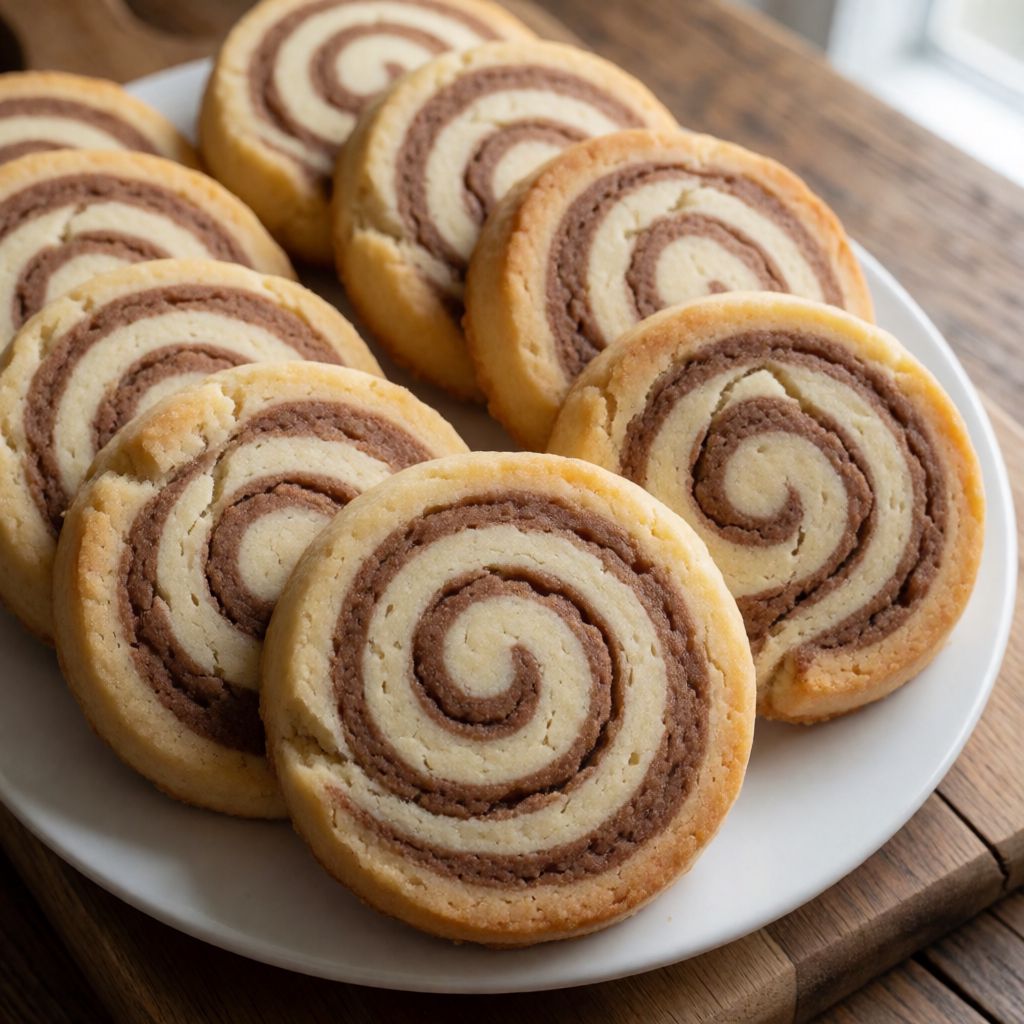
 AI photo
Spiral Pinwheel Biscuits
A two-tone spiral biscuit, light vanilla dough swirled with a cocoa-orange dough, sliced thin and baked until crisp.
Labels are worked out automatically from the ingredients and can be wrong. Check the packaging if it matters to you.
Ingredients
Light dough
- 150 g Plain flour
- ½ tsp Baking powder
- ½ tsp Vanilla powder
- 60 g Caster sugar
- 75 g Butter soft, at room temperature
- 1 pcs Egg beaten
- Water as needed, to bring the dough together






Dark dough
- 100 g Plain flour
- ½ tsp Baking powder
- 40 g Brown sugar
- 15 g Cocoa powder unsweetened
- 1 tsp Cinnamon ground
- ½ pcs Orange unwaxed, finely grated zest
- 1 tsp Cold water or orange juice for mixing
- 50 g Butter soft, at room temperature
- Cold water or orange juice as needed, to bring the dough together





For brushing
- 1 pcs Egg beaten, for brushing
Steps
For the light dough: mix the flour, baking powder, sugar and vanilla powder, then rub in the butter with your fingertips or two knives until it forms fine crumbs.
5 minBeat the egg, add half to the dough, mix and bring together into a ball, adding a little cold water if needed — the dough should be smooth, with no dry crumbs.
3 minLeave the light dough in the fridge for at least 1 hour, or up to overnight.
60 minFor the dark dough: mix the flour, cinnamon, cocoa, orange zest, baking powder and brown sugar, then rub in the butter with your fingertips or two knives until it forms fine crumbs.
5 minBring the dark dough together with the second half of the egg, adding a little cold water or orange juice if needed — the dough should be smooth, with no dry crumbs.
3 minLeave the dark dough in the fridge for at least 1 hour, or up to overnight.
60 minRoll out both doughs into rectangles on a lightly floured surface, brush one layer with beaten egg, lay the second layer on top and roll up into a log from the short side.
10 minPut the log in the fridge for 1 hour.
60 minSlice the log into thin biscuits just under ½ cm thick and arrange on a baking tray lined with baking paper, leaving a little space between them.
5 minBake in a preheated fan oven at 175°C for about 15 minutes.
15 minRemove the biscuits from the oven and let them cool on a wire rack.
15 min
This is two shortbread-type doughs, one plain and one spiced with cocoa and orange, rolled together and cut into coins so each biscuit shows a spiral. It's not a complicated dough — flour, sugar, butter, a bit of egg — but it's an unforgiving one, because the whole point is a clean line between light and dark, and anything that blurs that line (soft dough, warm hands, a blunt knife) shows up on the plate.
What decides whether it works isn't the baking, it's the chilling. You're asking two separate crumbly doughs to behave like a single sheet of something — rollable, foldable, sliceable without cracking or squashing flat. That only happens when the butter in them is cold and set, not when it's soft and spreadable. So the hour in the fridge after mixing, the hour after rolling into a log — those aren't optional pauses for your convenience, they're the mechanism. Skip them and you get a log that oozes out of round the moment the knife touches it, and biscuits that bake into puddles instead of discs.
Forty biscuits from this, each about a bite and a half — fine for a tea tray, a bake sale, or alongside the Sunday roast leftovers rather than after the roast itself, since nobody's got room for twelve pinwheels after a joint of beef. Make tea with milk to go with them; the orange and cocoa in the dark half actually stand up well against strong tea, better than against coffee.
Flour is just flour here — nothing special, plain flour, no need to hunt down a particular brand. Baking powder in small amounts like this isn't for rise, it's for a slight lift so the biscuit isn't totally dense; it's there as insurance, not as the main actor — butter and cold-rubbing do the real work of structure.
The butter has to be soft enough to rub into the flour by hand but this is a shortbread mechanism, not a creaming mechanism — you're coating flour granules in fat so gluten barely develops, which is why these snap rather than chew. Rub it in with fingertips, don't melt it and pour it in — melted butter gives you flat, greasy discs instead of a dough that holds a spiral shape. Any butter will do, salted or not; if you've only got margarine, it'll work but the flavour goes flatter and the dough is slightly wetter, so hold back a touch of the egg or water.
The egg binds — it's doing what water alone can't quite do, giving you a dough that holds together without being wet. Splitting one egg between two doughs is a bit fiddly in a British kitchen where egg sizes vary; don't agonise over the exact half, eyeball it, both doughs will tell you themselves whether they need a splash more liquid — the test is no dry crumbs, not a number on a scale.
Cocoa and cinnamon and brown sugar in the dark dough aren't just for colour contrast, though that's the visible point of the whole exercise — cocoa also brings a little extra fat-absorbing powder into that dough, which is part of why it needs its own butter ratio rather than sharing one lump of dough split and dyed. Orange zest is the thing to not skip or substitute lazily — zest, not juice, because you want the oil in the peel, not the acidity; grate only the orange part of the skin, the white pith underneath is bitter and will sit there sourly in an otherwise sweet biscuit. If you've no fresh orange, a little orange extract gets you partway there, but there's no real substitute for zest's actual oil — lemon zest works as a different but valid variant, just don't call it the same biscuit.
Rolling the two rectangles to match size matters more than people expect — if one sheet is bigger than the other, your spiral goes off-centre and the slices come out lopsided, thick on one side thin on the other, which bakes unevenly. Egg wash between the layers isn't decoration, it's glue — without it the two doughs can shear apart in the oven's heat and you get biscuits that fall into two separate crescents on the tray.
On slicing: "thin, just under half a centimetre" is doing real work — thinner than that and they're fragile logs, snap before they hit the tray; thicker and the spiral reads as two slabs of colour instead of a spiral, and the centre stays raw-tasting while the edges brown. Some say you need a serrated knife for clean slices — no, a sharp plain knife works better here, serrated drags on cold, hard dough and tears the spiral rather than cutting it; what actually matters is chilling the log hard enough that it resists the blade instead of squashing under it.
175°C fan is hot enough to set the butter and brown the edges before the centre dries out — in a standard fan oven with hot spots, rotate the tray halfway if your oven runs unevenly, since there's no steam or kazan-style heat buffering here, just a flat domestic oven doing its flat domestic thing. Doneness isn't the clock, it's the edges — when the pale dough at the rim goes from cream to a faint gold, and the dark dough looks matte rather than wet-looking, they're done; fifteen minutes is your floor, not your answer. And let them sit on the tray a minute before moving to a rack — straight off the oven they're soft enough to bend, and only firm up as they cool, which is when the shortbread snap actually arrives.