
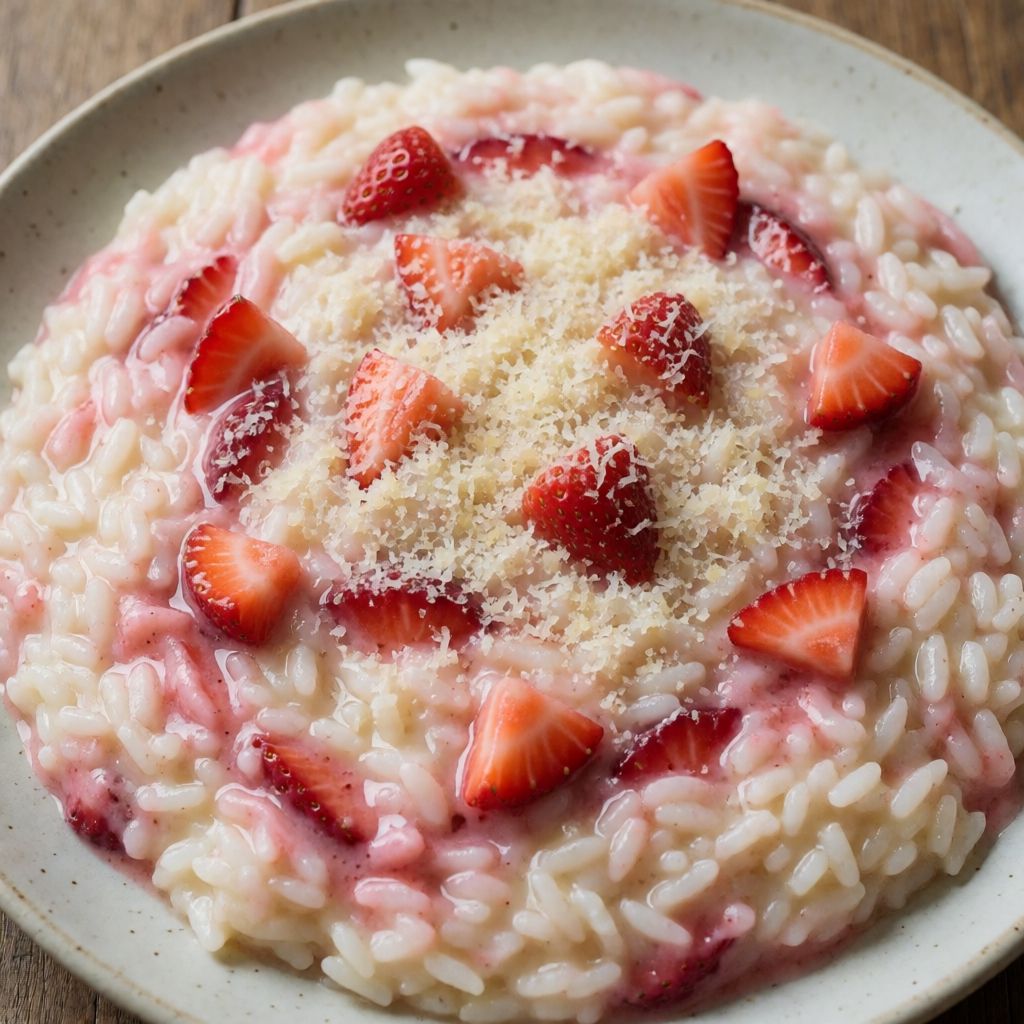
 AI photo
Strawberry Risotto
A creamy risotto with fresh strawberries and white wine, finished with butter and Parmesan.
Labels are worked out automatically from the ingredients and can be wrong. Check the packaging if it matters to you.
Ingredients
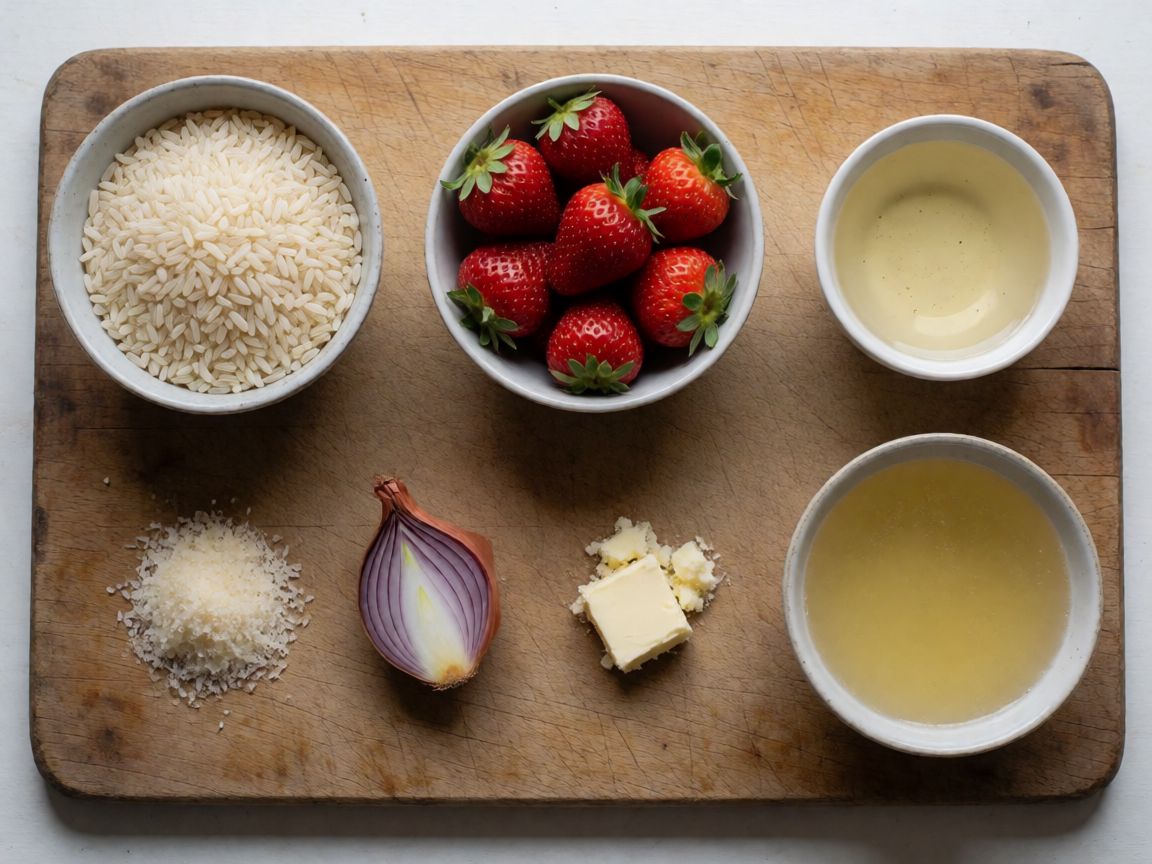
- 200 g Carnaroli rice
- 250 g Strawberries
- 200 ml White wine
- Parmesan to taste
- 0.5 pcs Shallot
- Salt to taste
- Butter to taste
- Vegetable stock to taste







Steps
Combine the strawberries with the white wine and leave to marinate for at least 20 minutes.
20 minIn a saucepan, sauté half the shallot in butter until soft.
Add the rice and toast for a few minutes, stirring constantly with a wooden spoon, until the grains become translucent.
Pour in the white wine, having strained out the strawberries first, and let it evaporate.
Once the wine has fully evaporated, continue cooking the risotto, gradually adding hot vegetable stock.
After 5 minutes, add the strawberries and continue cooking the risotto until the rice is done.
5 minRemove the pan from the heat.
Add salt to taste, the Parmesan and a knob of butter, stirring vigorously until creamy.
Serve immediately, garnishing the plate with a few strawberry slices.
Strawberry risotto sounds like a joke dessert menus play on diners, but it isn't a dessert — it's a savoury plate that uses fruit the way other risottos use tomato or saffron: for acid, colour, and a little sugar to round off the butter. What decides whether it works isn't the strawberries themselves, it's when they meet the heat and for how long. Too early and they collapse into jam, bleeding sugar that scorches on the bottom of the pan. Too late and they stay raw lumps sitting on top of cooked rice instead of inside it. Five minutes before the rice is done is the window — not a rule carved in stone, but the point where the fruit has time to soften and give up some juice without turning to mush.
The rice is Carnaroli for a reason that has nothing to do with brand loyalty. Its grain has a high ratio of a starch called amylose to one called amylopectin, which means the outside of the grain breaks down into a creamy film while the centre holds its shape and a little bite. That's what makes risotto a sauce with rice in it, not rice with sauce poured over. Toasting the grain in butter before any liquid touches it isn't a cosmetic step — it seals the surface just enough that the starch releases in a controlled way instead of all at once, so you get cream instead of porridge. You'll know it's done when the grains go from opaque white to a glassy, almost translucent edge, with a faint nutty smell. That's a few minutes, not a stopwatch reading.
Stock is doing more work here than people give it credit for. There's no meat, no anchovy, no deep umami base in this dish — the stock and the Parmesan are carrying all the savoury weight against the fruit's sugar and the wine's acid. That means it has to be seasoned properly on its own, tasted and corrected before it goes anywhere near the rice, because risotto never tastes better than the liquid you built it from. And it has to go in hot. Cold stock dropped onto hot rice stops the cooking dead for a few minutes while everything comes back up to temperature, and in that gap the grain sits in liquid without releasing starch evenly — you end up with patches that are mushy and patches that are still hard. Keep it on a low simmer in a second pan the whole time; in a flat with one decent hob, that usually means borrowing a back ring.
The wine does two jobs, and both happen before the stock goes in. First, it marinates the strawberries — osmosis pulling juice and colour out of the fruit into the liquid, which is why you leave it the full twenty minutes and not five. Second, once strained off the berries, it deglazes the toasted rice, its acid tightening the starch gel on the grain's surface so the risotto holds structure rather than turning gluey later. Straining it matters for a mundane reason: strawberry seeds and pulp left in the pan catch on the bottom before the liquid's fully evaporated, and what was meant to be fruity turns faintly burnt. Use a dry white, something with real acidity — a Pinot Grigio, a Sauvignon Blanc, whatever's open in the fridge that isn't sweet. A sweet wine on top of sweet fruit tips the whole dish into cloying, and there's no cheese in the world that rescues that.
Carnaroli is sold in most UK supermarkets now, usually shelved next to the Arborio with a higher price tag that reflects a longer growing season in the Po valley, not marketing. If you can't find it, Vialone Nano is the honest substitute — slightly starchier, cooks a touch faster, keep tasting. Arborio will do in a pinch, but it's softer and less forgiving: oversalt your attention for a minute and it blows past al dente into stodge.
Shallot gives sweetness without the sharper bite of onion, which matters here because the dish already has sugar coming from two directions — the shallot and the fruit. If you've only got onion, use half the amount and let it go further into softness before the rice goes in, so none of its raw edge survives.
Parmesan has to be a cheese that melts into the starch rather than stringing or turning rubbery — aged, hard, dry-rind cheese. Parmigiano Reggiano is the standard; Grana Padano works almost as well and is usually a pound or two cheaper. Grate it fresh off a block. The pre-grated bags, sitting in anti-caking powder, won't melt the same way and leave grit instead of cream.
Butter is unsalted, and it's there twice for two different reasons: once to soften the shallot without browning it — gentle heat, the shallot going soft and faintly glassy, never coloured — and once at the end, where the quantity you use decides how creamy the final dish looks on the plate more than anything else in the method. Don't reach for olive oil at that last stage as a lighter option; oil won't emulsify into the starch the way butter does, and the risotto turns greasy instead of glossy. This is one of the few places where the fat isn't a stand-in for flavour, it's doing a specific physical job, and there's no clean substitute for it.
Patience is the actual ingredient that ties the whole thing together — the twenty minutes the strawberries sit in wine before you've so much as touched the rice, and the slow, ladle-by-ladle feeding of stock afterwards. Rush either one and you haven't made a different risotto, you've made a worse one.