
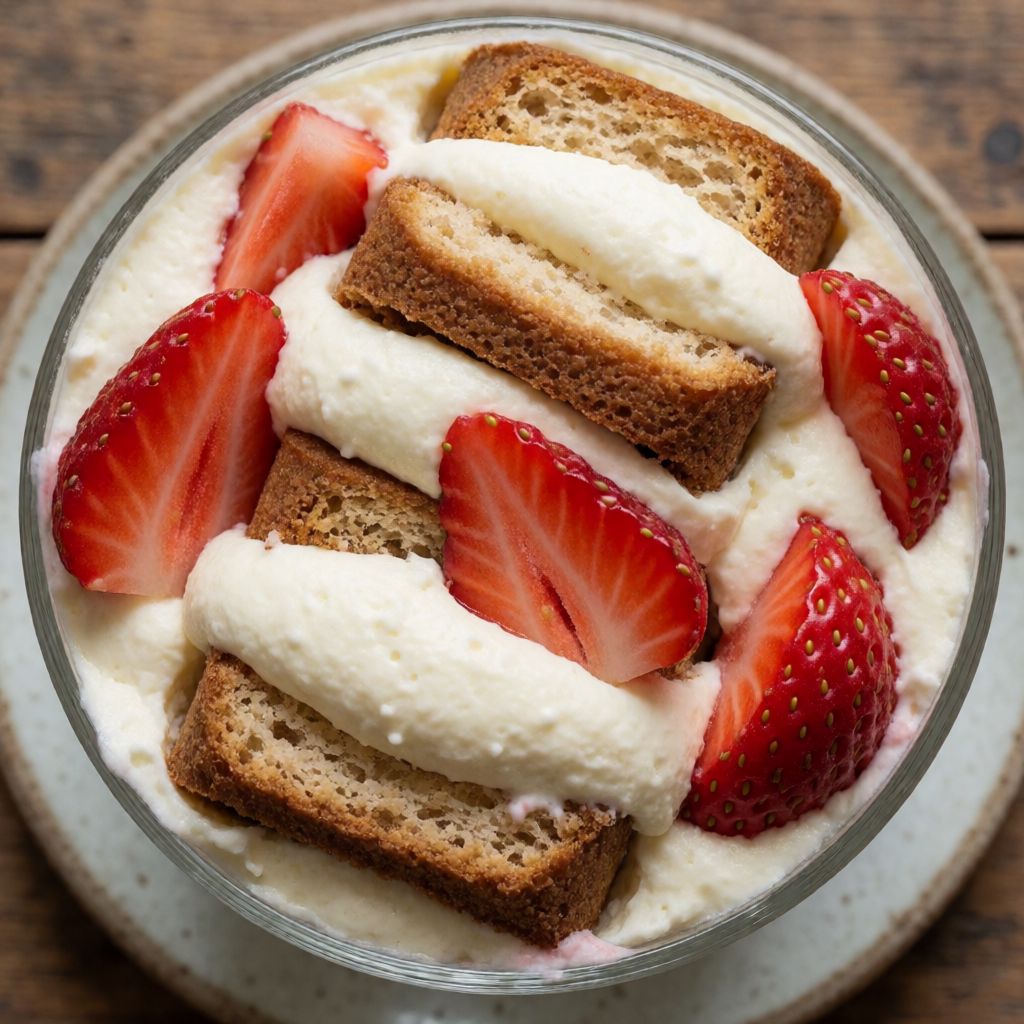
 AI photo
Strawberry Tiramisu
A creamy mascarpone tiramisu layered with sweet strawberries and sponge finger biscuits.
Labels are worked out automatically from the ingredients and can be wrong. Check the packaging if it matters to you.
Ingredients
- 60 g Caster sugar
- 2 pcs Egg yolks
- 450 g Strawberries
- 250 g Mascarpone
- 250 ml Double cream
- 3 package Sponge fingers
- Milk as needed






Steps
Whisk the egg yolks with the caster sugar using an electric mixer until pale and smooth.
Add the mascarpone and continue whisking until you have a smooth cream.
Whip the double cream to stiff peaks and gently fold it into the cream.
Layer the tiramisu: a layer of cream, sponge fingers dipped in milk, another layer of cream, and sliced strawberries.
Chill in the refrigerator for a few hours before serving.
What was changed
Sponge fingers are used here as the widely available UK alternative to the original biscuit.
This is tiramisu with the coffee taken out and strawberries put in its place — same architecture, different filling. The dish stands or falls on two things: whether the cream holds air, and whether the sponge fingers hold shape. Everything else is decoration.
The cream is not a custard. You whisk yolks and sugar only until the sugar dissolves and the mixture turns pale — that's air going in, not heat going in. Add the mascarpone cold, straight from the fridge, because warm mascarpone turns oily and the whole cream slackens. Then fold in the whipped cream rather than stir it — folding keeps the bubbles you just built, stirring collapses them, and a collapsed cream is a dessert that pools on the plate instead of standing on it.
The sponge fingers get dipped in milk, not coffee, because this isn't that tiramisu. The dip has one job: soften the dry biscuit's surface enough to merge with the cream above and below, while the core stays dry enough to hold a line when you cut it. Dunk too long and the biscuit turns to paste; too short and you get a dry streak running through a wet dessert — which is worse than either extreme alone.
Some say tiramisu needs hours in the fridge because "the flavours need to blend" — not quite. What's actually happening is moisture from the cream and the milk-soaked sponge redistributing, and the mascarpone cream firming as its fat sets cold. Rush it and you get a dessert that's warm-soft in the middle and won't hold a slice. A few hours is the honest minimum; overnight is better, and nobody has ever complained that a tiramisu sat too long.
Egg yolks carry the fat and lecithin that let yolk, sugar and mascarpone emulsify smooth instead of grainy. Raw yolks in a chilled dessert make some people nervous — fair enough, but in the UK eggs carrying the red lion mark are vaccinated against salmonella and the Food Standards Agency considers them safe eaten raw. If your eggs don't carry that mark, or you're serving someone pregnant or immunocompromised, that's the moment to look for a cooked custard-base tiramisu, not swap something in here and hope.
Caster sugar is fine-grained for a reason: you're dissolving it into yolks by whisking, not by heat, and coarse sugar takes longer and risks staying gritty. Granulated works if you blitz it briefly or just whisk longer and taste for grit before moving on — the criterion is "dissolves fast," not the bag it came in.
Mascarpone is cream cheese with more fat and almost no tang — that's what gives this its silkiness rather than a cheesecake sharpness. If you can't find it, full-fat cream cheese loosened with a spoon of double cream gets you close. The criterion is high fat, low acidity, not a specific tub.
Double cream's job is structure, not richness: it needs over about 36% fat to whip to stiff peaks and actually hold the mascarpone cream up rather than let it slump under its own weight. Whipping cream, around 35%, will just about do it if you don't overbeat; single cream won't — it has nowhere near enough fat to trap air at all.
Sponge fingers (savoiardi) are dry and full of air pockets from their original bake, and that structure is exactly what lets them absorb milk at the surface without falling apart. Any dry, airy biscuit works on the same logic; anything already soft or moist — a Victoria sponge, say — turns to mush the instant it meets milk, because it has no dry structure left to protect it.
Strawberries matter more by taste than by look: ripe ones give up juice into the cream and go soft and sweet against it; underripe ones stay firm and sharp. Taste one before you slice the punnet — that tells you more than the colour of the skin. And the milk itself, in place of coffee, is doing the same job coffee would — carrying a little fat and flavour into the biscuit — without the bitterness that would fight the strawberries, which is really the whole reason this version has swapped it out rather than just added fruit on top.