
 AI photo
Stuffed Peppers
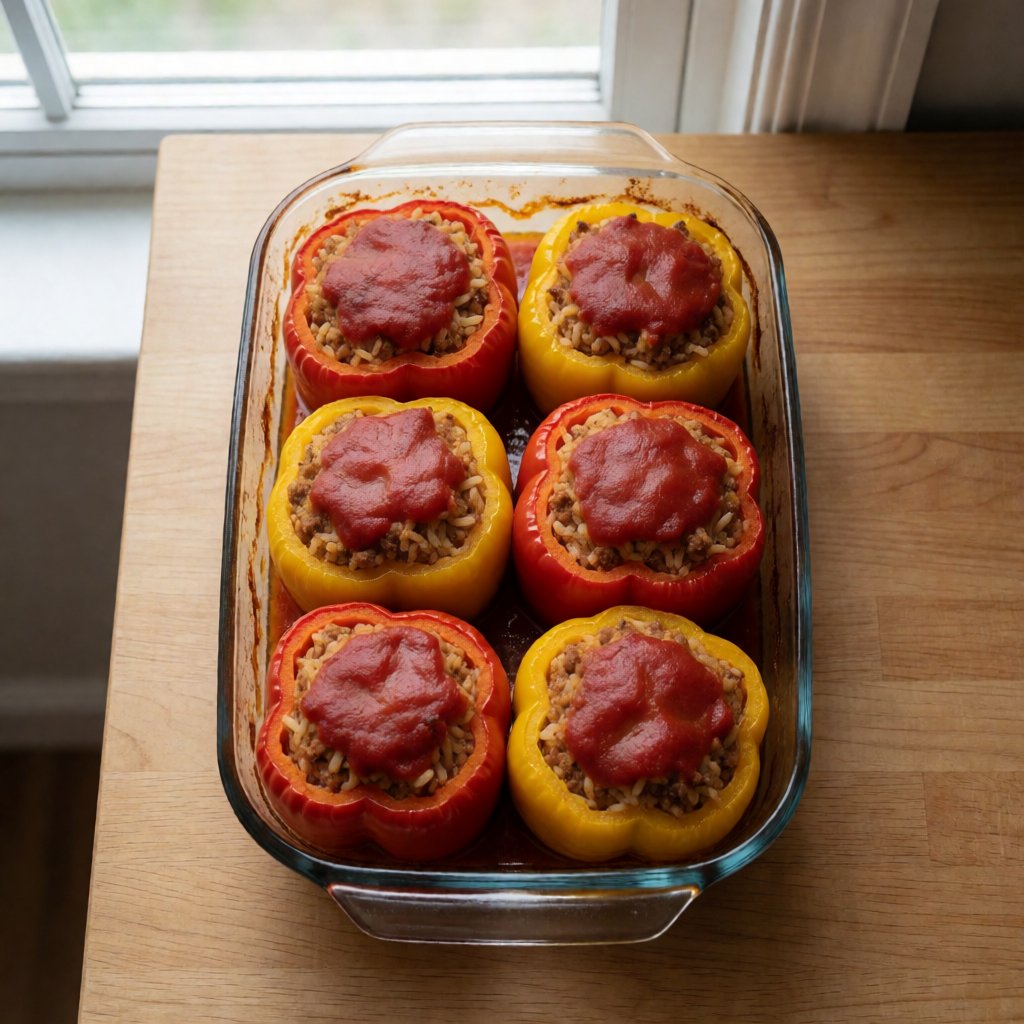
Sweet peppers stuffed with a pork and beef mince, rice and tomato sauce, baked until tender.
Ingredients
- 600 g Bell peppers 4 small
- 250 g Pork and beef mince
- 50 g Rice boiled for 8 min
- 0.5 pcs Onion
- 150 ml Tomato passata
- 150 ml Water
- 1 pinch Salt to taste
- 1 pinch Black pepper to taste








Steps
Boil the rice for 8 minutes.
8 minMix the mince with the rice, onion and salt; stuff the peppers.
Place the peppers tightly in a baking dish and pour over a sauce made from the tomato passata and water in a 1:1 ratio.
Cover with foil and bake at 200°C for 45 minutes; the filling should reach an internal temperature of 71°C.
45 minRemove the dish from the oven.
What was changed
Swapped the mince for Pork and beef mince and the tomato paste for Tomato passata, items British shoppers can easily find.
Four peppers standing in a dish, each one holding its own little stew: mince, rice and onion inside, a thin tomato broth working away outside. Two things are cooking at once — the filling steaming inside its vegetable case, and the pepper itself slowly braising in the sauce underneath. That's the whole mechanism, and once you see it that way, the steps stop being mysterious.
What decides whether this works is not the recipe, it's the packing. Stand the peppers tight against each other in the dish — shoulder to shoulder, no gaps. Tight peppers prop each other upright, so the filling stays put instead of leaking into the sauce as the walls soften. Loose peppers lean, the filling spills, and you end up with meat soup instead of stuffed peppers.
Some say you should parboil the peppers first to soften them faster. No — because that just rinses their sweetness down the sink, and you'd still need the full 45 minutes for the filling to cook through regardless. Pack them tight, cover them, and the pepper softens on exactly the same clock as the meat. One pan, one timer, nothing wasted.
Start with the mince. Pork alone is often too fat and soft, beef alone too lean and tight — together they hold water better than either on its own, so the filling stays moist through 45 minutes of oven heat instead of drying into pellets. If you've only got beef, add a spoon of oil or a knob of butter worked through the mince before stuffing; it's standing in for the fat pork would have given you.
The rice is boiled for exactly 8 minutes, not until done — and that's the whole point. Half-cooked rice still has an unbroken starch layer gripping each grain, so it won't turn to paste later. It finishes its cooking inside the pepper, swelling on meat juice and the tomato-water sauce that seeps up through steam, picking up flavour it could never get boiling in plain water. Boil it fully first and by the time the peppers come out, you have rice porridge, not rice.
The onion goes in raw, grated or very finely chopped, not fried. Raw onion still has its water locked inside the cell walls; as the oven heats it, that water releases slowly and bastes the mince and rice from within, the way a frying pan never could reach inside a sealed pepper. Frying it first would just mean less moisture left to do that job later.
Tomato passata cut with water, one part to one, isn't thrift — it's arithmetic for a 45-minute bake. Neat passata is concentrated enough that over that time it reduces to a thick, sticky paste that catches on the bottom of the dish before the filling is anywhere near done. Diluted, it has enough liquid to keep braising the pepper skins the whole time and still coats the plate as a proper sauce at the end, not a glaze.
Choose peppers that are squat and stand flat on their own — that's not about variety, it's about geometry, since a pepper that wobbles on its own will definitely wobble packed next to three others. Colour is yours to decide: red and yellow are sweeter from more time on the plant, green sharper and slightly bitter, and either works here since the sauce and meat carry most of the flavour anyway. Four small ones for two people means two each, a proper plateful without pretending it's a starter.
The foil is your lid, standing in for what a heavier pot with a tight-fitting cover would do on its own — trapping the steam that keeps the tops of the peppers from drying out while the bottoms braise in sauce. Leave it on for the whole bake. Lifting the foil to check halfway lets that steam out, and you'll pay for the curiosity with a dry pepper top and ten more minutes to compensate. Patience, here, is simply not touching the dish — let the oven and the covered steam do the work they're already doing.
·