
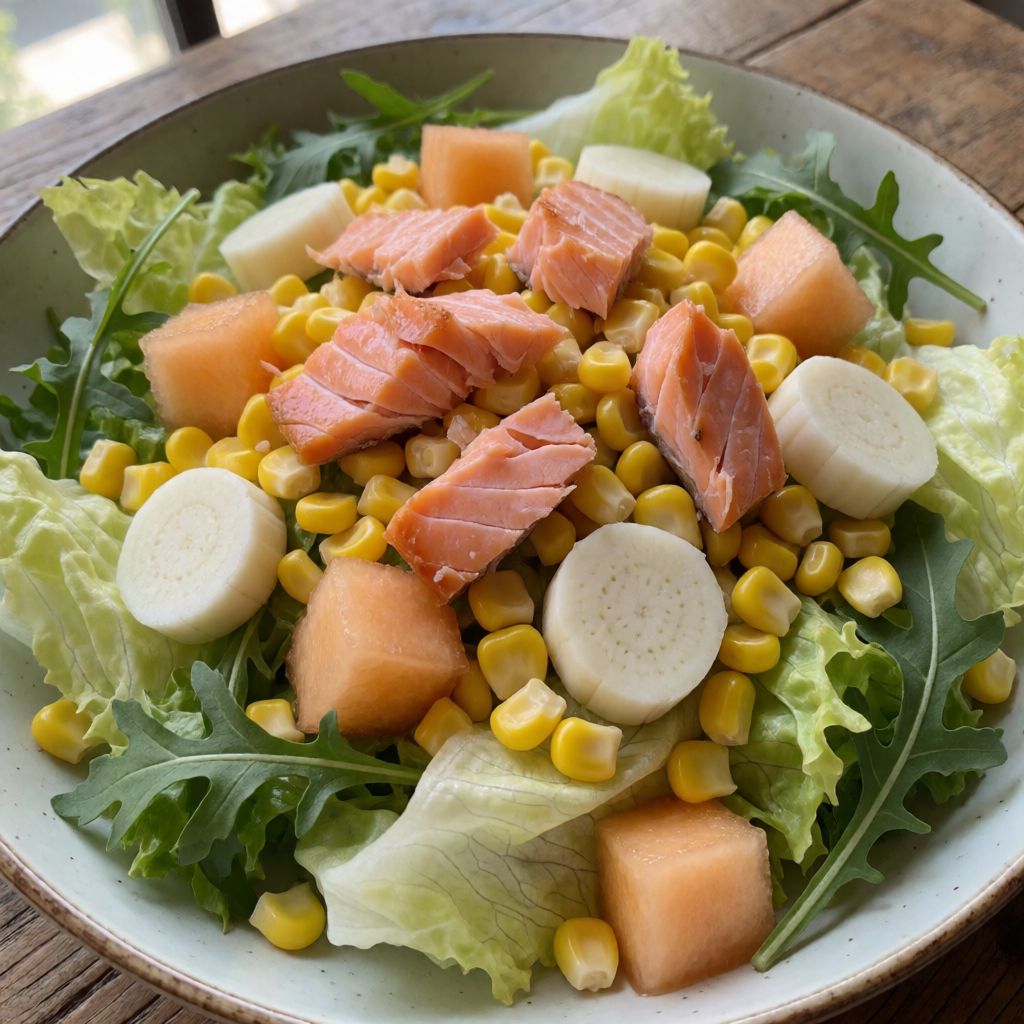
 AI photo
Summer Salad
A refreshing summer salad with grilled salmon, rocket, lettuce, melon, palm hearts and a sweet mustard dressing.
Labels are worked out automatically from the ingredients and can be wrong. Check the packaging if it matters to you.
Ingredients
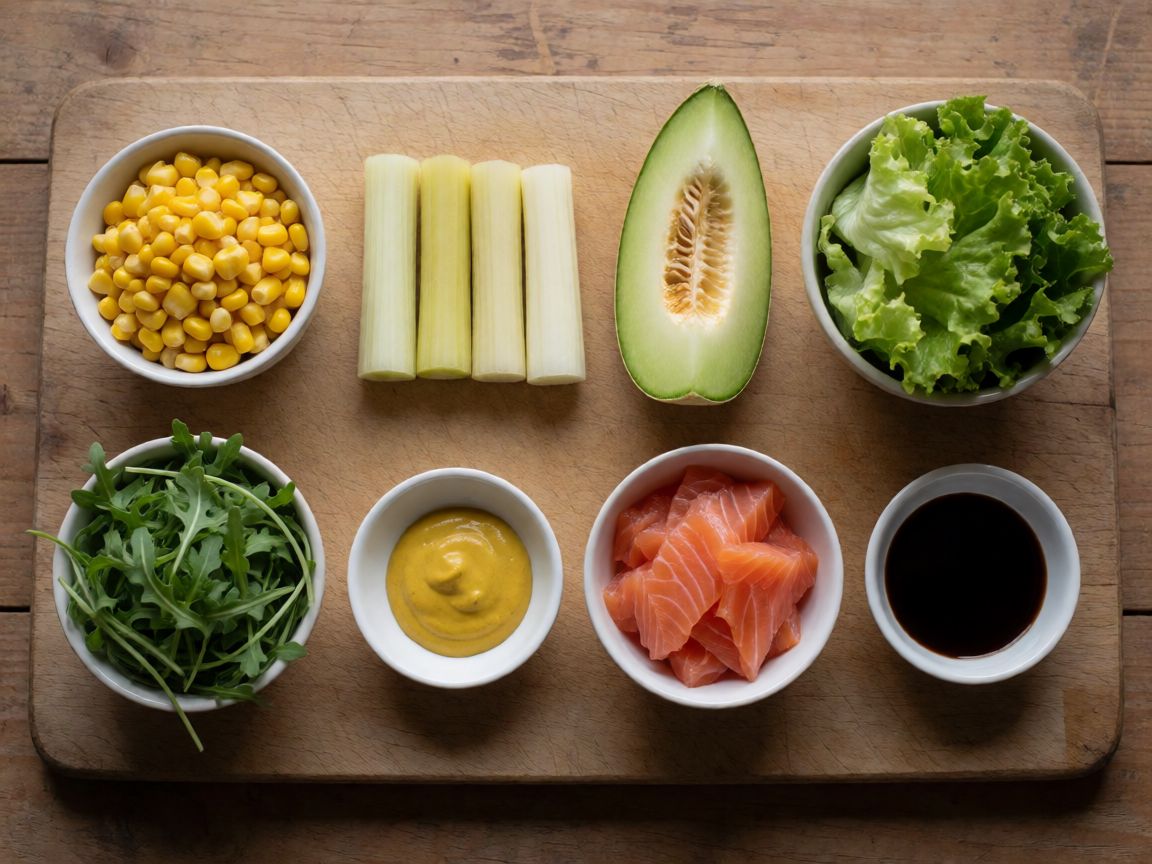
- 1 can Tinned Corn drained
- 4 pcs Palm Hearts
- 1/4 pcs Melon
- 200 g Lettuce
- 200 g Rocket
- 200 g Salmon
- 100 ml Balsamic Vinegar
- 30 ml Olive Oil
- 20 ml Water
- Salt to taste
- Black Pepper to taste
- 20 g Mustard sweet










Steps
Grill the salmon until cooked through (the internal temperature of the fish should reach 63°C).
10 minWhile the salmon cooks, place the lettuce and rocket in a salad bowl, then add the corn, palm hearts and melon.
5 minMake the dressing by whisking together the balsamic vinegar, olive oil, sweet mustard and water until thickened.
5 minCut the cooked salmon into small cubes.
2 minDress the salad, season with salt and black pepper to taste, and serve.
3 min
This is a composed salad, not a tossed one: a cold base of leaves and fruit, a few tinned things for bulk, and one warm element — the salmon — laid over the top. What decides whether it works isn't the list, it's two mechanical questions: did you stop the salmon at the right moment, and did the dressing actually bind.
Start with the salmon. In a UK kitchen, "grill" usually means the overhead broiler, not an open flame — so you're cooking by radiant heat from above, which browns the top surface while the underside lags behind. On a ridged pan on the hob it's the reverse: contact heat from below, top catching up late. Either way, 63°C is a food-safety floor someone decided on, not a flavour target, and you likely don't own a probe thermometer anyway. Watch the flesh instead: it goes from glassy, translucent pink to a matte, slightly paler colour, and the muscle starts to separate along its natural seams when you press it. Pull it off a touch before that's finished everywhere, because the fish keeps cooking from its own stored heat once it's on the plate — carryover does the last bit of work for you. Some say salmon should flake apart easily right there in the pan to be properly done — no: by the time it flakes that easily in the pan, it's already dry, because you waited for a cue that only shows up after moisture has gone.
On the fish itself: buy for fat, not for cut. A fattier piece — belly side, or a thick fillet rather than the thin tail end — survives direct heat without drying out, because fat buys you time against moisture loss. If you cut the piece unevenly, the thin end finishes well before the thick end, so you're either serving it raw in the middle or dry at the edge; cutting it into roughly even portions before cooking solves that, not more heat. Substitution criterion: any oily fish with enough structure to hold together under a grill — trout works, mackerel works if you want something more assertive, white fish does not, because it has no fat reserve to protect it.
The melon is doing a strange double job: it's playing vegetable (crunch, moisture, bulk) and dessert (sweetness) in the same bite, set against the salt of the dressing and the pepper of the rocket. Any firm-fleshed melon does this — cantaloupe, honeydew, whatever's in season or on offer — the only requirement is that it holds its shape when cut rather than collapsing to pulp. If you have no melon, the criterion is sweet, watery, structurally firm fruit: a ripe but firm pear does the same job, differently.
Corn and palm hearts are tinned for reasons that have nothing to do with taste. Palm hearts don't travel or keep well fresh at all; corn is a summer crop you want available in January. Tinning solves both problems, and that's the whole story — no mystique, just shelf life. Their role in the bowl is mild crunch and volume, not flavour, which is why they shouldn't be seasoned separately: they're built to absorb whatever dressing they sit in.
Lettuce and rocket aren't interchangeable, even though they're both "salad leaves." Lettuce gives bulk and a clean crunch with almost no flavour of its own; rocket gives a peppery bitterness that's the only thing in the bowl sharp enough to stand up to the melon's sweetness. Lean too far toward lettuce and the salad has no backbone; lean too far toward rocket and it turns bitter and one-note. The two together is the point, not an accident of what was in the fridge.
For the balsamic, mind that cheap bottles are often thinner and sharper than a proper aged one, so the amount of water you need to loosen the dressing isn't fixed — taste as you whisk. If you've no balsamic at all, the criterion is a dark, slightly sweet vinegar: sherry vinegar with a touch of honey gets you most of the way there.
And the one place patience actually earns its keep here is the whisking. Rush it and you get two liquids sitting in the same bowl pretending to be a dressing, which separates again the moment it touches a leaf. Give it the time to thicken properly, and give the salmon its minute of rest off the heat before you cube it — that's not wasted time, that's the carryover heat finishing the job so you don't have to overcook to compensate.