
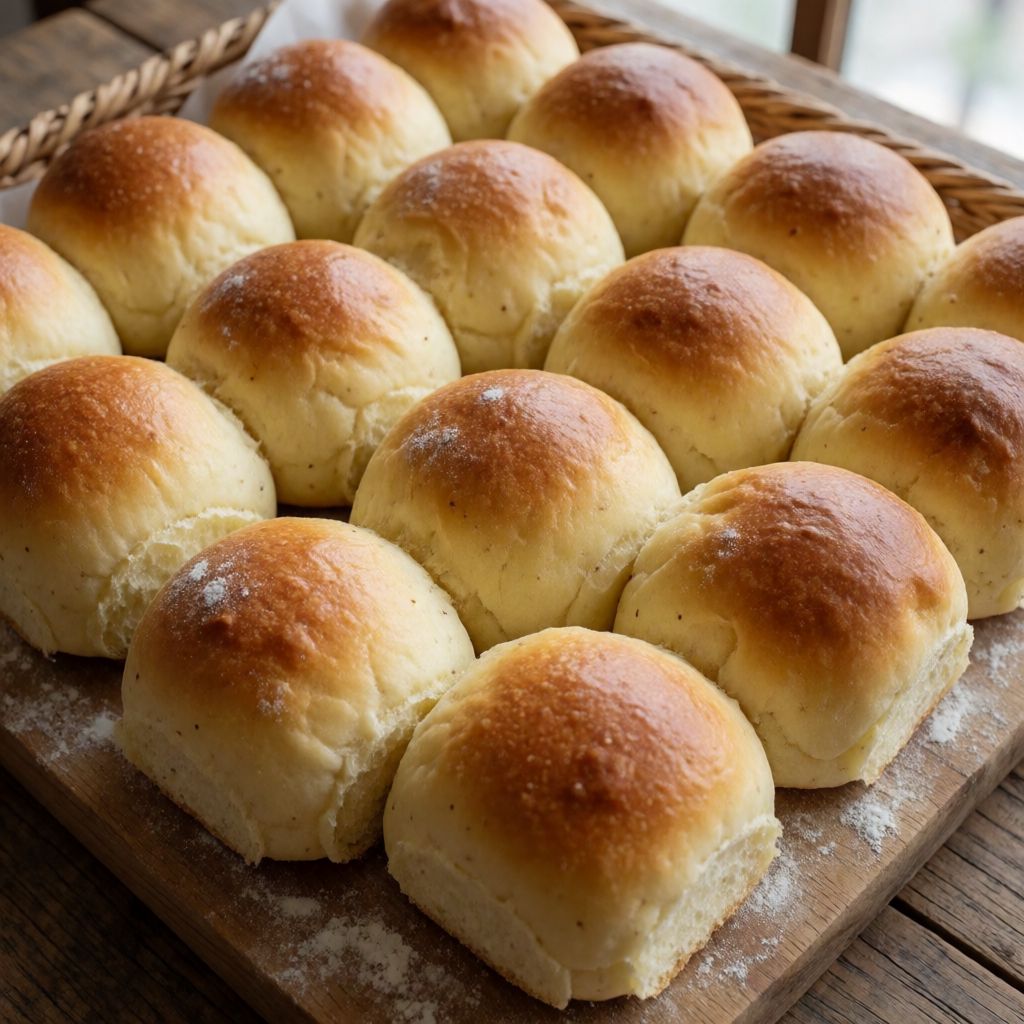
 AI photo
Tea Buns
Soft, lightly spiced yeasted buns flavoured with cardamom, finished with a golden egg wash.
Labels are worked out automatically from the ingredients and can be wrong. Check the packaging if it matters to you.
Ingredients








Steps
Stir the yeast into a bowl with the milk. Add the remaining ingredients and knead the dough with a mixer on low speed for 10 minutes.
10 minLeave the dough to rise on the kitchen counter for 1 hour.
60 minDivide the dough into equal pieces (60–80g each) and shape into round buns. Place them on a baking tray lined with baking parchment.
Leave the buns to prove under a tea towel for about 90 minutes.
90 minBrush the buns with the beaten egg.
1 minBake the buns in a fan oven preheated to 190°C for 15-17 minutes until golden.
16 minLet the buns cool on a wire rack before serving.
5 min
These are soft, slightly sweet rolls perfumed with cardamom — the kind of thing you'd put out next to a pot of tea with milk, not instead of toast, but as something a bit more festive. Think of them as a cousin of the Swedish kardemummabulle that wandered into a British kitchen and settled in nicely, because cardamom and milky tea get on well together, and because an enriched yeast dough keeps for days without going stale the way lean bread does.
What decides whether these work isn't the ingredient list, it's two separate waits and one heat. The dough has to rise twice — once in bulk, once shaped — and each rise is doing a different job. Skip or shortcut either one and you get a dense, tight bun that looks right and eats like a doorstop. The oven heat then has one task only: set the crust and colour it before the inside dries out. Everything else — the kneading, the egg wash — exists to make those two waits and that one heat actually pay off.
Some say yeasted dough needs watching like a pot of milk. It doesn't. It needs you to leave it alone on the counter, under a cloth, away from a draught, and come back when it looks different, not when the clock says so. Patience here isn't a virtue you perform, it's literally the ingredient doing the work — the yeast needs real time to eat through the sugars in the flour and puff the dough with gas. Rush it and no amount of butter or cardamom will save you.
Yeast is the engine, and 20g fresh yeast is a generous amount — it's there to give you a reliable rise in a flat that might be draughty or a bit cool, not tropical like a bakery. If you can only get dried yeast, use about a third of the weight and dissolve it the same way in the room-temperature milk. That word 'room-temperature' matters: yeast is a living thing, and hot milk stuns it, cold milk just makes it sulk and take forever. Room temperature is the compromise that lets it wake up at a sensible speed.
Here's a myth worth killing: that the sugar in the recipe is yeast food, and without it the dough won't rise. It isn't needed for that — yeast happily feeds on the sugars already locked up in the flour. The 50g of sugar here is for flavour and for colour, because sugar caramelises in the oven and helps that golden crust the recipe is chasing. Take it down if you want a less sweet bun; the rise won't suffer for it.
Cardamom is the signature here, and it's not decoration. It's the spice that made this style of enriched bun famous in the first place, carried along old trade routes into Scandinavian baking where it became a teatime habit the way cinnamon did in Britain. If you haven't got cardamom pods or ground cardamom, don't leave the gap empty — a pinch of ground cinnamon and a little grated nutmeg will get you into similar territory, warm and a bit perfumed, though not identical.
Butter's job is tenderness — fat coats the gluten strands and stops them linking up into something chewy, which is exactly what you want in a bun and exactly what you don't want in a baguette. Any neutral fat with no smell of its own can stand in — a flavourless oil, or a mild margarine — though you'll lose some of the richness butter gives the crumb once it cools.
The egg does two jobs and only one of them is inside the dough: beaten into the mix it adds richness and helps the crumb hold together, and brushed on top before baking it's what gives you that shine and deep gold colour, because the proteins and sugars in it brown faster and harder than the dough underneath. Skip the wash and you still get a cooked bun, just a pale, matte one — fine to eat, less inviting to look at.
Ten minutes of kneading, even by machine on low, is there to build a gluten network strong enough to trap the gas the yeast produces — without it the dough can't hold its rise and collapses as soon as you shape it. The two rests after that aren't about minutes, they're about what you see: the dough roughly doubling in the bowl, then the shaped buns visibly puffing and softening under the towel before they go in. The oven time is the same story — 190°C in a fan oven gets you a hot, fast environment that sets the crust before the inside overbakes, but 'golden and springs back when you press it' is the real finish line, the quoted minutes are just where to start checking. And let them cool on a rack, uncovered — stack warm buns on a plate and the steam trapped underneath turns the base soft and a bit sweaty, which is a small, avoidable disappointment after all that waiting.