
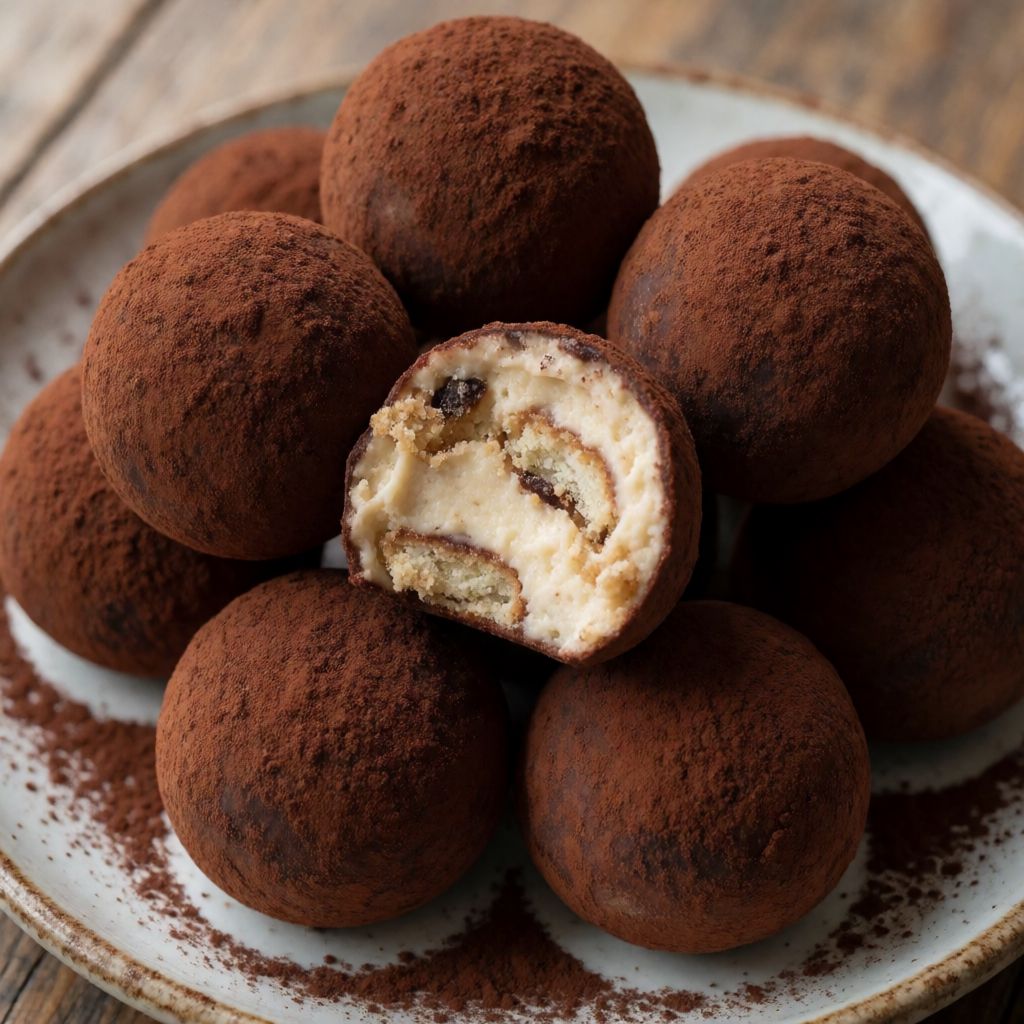
 AI photo
Tiramisu Truffles
No-bake tiramisu truffles made with crushed biscuits, mascarpone, coffee and a hidden Nutella centre, finished in cocoa.
Labels are worked out automatically from the ingredients and can be wrong. Check the packaging if it matters to you.
Ingredients
- 120 g Sponge finger biscuits (savoiardi)
- 250 g Mascarpone
- 60 g Caster sugar
- 1 pcs Coffee
- Nutella to taste
- Cocoa powder to taste





Steps
Crush the sponge finger biscuits (savoiardi) in a blender until they form fine crumbs.
In a separate bowl, beat the mascarpone with the caster sugar using an electric mixer.
Add the biscuit crumbs and mix by hand with a spatula until smooth.
Pour in the coffee, stir, and put the mixture in the freezer for 10–15 minutes.
10 minOnce chilled, shape the truffles: take a small amount of the mixture, flatten it in your palm, place a teaspoon of Nutella in the centre and roll into a ball.
Roll each ball in cocoa powder.
Place the tiramisu truffles in the refrigerator and keep them there until serving.
What was changed
The original biscuits were swapped for Sponge finger biscuits (savoiardi), which are easier to find in UK shops.
This isn't tiramisu rebuilt in miniature — it's tiramisu stripped of its architecture. No layers, no egg, no long soak in coffee. What's left is the flavour triangle that makes tiramisu what it is — bitter coffee, sweet cream, dark cocoa — squeezed down into something you eat in one bite, no fork needed.
What decides whether it works isn't the coffee and it isn't the Nutella. It's whether the mascarpone gets cold enough to stop behaving like cream and start behaving like a solid. Mascarpone is mostly fat, and fat has a point where it stops being spreadable and starts being mouldable — the same thing that happens to butter when you chill it before making pastry. The freezer here isn't freezing anything; ten to fifteen minutes in a domestic freezer won't make ice crystals in a dairy paste. It's there to firm that fat. Skip the chill and the mixture sticks to your palms, won't round up, and the Nutella bleeds straight through the crumb before you've even got to the cocoa.
Some say tiramisu needs raw egg yolk to bind it — not here, and not because this is a lesser version. Egg's old job was richness and a soft set. Mascarpone's fat and the biscuit's starch do both without it, which also means nothing raw is sitting in your fridge waiting to go off before the truffles are eaten.
Forget counting minutes on the chill. The test is in your fingers: press a bit of the mixture between two of them. If it holds the dent and doesn't flow back, it's ready to roll. If it springs back wet and shiny, it needs more cold, not more time on a clock that doesn't know your fridge.
Savoiardi earns its place here for its dryness, not its sponginess. Blended, it should turn to near-powder, not paste — that fine, dry crumb is what lets it drink the coffee and the mascarpone's moisture evenly instead of going gluey in patches. If you can't get savoiardi, any plain, dry, not-too-sweet biscuit will do the same job — digestives, rich tea, even plain shortbread crumbs. The criterion is simple: it should shatter to dust in the blender, not clump.
Mascarpone you choose for fat, plain and simple — fresh, high-fat, no sourness creeping in at the edges. If you've none, full-fat cream cheese loosened with a spoon of double cream gets you close: thick enough to hold its shape once cold, soft enough to beat smooth when it isn't.
The coffee's only job is flavour and a touch of moisture, not soaking anything through — unlike a proper tiramisu, nothing here needs to drink it slowly over hours. So the method matters less than the strength. Some insist it must be espresso; no, because the coffee is stirred into a paste here, not poured over biscuit that has to absorb it. Strong instant coffee, dissolved in the smallest amount of hot water and cooled, does exactly the same work.
Caster sugar is chosen for how small its grains are — it dissolves into the mascarpone under the mixer rather than sitting grainy on the tongue. If all you have is granulated, beat it longer until you can't feel it between your fingers anymore. Don't swap in icing sugar on a whim — it carries cornflour, and that will dull the set you're relying on.
Nutella is the hidden centre, and what matters about it is texture, not brand: a soft, spreadable paste, sweet and fatty enough to stay put at fridge temperature without turning runny. Any nut butter loosened with a little honey, or a spoon of dulce de leche, will sit in that centre just as happily.
Cocoa powder does two jobs at once. It cuts the sweetness of the filling with its own bitterness, and — just as important in a domestic kitchen — it's a dry dusting that stops the balls sticking to your hands and to each other on the plate, the same mechanism as flour on dough. Use the plain, unsweetened kind; sweetened cocoa or drinking chocolate just adds more sugar you don't need.
The patience here is the chilling, twice over — once before shaping, once before serving — and it's not optional seasoning, it's structural. A truffle served warm is a smear, not a ball. And if you're making these on the same day as a Sunday roast, that's exactly their advantage: no oven, no hob, nothing competing with the potatoes for space or heat. They just want a cold corner of the fridge and the time you're not watching them.