
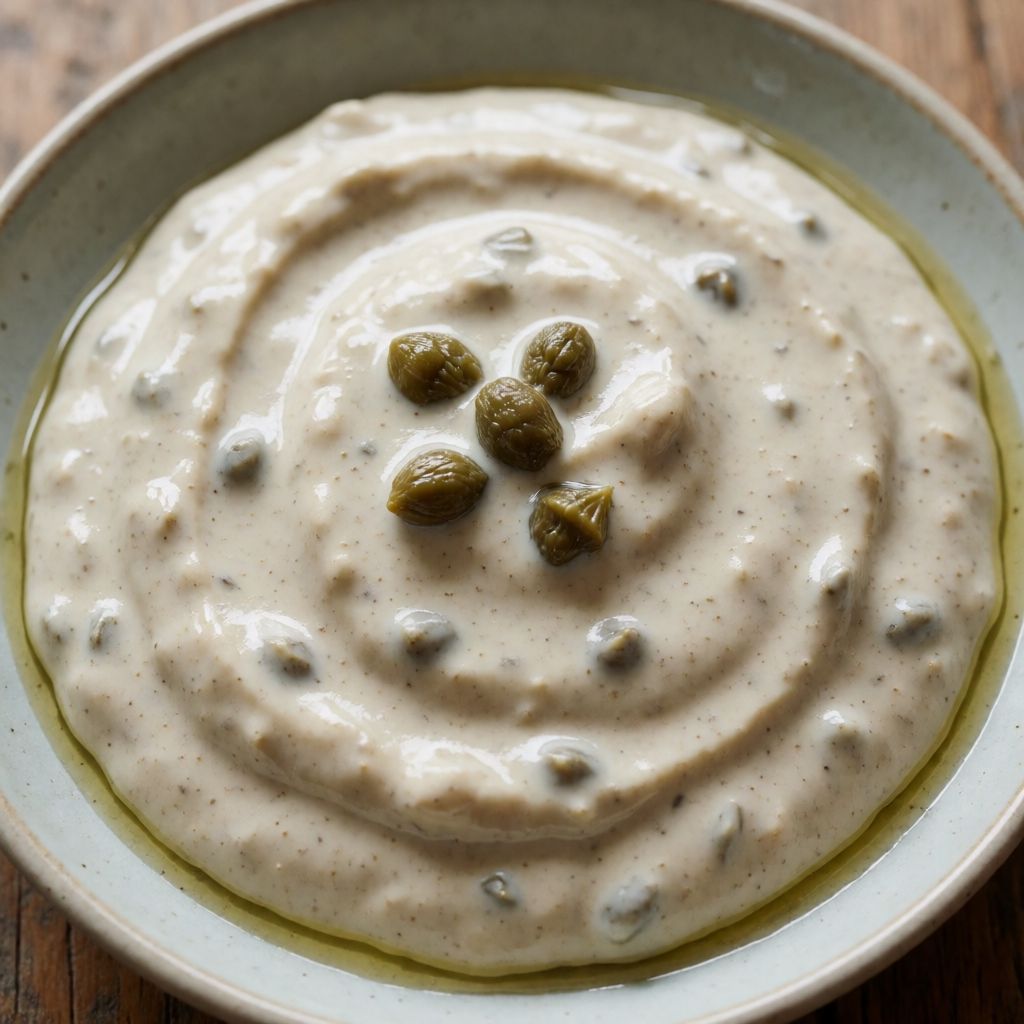
 AI photo
Tonnato Sauce
A classic Italian sauce made with egg yolks, olive oil, tuna, anchovies and capers, served with meat or used as a filling.
Labels are worked out automatically from the ingredients and can be wrong. Check the packaging if it matters to you.
Ingredients
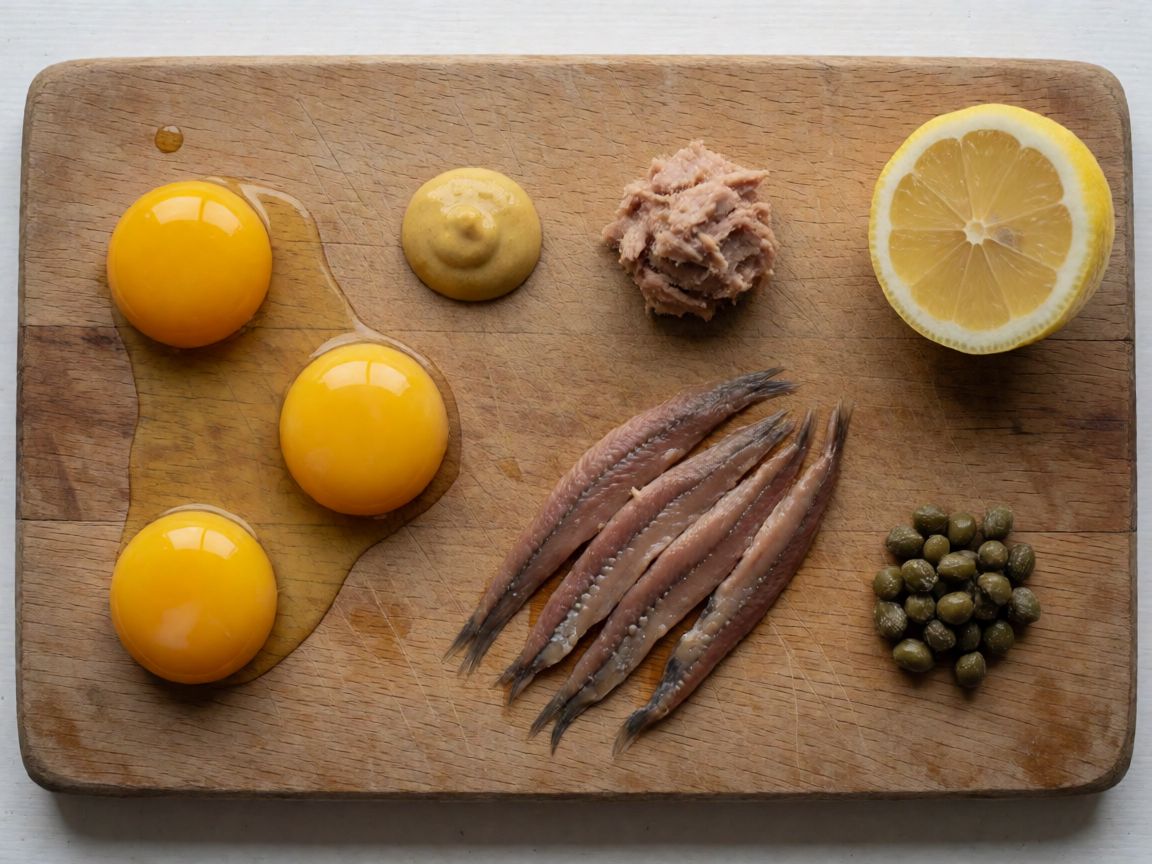
- 3 pcs Egg yolk
- 350 g Olive oil
- 1 tsp Mustard
- 150 g Tuna
- 4-5 pcs Anchovies
- 25 g Capers
- 0.5 pcs Lemon juice juice of half a lemon
- Salt to taste
- Black pepper to taste









Steps
Combine the egg yolks, lemon juice, mustard and a pinch of black pepper.
Whisk with an immersion blender or mixer, and while continuing to blend, pour in the olive oil in a thin, slow stream.
On a separate board, finely chop the capers and anchovies, then add them to the mayonnaise and mix.
Mash the tuna, add it to the sauce and mix until you reach the desired consistency.
Serve the tonnato sauce with meat dishes or use it as a filling.
Tonnato is mayonnaise that has been told it's going to meet tuna, so it holds itself together a little more seriously. Underneath the anchovies and capers, this is the same emulsion that holds any mayonnaise: egg yolk wrapping tiny droplets of oil in a film thin enough to taste smooth, thick enough to coat a spoon. Everything else — the tuna, the anchovy, the capers, the lemon — is seasoning riding on top of that structure. If the emulsion breaks, no amount of good tuna saves it; you get an oily, grainy mess that tastes of fish fat, not fish sauce.
What decides whether it works is speed of pouring, not speed of whisking. The yolk can only wrap oil as fast as you offer it. Pour too fast, in a splash instead of a thread, and the oil arrives faster than the yolk can coat it — droplets merge, the sauce curdles, and it's not bad luck, it's just arithmetic. Three yolks can comfortably carry around 350g of oil if you give them the time to do it properly; that's exactly the ratio here, so you're not fighting the recipe, you're fighting your own impatience with the stream.
Some say mayonnaise must be whisked by hand or it won't 'take'. No — what makes it take is shear, the oil being torn into droplets small enough to stay suspended, and an immersion blender does that better than most wrists, because its blade spins far faster than any arm can move. Hand-whisking works too, it's just slower and more tiring, not more correct.
Egg yolk is the actual engine here — it's the emulsifier, the only ingredient that can hold oil and water-based liquid (lemon juice) in the same sauce without them splitting apart. Use eggs at room temperature; cold yolk is stiffer and slower to loosen, so the oil goes in unevenly and you get pockets that split before the rest catches up. If you're worried about raw egg, this isn't the sauce to cut that corner in — pasteurised yolks exist for exactly this reason, use them and don't think twice.
The oil should have no character of its own strong enough to fight the fish. A loud extra virgin olive oil brings its own bitterness and grassiness, and against anchovy and tuna that turns muddy rather than rich. A milder olive oil, or any neutral oil with no real smell — sunflower, a light rapeseed — lets the fish lead. This is a substitution by criterion, not brand: smell the oil on its own first; if it smells like a good oil, it's wrong for this job.
Mustard isn't there for heat, it's there for stability — mustard seed contains its own emulsifying compounds, so a teaspoon acts like insurance alongside the yolk, giving you a wider margin if your pouring hand isn't perfectly steady yet. Lemon juice does three jobs at once: it thins the thick emulsion to a spoonable consistency, it cuts the fattiness of the tuna and oil, and the acid gives the yolk proteins a slight head start in setting up the structure. Half a lemon is a guide, not a law — taste as you go, because lemons vary wildly in how much they actually give up.
Tuna in oil, not in water, is the one worth paying for here — the oil-packed kind keeps its fat, and that fat is what makes the sauce feel rounded rather than lean and stringy once mashed in. If all you have is water-packed, drain it well and add a touch more oil elsewhere to compensate, or the sauce will taste thin against the salt of the anchovies.
Anchovies and capers are salt-cured, concentrated flavour, not bulk — their job is to push the sauce from 'creamy with fish' to something with a savoury backbone, the way a small amount of cured, salted ingredient can carry a whole dish if you let it dissolve in rather than sit as chunks. Chop them fine; the point is for them to disappear into the texture, not announce themselves as pieces. Go easy on added salt until you've mixed both of these in — they're doing most of the salting work already, and a sauce you can't taste properly until the next day, after it's sat and the salt has settled in, is a sauce you've over-salted on a rush to taste it fresh.
And give it the time it actually needs: pour the oil slowly enough that your arm gets a little bored, let the mashed tuna fold in rather than being beaten in. Patience here isn't a virtue tacked on for the sake of it — it's the difference between an emulsion and a split sauce, which is the whole dish.