
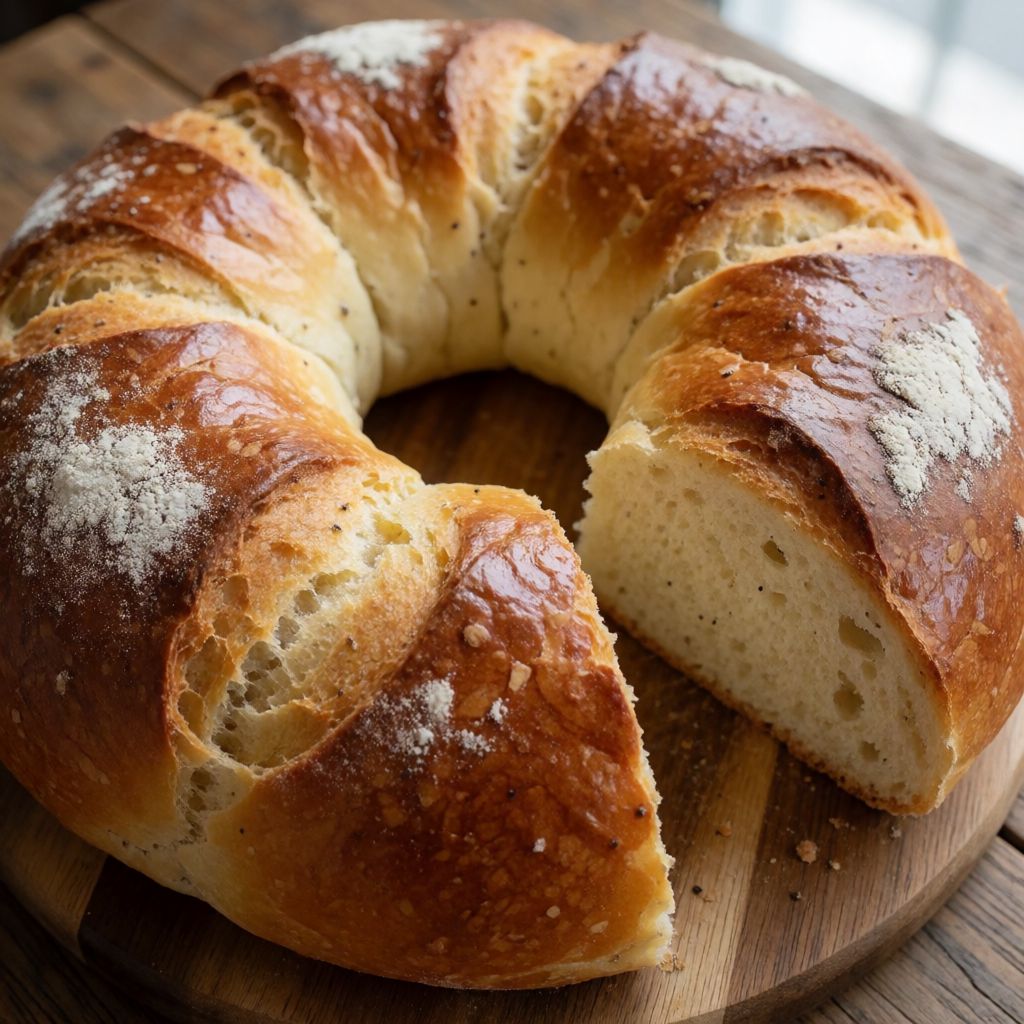
 AI photo
Neapolitan Tortano
A savoury Neapolitan Easter bread filled with a rich mix of cured meats, cheeses and boiled eggs, rolled and baked until golden.
Labels are worked out automatically from the ingredients and can be wrong. Check the packaging if it matters to you.
Ingredients
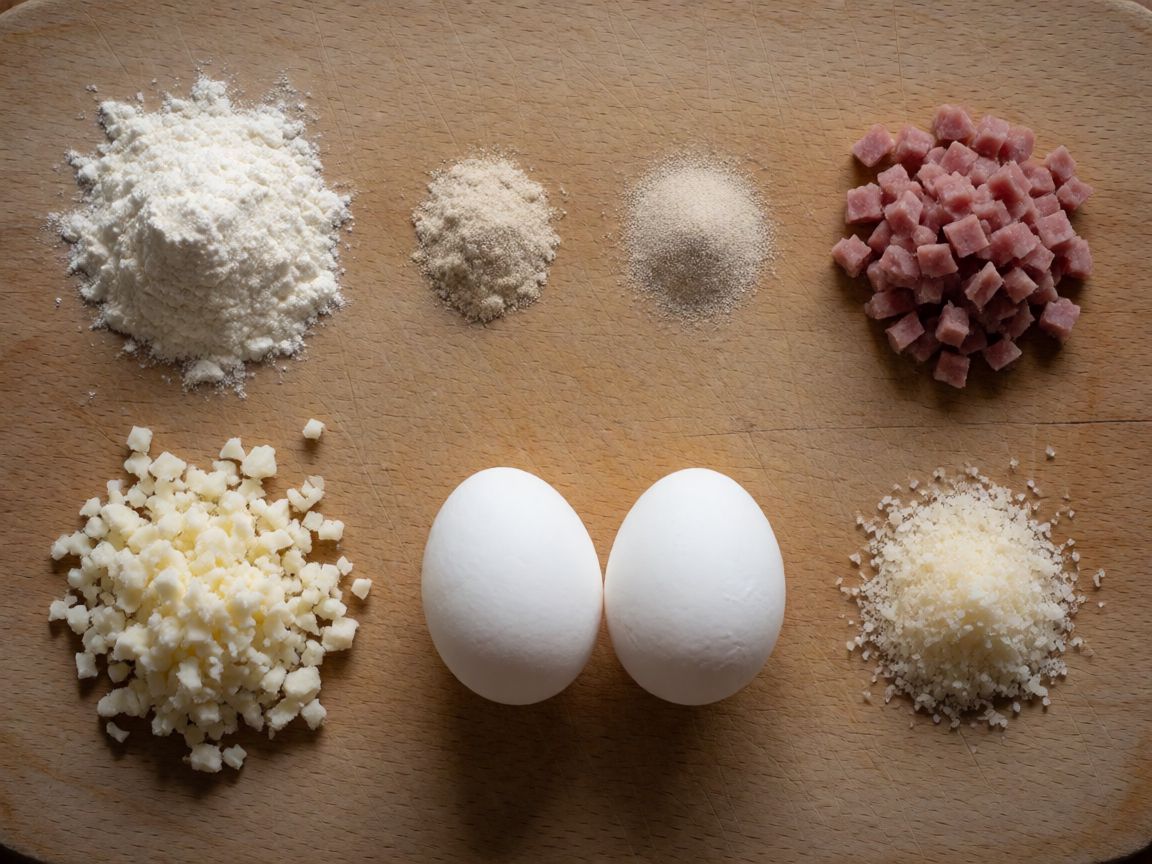
- 500 g Plain flour
- 100 g Lard
- 25 g Yeast
- 1 tbsp Black pepper
- 8 g Salt
- 260 g Water
- 350 g Cured meats cut into cubes (Salami Napoli, mortadella, ham, pancetta)
- 300 g Cheese mix caciocavallo, provolone
- 2 pcs Boiled egg cooked
- 50 g Pecorino
- Black pepper to taste





Steps
Dissolve the yeast in warm water in the bowl of a stand mixer, stirring with a spoon.
Add the flour and grind about 1 tablespoon of black pepper straight onto it.
Start kneading the dough; gradually add the lard in small pieces, continuing to knead energetically.
Once all the lard has been absorbed, add the salt and knead for a few more minutes until the dough is smooth and elastic.
Transfer the dough to a bowl greased with lard, cover with cling film and leave to rise.
120 minBoil the eggs for 8 minutes in boiling water, cool and cut into small cubes.
8 minCut all the cured meats and cheeses into cubes and mix them together in a separate bowl.
Roll out the dough on a lightly floured surface into a square.
Spread the cubes of cured meat and cheese over the dough, add the eggs, pecorino and pepper to taste.
Roll the dough into a tight log and shape it into a long rope.
Place the rope into a ring mould greased with lard, press firmly and check that no air pockets remain.
Leave the tortano to rise for another 2 hours, covered with cling film.
120 minBake at 180°C for about 50 minutes.
50 minRemove the tortano from the mould and let it rest for a few hours before slicing.
Tortano is a Neapolitan Easter bread, but calling it "bread" undersells it — it's a ring of enriched dough wound around a seam of cured meat and cheese, baked until the fat inside half-melts into the crumb. Think of it as the savoury cousin of panettone: same logic of a rich, slow dough, completely different filling, and it comes from the same place — using up the good stuff in the larder before a feast, in a pastry that can sit on a table for days.
What decides whether it works is the dough's structure, not the filling's variety. You can put almost any cured meat and cheese in there and it'll taste fine. But if the dough is slack, or under-proved, or rolled too thin at the shaping stage, the weight of all that salami and cheese will tear it open in the oven and you'll get a ring with a crater instead of a ring with a spiral. The dough has to be strong enough to hold a cargo, which is why the kneading is long and the lard goes in gradually rather than all at once — lard in big lumps just greases the gluten strands before they've formed and you end up with a dough that won't develop.
Some say a tortano needs a wood oven to get that bronzed, almost leathery crust. No — what it needs is even, dry heat for close to an hour, and a British fan oven does that perfectly well, arguably better than a domestic gas oven with hot spots. What a wood oven gives you that yours won't is a faint smoke note on the crust; nothing that changes the bite of the thing.
Start with the dough itself, because this is where most of the failures actually come from, long before anyone cuts the salami. Flour: a plain flour with modest protein is traditional here and it's not an aesthetic choice — too much gluten strength and the dough fights you when you try to roll it thin enough to spread the filling evenly; too little and it can't hold the weight of 350g of meat and 300g of cheese rolled into it. If your plain flour feels notably weak, a small spoon of strong bread flour mixed in won't hurt. Lard is the fat of choice because it melts at body temperature and leaves the crumb tender rather than greasy the way oil would, and because this is peasant food built around what a pig-slaughtering household had lying around — not a flavour statement, an economic one. If you don't keep lard, use a flavourless solid fat — any fat with no taste of its own that's solid at room temperature; a mild white vegetable shortening does the job, butter is a poor substitute here because its water content fights the dough and its flavour fights the filling.
The yeast quantity looks enormous to a British home baker used to a sachet of 7g dried yeast for a loaf — 25g is fresh yeast, and fresh yeast is roughly a third the strength by weight of dried, so don't panic and don't substitute gram-for-gram with dried from a packet; if fresh isn't sold near you, use about a third of the weight in fast-action dried, dissolved the same way in the warm water first so you can see it's alive before it goes anywhere near the flour.
The filling is genuinely where you can please yourself, and that's worth saying plainly because people treat this dish as if it has a sacred formula. Salami Napoli brings fat and chilli-edged spice, mortadella brings softness and a faint sweetness, ham and pancetta bring saltier, leaner notes — together they give you contrast in texture as much as flavour, which matters because a filling of all one cured meat goes monotonous by the third bite. The cheese mix of caciocavallo and provolone is chosen for how it behaves in heat: both are semi-hard cheeses that soften and go slightly stringy rather than oozing out through the seams, which a very soft cheese would do. If you can't get either, a good mature cheddar or a block mozzarella that's been drained hard will behave similarly enough — just avoid anything wet.
The boiled eggs are not there for flavour so much as for the slice — cut the tortano after baking and you want coins of yolk showing through the spiral, which is why they're diced small rather than left whole or halved; a whole egg buried in dough bakes unevenly and you risk a grey, rubbery yolk by the time the crust is done. Eight minutes gives you a yolk that's set but not chalky — if you're used to British timing, that's closer to what you'd call a firm-but-not-hard boiled egg; pull them the moment the white has fully set and cool them fast under the cold tap so the yolk doesn't keep cooking from residual heat.
The pecorino scattered at the end and the raw black pepper ground straight onto the flour are doing the same job from two directions — pecorino is sharp and salty enough to cut through all that fat, and the pepper, ground into the dough itself rather than just the filling, means every bite of crust carries a little heat instead of the pepper sitting as isolated pockets in the meat layer. Don't skip grinding it into the dough and think you'll make up for it in the filling — it's a different effect entirely, more background warmth than a bite of pepper.
On the two rises: the first, in the bowl, is about building the gas structure that will give you an open, light crumb rather than something dense; the second, once it's shaped into a ring with all that cold, heavy filling weighing it down, is about letting the yeast recover from the shock of being rolled flat and stuffed. Both need to go until the dough looks genuinely swollen and feels soft and pillowy when you press it, not just "has had two hours" — in a cooler British kitchen, especially without the under-floor warmth of a Neapolitan June, that two hours might need to become three. Patience here isn't a virtue tacked on for flavour — it's structural. A tortano baked before its second prove is finished doesn't rise much further in the oven; the oven spring you're hoping for from the heat has to come from yeast activity that's already built up, not activity the oven will somehow switch on.