
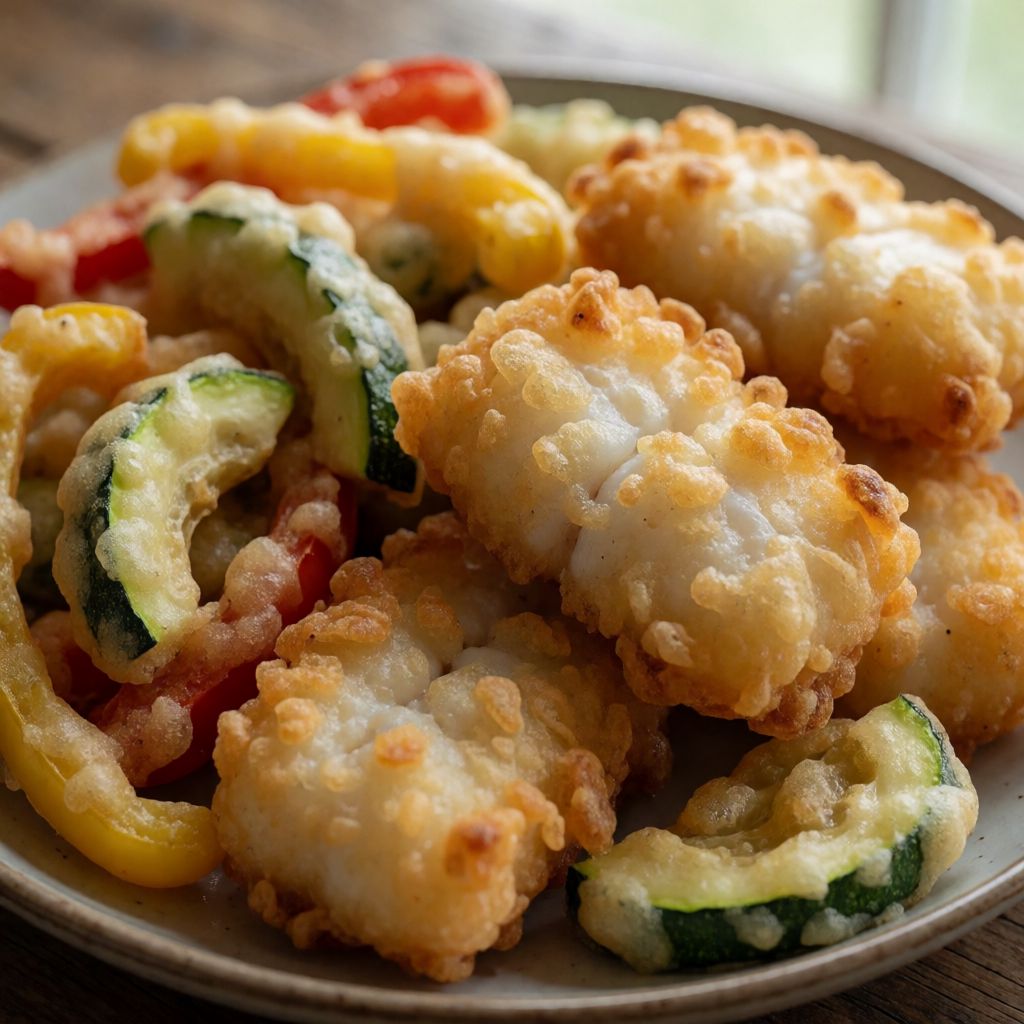
 AI photo
Battered Cod with Vegetables
Crispy battered cod served with lightly fried courgette and pepper.
Labels are worked out automatically from the ingredients and can be wrong. Check the packaging if it matters to you.
Ingredients
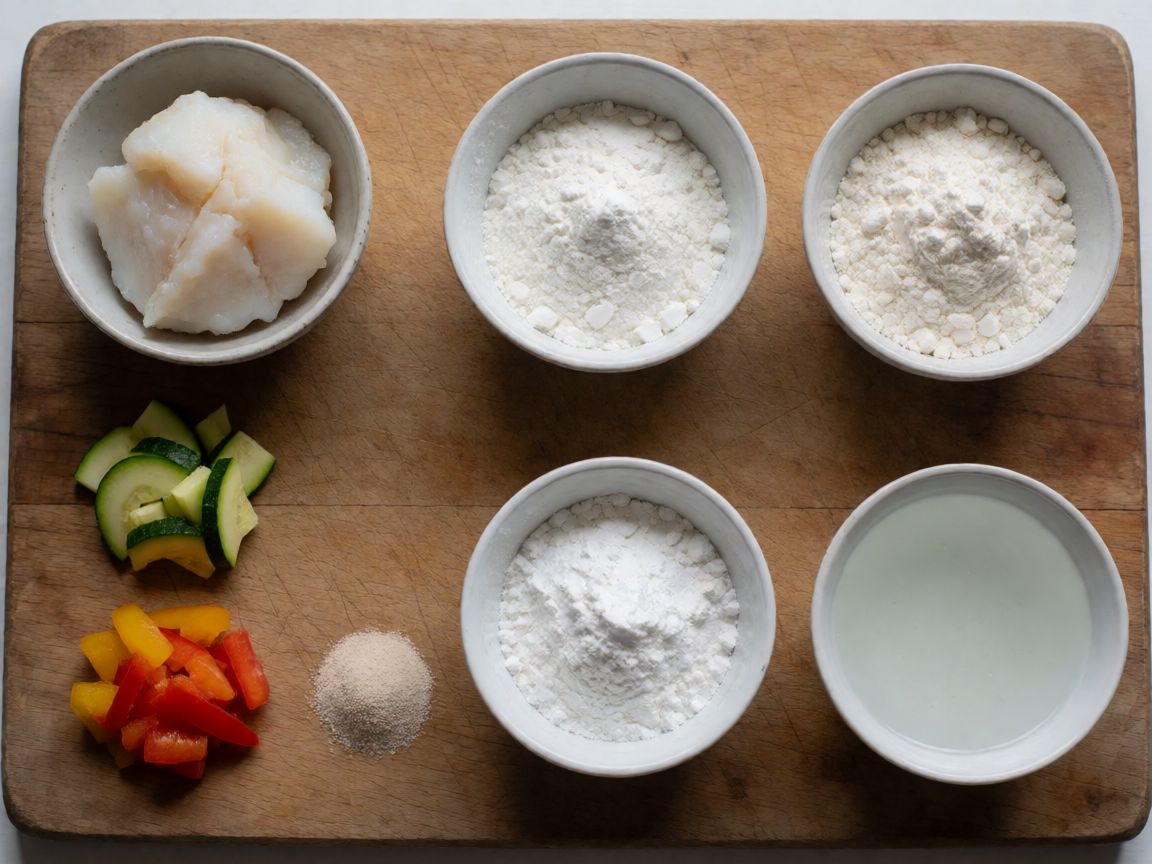
- 250 g Cod
- 70 g Courgette
- 100 g Bell pepper
- 35 g Rice flour
- 35 g Plain flour
- 70 g Potato starch
- 15 g Yeast
- 150 ml Sparkling water chilled
- Salt to taste
- Corn oil for frying



Steps
Heat a frying pan with oil until hot.
In a bowl, mix the plain flour, rice flour, potato starch and yeast; add the chilled sparkling water and whisk until the batter is smooth.
Dip the cod and vegetables in the batter and fry the fish until golden; check that it reaches an internal temperature of 63°C.
Remove the cooked fish, place it on a tray lined with paper towel and put it in the oven for a few minutes to keep warm.
Fry the vegetables until crisp.
Take the fish out of the oven, add the vegetables, season with salt and serve.
This is a fry-twice dish wearing the clothes of a fish supper: cod and two vegetables, dipped in the same batter, cooked in two separate turns in the same oil. It borrows from tempura — rice flour, cold fizzy water, speed — but it's not trying to be Japanese, it's trying to be crisp without being greasy, and that's a different problem.
What decides whether it works is not the fish, it's the oil temperature and the order of frying. Cod cooks fast and goes from translucent to opaque in a blink; crowd the pan or let the oil cool, and the batter sits there absorbing fat instead of sealing against it, and you get a soggy jacket round a dry fish. Fry the vegetables separately, after the fish, because they want a longer, hotter stay to go crisp, while the fish wants to be in and out. Put them in together and one of the two will be wrong.
Some say deep-frying wants the oil as hot as you can get it. No — too hot and the crust is brown and set before the cod's centre has gone from glassy to opaque, so you cut it open to raw fish under a biscuit. You're looking for oil that hisses and the batter puffs on contact within a second or two, not oil that spits and smokes. On a domestic hob, without a thermometer, that hiss and that puff are your gauge — drop in a teaspoon of batter first and watch it, before the fish goes anywhere near.
Cod: choose a fillet of even thickness, not the thin tail end tapering into nothing — an uneven piece means one end is done while the other's still glassy, and you end up overcooking the thick part to rescue the thin one. Any firm white fish that holds together in a fillet works the same way — haddock, hake, pollock — the mechanism doesn't care what fish it is, only that it's firm enough to survive being dipped and lowered without falling apart.
Courgette and pepper: thin cut, because the batter only seals the outside — it does nothing to cook the inside beyond what the oil's heat does through the crust. That's fine for pepper, which is pleasant with a bit of bite left in it, but if your courgette slices are thick you'll get a crisp shell round a vegetable that's still cold and raw in the middle. Cut them so the inside has a chance to catch up with the outside in the time the crust needs to crisp.
The batter is three starches doing three different jobs, not one flour doing everything. Plain flour has gluten, and gluten is what makes the batter cling to the fish instead of sliding off into the oil — but too much of it and the crust turns bready and tough instead of brittle. Rice flour has none of that gluten, so it crisps thin and shatters rather than chews — it's the ingredient doing the actual crunch. Potato starch is pure starch with nothing else in it, and pure starch blisters and browns fast in hot oil, giving you that lacy, blistered look rather than a smooth pancake coating. Take any one of the three away and the batter still works, just differently — less rice flour, less shatter; less starch, less blister; less plain flour, and it won't hold onto the fish at all. If you've only got one flour in the cupboard, cornflour (cornstarch) can stand in for the potato starch — same job, pure starch, no protein to toughen things.
The yeast is the odd one in this batter, because there's no time given for it to do what yeast normally does — there's no rest, no rise, straight from bowl to hot oil. I haven't tested this batter without it to tell you exactly what it's contributing, and I won't pretend I have. What I can tell you honestly: don't let the batter sit around waiting for the yeast to work, because that's not what it's there for in this recipe, and a batter left to sit develops gluten from the standing liquid and turns elastic instead of staying short — which is the opposite of what you want. Mix it, use it, don't let it wait on the counter feeling important.
Sparkling water, chilled, is doing two separate jobs and people often credit it with only one. The carbon dioxide gives you bubbles that expand the moment they hit hot oil, which is most of your lightness. The cold is a separate thing entirely — cold liquid slows the gluten in the plain flour from developing, so the batter stays short and brittle rather than stretchy. Some say "the fizzier the better," but fizz escapes the moment you pour it, so work fast once it's in the bowl — a flat sparkling water that's been open an hour has already given up the one thing it was there for.
Salt goes on at the end, after frying, not into the batter or onto the raw vegetables beforehand. Salt pulls moisture out by osmosis — season a courgette slice ahead of time and it weeps water onto the surface, and wet surface is exactly what stops batter from clinging and exactly what makes it spit in the oil. Corn oil is there for its lack of a flavour of its own and a smoke point comfortably above frying heat — the criterion is any oil that smells of nothing and can take the heat without smoking, so sunflower or groundnut oil do the same job. Leave the olive oil in its bottle for this one; it smokes too low and brings a taste you don't want fighting the fish.