
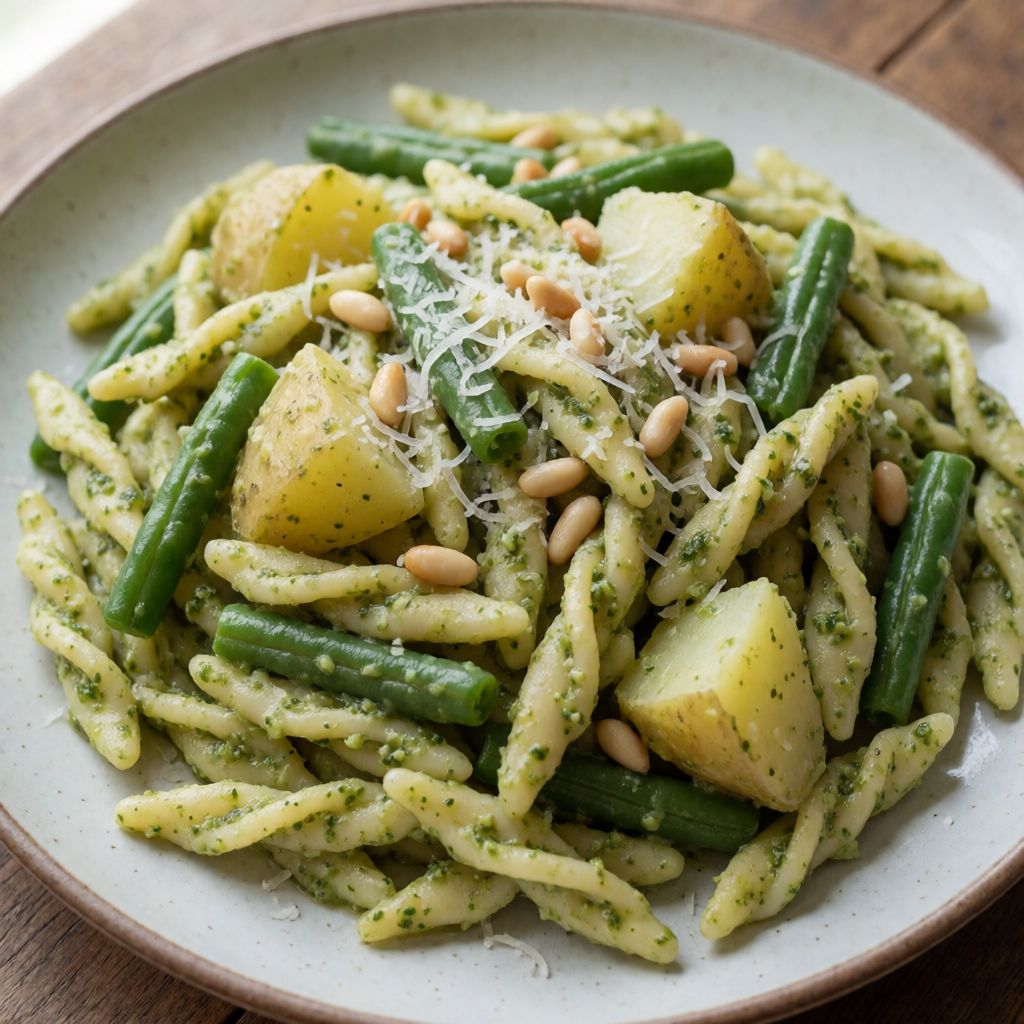
 AI photo
Trofie with Pesto, Potatoes and Green Beans
A classic Ligurian-style pasta: fresh basil pesto tossed with trofie, potatoes and green beans.
Labels are worked out automatically from the ingredients and can be wrong. Check the packaging if it matters to you.
Ingredients
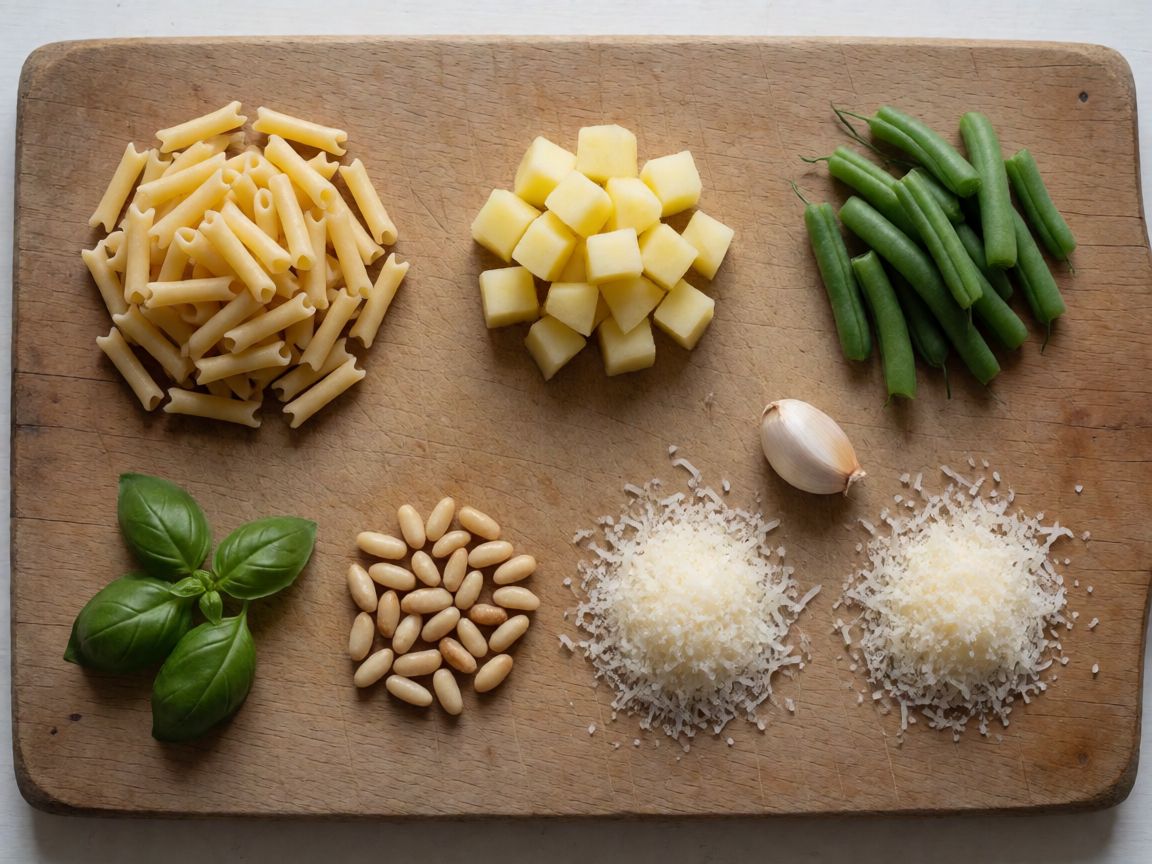
- 500 g Trofie
- 300 g Potatoes
- 150 g Green beans
- 70 g Basil
- 50 g Pine nuts
- 70 g Parmesan
- 20 g Pecorino Sardo
- 1 clove Garlic
- 100 ml Olive oil
- 3 g Coarse salt






Steps
Wash the basil leaves and gently pat them dry on a clean towel. In a mortar, crush the garlic with a pestle until creamy.
Add the basil leaves and salt, continuing to crush in circular movements.
Add the pine nuts and crush until the mixture is smooth and creamy.
Add the Parmesan and Pecorino Sardo and crush until fully combined.
Pour in the olive oil and work it through with the pestle.
Set the pesto aside to rest.
Trim the ends of the green beans and rinse them under running water.
Cut the potatoes into cubes and place them in a bowl of cold water.
Bring water to the boil in a pot, salt it, add the potatoes and cook.
7 minAdd the green beans and cook.
7 minAdd the trofie and cook for the time stated on the packet.
Drain everything together, transfer to a bowl and toss with the pesto, adding a little water if needed.
Serve with toasted pine nuts and fresh basil leaves.
This is a Ligurian dish built on one piece of economics: the Genoese coast had basil, olive oil and a trade route for pine nuts, but almost no flat land to grow much else — so potatoes and green beans went into the same pot as padding, and the pasta went in last to save washing a second pan. Nothing here is decorative. It's a poor port town's answer to "how do I feed four people with one pot of boiling water."
What decides whether this works is the pesto, and the pesto is decided by heat — or the total absence of it. A mortar and pestle crush and bruise; a blade spins and heats. Heat opens basil's cells and lets the chlorophyll meet oxygen and enzymes, and the green goes from grass to khaki inside minutes. So: some say you need a blender because who has time for a mortar — no, because the blender is exactly what ruins it. If you must use one, pulse in short bursts and let the blade cool between them, or just accept a less vivid green and a slightly bitter edge; that's the trade, not a failure.
Basil is the only ingredient that can't be substituted and still be this dish — swap it and you have a different pesto, fine on its own terms, just not this one. Buy it with the stems still a bit firm and the leaves dry; wet basil bruises in the bag and starts that same oxidation you're trying to avoid in the mortar. Pat it properly dry before you crush it — water dilutes the oil's grip on flavour and thins the sauce before it's even made.
Garlic goes in first and alone because a dry clove crushes to a paste far more easily against stone than it will once it's fighting wet basil leaves for space — crush it to cream, not chunks, or you'll bite into a hot raw lump later. If raw garlic repeats on you, halve it, or use a clove that's just started to sprout — milder, less aggressive, still does the job.
Pine nuts are there for fat and a soft, resinous sweetness; they're also the most expensive thing in the bowl, which is why Genoese cooks have always used fewer than you'd expect and leaned on olive oil to carry the rest. If the price puts you off, walnuts give a similar oiliness with a rounder, slightly bitter note — not the same pesto, but the same idea: a nut with enough fat to emulsify, not a dry one like almonds that will just sit there.
The two cheeses aren't interchangeable with each other, and that's deliberate: Parmesan gives savoury depth and body, Pecorino Sardo (a sheep's cheese, sharper and saltier than Pecorino Romano) gives the edge that stops the whole thing tasting flat and milky. If you can't find Pecorino Sardo, Pecorino Romano gets you most of the way — use a touch less, it's saltier still. All-Parmesan works, it just reads softer, more polite.
Olive oil here is doing two jobs — flavour and emulsion — so "any oil with no smell of its own" is exactly the wrong criterion for once; you want oil with a smell, something peppery and grassy, because it's not hiding behind other fats the way it does in a stew. A bland supermarket oil will make a technically correct pesto that tastes of nothing in particular.
On potatoes: waxy ones hold their cube shape in the boil; a floury baking potato will start sloughing apart and cloud your water with starch before the beans and pasta even go in. If that's what's in the cupboard, cut the pieces a touch larger to buy yourself some structural margin.
Last thing, and it's not a minor one: let the pesto rest before you toss it, and don't rush the mortar work either. Patience here isn't sentimental — it's the difference between oil that's been worked into the paste and oil that's just sitting on top of it, which is what you get if you dump it all in and stir twice. Thirty seconds of unhurried circular pounding does more than the ingredient list suggests.