
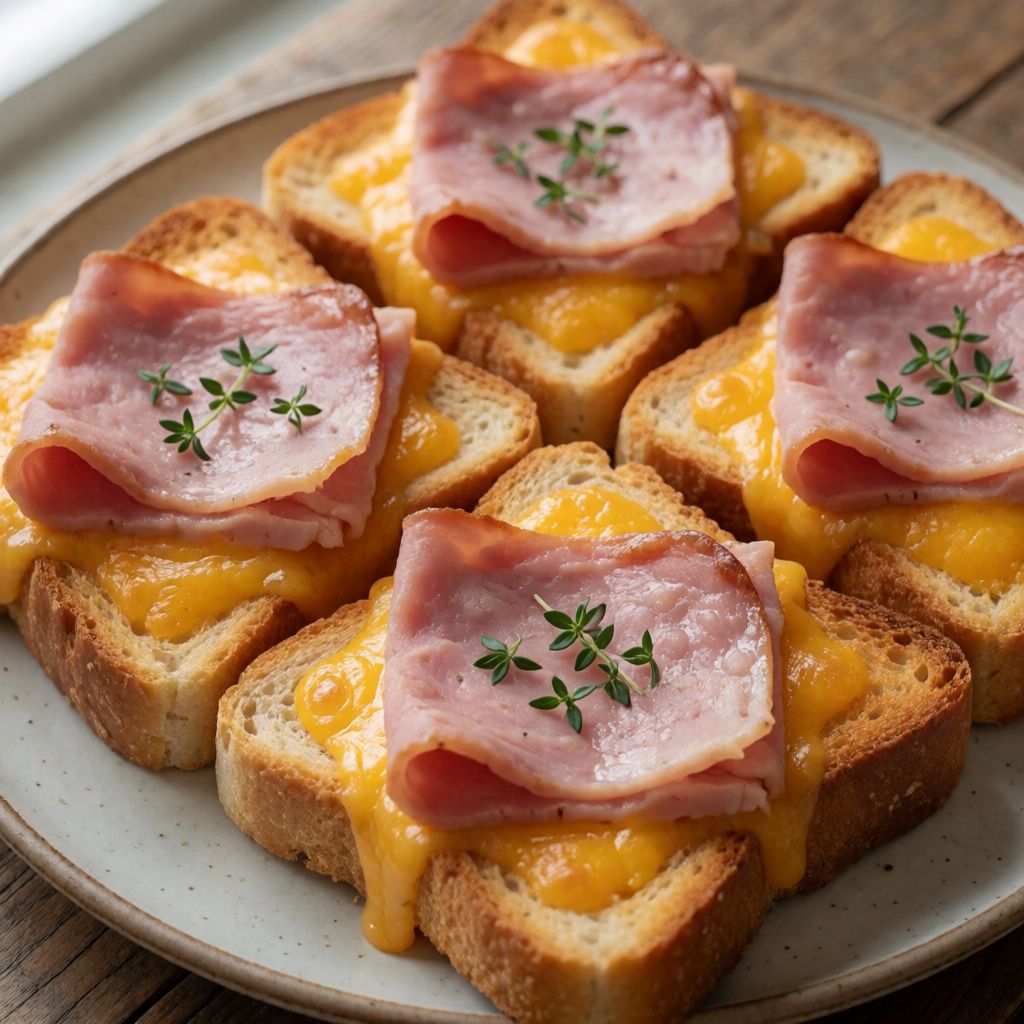
 AI photo
Truffle Toast
A quick toasted sandwich with truffle tapenade, ham and melted cheese, buttered and crisped until golden.
Labels are worked out automatically from the ingredients and can be wrong. Check the packaging if it matters to you.
Ingredients
- 8 pcs Bread
- 4 pcs Ham sliced
- 2 tbsp Truffle tapenade
- 2 pcs Thyme sprigs
- 150 g Mature cheddar finely grated
- 20 g Butter




Steps
Spread the truffle tapenade onto the bread slices.
Top with the ham, freshly grated mature cheddar and thyme.
Cover with another slice of bread and butter the outside.
Toast until golden and crisp in a toaster or on a hot pan.
15 min
What was changed
Replaced the cheese with Mature cheddar, which British cooks are more likely to have on hand for toasting.
This is a grilled cheese built around ham and a truffle paste instead of mustard — same mechanism as any toastie, just with more perfume in it. Two slices of bread become a sealed little oven: the outside has to brown and crisp while the inside — cheese, ham, that truffle paste — has to come up to melting temperature. Everything that can go wrong with this dish comes from those two things happening at different speeds.
The heat decides it. Not "medium" — that tells you nothing about what's happening to the butter or the cheese. What you're after is a pan hot enough that the butter foams and starts to smell faintly nutty within half a minute of contact, but not hot enough that it spits and browns black before the middle has had its three or four minutes to catch up. If the crust is dark and the cheese inside is still cold and stiff, the pan was too hot and you rushed it — that's the one defect this dish actually has, and it's always a heat problem, never a timing problem, whatever the clock tells you.
Doneness is cheese pushing at the edges, not a number of minutes. You'll see it start to go glossy and slump at the rim of the sandwich before you ever cut into it — that's your cue, the fifteen minutes in the method is a floor, not a target. Press the sandwich gently with a spatula partway through; it should give like a ripe pear, soft but not collapsing, and that's the melt you're chasing.
Bread is the shell, and its job is structural more than flavourful: it has to hold its shape while the inside goes soft, so something with a bit of crumb to it — a decent sandwich loaf, sourdough, anything that isn't too airy or too thick — works better than a crusty bloomer, which insulates so well the middle stays cold long after the crust has gone the colour of a conker. If your only bread is thick-cut, slice it down; you're not after toast-shop thickness, you're after heat getting through in a sensible time.
Butter on the outside isn't just for crispness, it's for colour — the milk solids in it brown the way oil never will, which is why toast made in oil looks pale and sad next to toast made in butter. The trade-off is that those same milk solids scorch at a lower temperature than a clean oil would, which is exactly why you can't just crank the pan up to speed things along. If you're out of butter, any fat that browns — ghee, ideally, since the milk solids are already separated out and won't catch as easily — will do the job; a flavourless oil will crisp the bread but leave it looking and tasting flat.
Mature cheddar is doing more work here than people give it credit for. Ageing breaks down the proteins and dries the cheese out a little, which is exactly what makes it melt loose and stringy instead of just going greasy and separating — a mild, young cheddar holds its shape under heat and never quite gives you that pull. Finely grating it isn't fussiness either: more surface area means it melts through in the time the bread needs to brown, instead of sitting there in a half-melted lump while the crust burns around it. Any hard cheese that goes soft and glossy rather than oily under heat will substitute — a mature Red Leicester, an aged Gouda — just avoid anything rubbery like a fresh mozzarella, which needs far longer and far gentler heat than a sandwich gives it.
Truffle tapenade is an olive paste carrying truffle aroma, and it's worth knowing that most truffle products on a supermarket shelf get their smell from a lab-made aroma compound rather than actual truffle — that's not a scandal, it's just economics, real truffle doesn't keep and doesn't scale, so don't go hunting for the real thing here, use it sparingly either way because the aroma is the point and too much turns bitter and one-note. If you've none in the cupboard, a mushroom pâté with a splash of good olive oil gets you the same dark, earthy backing note, just without the specific perfume.
Ham only needs to come up to temperature, not cook, so its real job in the sandwich is to not add water — a wet slice straight from a packet steams the bread from inside and that's your other common failure, a soggy centre that never crisps no matter how long you leave it on the heat. Pat it dry if it's come out of liquid, and use a ham sliced thin enough to warm through in the time the cheese takes to melt.
Thyme goes in raw and stays raw — it's there for the sprigs to steam gently against the warm cheese and throw a little resinous smell up through the sandwich when you cut it, not to be cooked in any real sense. Strip the leaves off the stalk rather than laying in whole sprigs, which just burn at the edges and taste of nothing but ash. And once it's off the heat, give it a minute before you cut — the cheese needs that short rest to set just enough that it stays in the sandwich instead of running out onto the board the second the knife goes in. That minute is patience doing its job; it costs you nothing and saves you the mess.