
 AI photo
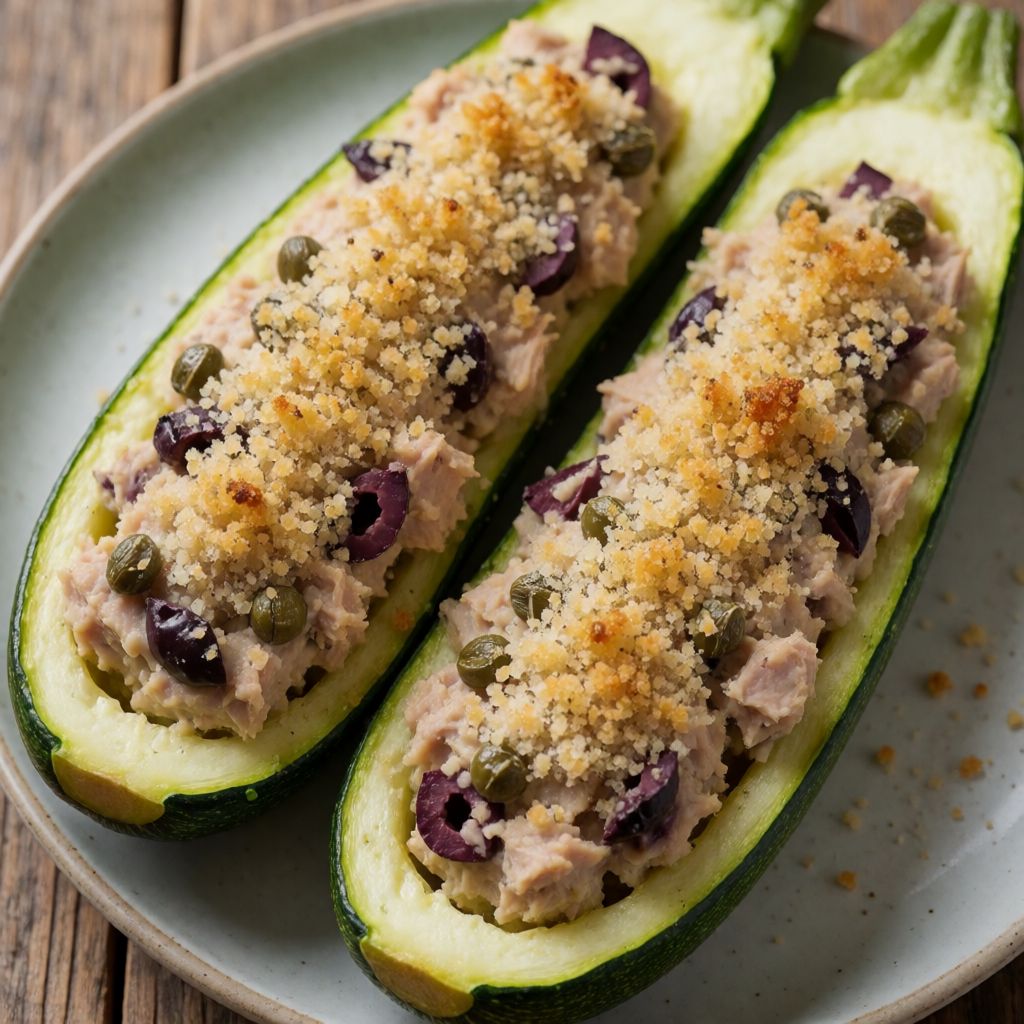
Tuna-Stuffed Courgettes
Courgettes hollowed out and filled with a creamy tuna, caper and olive mixture, then baked until golden.
Labels are worked out automatically from the ingredients and can be wrong. Check the packaging if it matters to you.
Ingredients
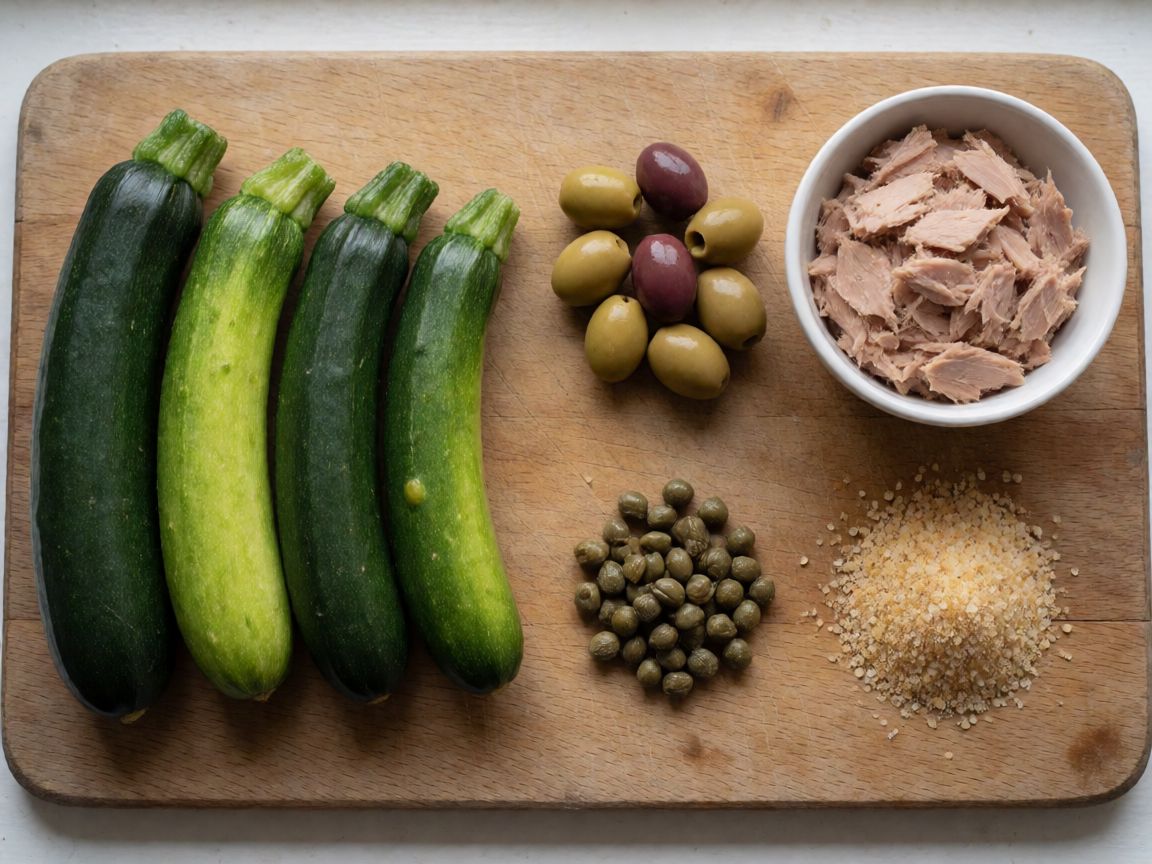
- 4 pcs Courgettes about 700 g
- 180 g Tinned tuna
- 50 g Taggiasca olives
- 1 tbsp Capers to taste
- 65 g Breadcrumbs
- 1 tbsp Olive oil to taste
- 1 pinch Salt to taste






Steps
Wash the courgettes and trim the ends, then boil them in salted water.
8 minDrain and cut the courgettes in half lengthways with a sharp knife.
Scoop out the flesh with a spoon and transfer it to a bowl to cool.
Add the tinned tuna, capers and Taggiasca olives to the cooled flesh.
Add salt to taste and mix.
Transfer everything to a blender and blend until smooth and creamy.
Add the breadcrumbs and stir in with a spoon.
Arrange the courgette halves on a baking tray lined with baking paper and fill them with the stuffing.
Press the filling down firmly with a spoon.
Sprinkle breadcrumbs and drizzle olive oil over each half.
Bake in a preheated fan oven at 180°C.
35 min
This is a courgette shell doing a job it wasn't built for: holding its shape while someone piles tuna and olives into it and bakes it twice as hot. What decides whether it works is the first boil — too long and you've made soup, not a boat.
You boil the courgette whole, before you cut it, for a reason that has nothing to do with speed. A whole courgette poached gently cooks from the outside in and keeps its skin as a wall. Cut it first and salted water gets into the flesh fast, turns it to mush, and you've got nothing to stuff. Eight minutes is the lower bound here — what you're actually watching for is the skin losing its squeak when you press it, going from "raw thud" to "gives a little." Push a knife tip in: it should slide, not crunch.
The filling is really a paste, not a stuffing in the pilaf sense — tuna, olives, capers and the scooped courgette flesh go into the blender together, which is the bit people skip because it looks like one step too many. Skip it and you get a lumpy, watery mix that slides off the shell in the oven. Blended, it binds into something closer to a spread, and the breadcrumbs you fold in afterwards are there to drink up any leftover water so the filling holds its shape under heat instead of weeping into the tray.
Some say tuna needs more than salt to taste of anything — no, because tinned tuna already carries its own salt and the brine it sat in, and the olives and capers are both salty by nature. Add more without tasting first and you've built a dish you can't eat without water nearby.
The second bake, at 180°C fan, is doing something different from the boil: it's not cooking the filling — tuna's tinned, already cooked, the courgette flesh is already soft — it's drying the top and warming the shell through so hot and cold don't fight each other on the plate. Thirty-five minutes is long for something that's technically already edible, and that's the real giveaway: this bake is about colour and a crust on the breadcrumb topping, not about safety. Watch the top, not the clock — you want it gone from pale and dusty to properly golden, with the oil you drizzled on having soaked in rather than sitting in a puddle. If your oven runs hot at the back, as most domestic fan ovens do unevenly, turn the tray halfway — nobody tells you this because it's not a "step," it's just kitchen sense.
Courgettes: pick the smaller, firmer ones, because what you need from them here is a wall that holds, not a watery marrow-adjacent vegetable that's mostly seeds. A courgette that's gone soft and bendy before cooking will never give you a shell worth filling — it'll collapse under its own stuffing. 700g for four pieces means you're looking at a reasonably substantial courgette each, enough that once halved and hollowed there's a real cavity, not a sliver.
Tinned tuna: buy it in oil if you can, drained — the oil carries flavour the water-packed tins don't, and since you're adding oil separately anyway for the drizzle, the tin's own oil isn't wasted, it's part of why the filling tastes of something beyond "fish." If all you have is tuna in water, it's not a disaster, but taste and adjust — you may want a touch more oil in the mix itself to stop the filling baking dry.
Taggiasca olives are small, dark, mild and mostly flesh around a thin stone — they bring a gentle bitterness without the harsh brine-punch of a big green olive. Any black olive with a soft, not sharp, flavour will do; what you're substituting for is the quality of "quietly savoury," not the specific Ligurian provenance. A loud Kalamata will fight the tuna instead of backing it up.
Capers: these are the sharp note, vinegar or brine depending on how they're cured, and "to taste" in the ingredient list is not laziness — it's an instruction, because capers vary wildly in strength tin to tin, jar to jar. Start with less than you think; you can't take it back out.
Breadcrumbs do two jobs here and that's worth knowing because it tells you what you can swap. Inside the filling, they're there to absorb moisture so the mix sets rather than seeps. On top, they're there to go crisp and brown under heat, giving you texture against the soft filling underneath. Any dry, plain crumb works — stale bread grated yourself, or bought dried crumbs — just avoid anything pre-seasoned, since you've already got salt coming from three other places in this dish.
Olive oil: use one with little aroma for the filling, since you don't want it fighting the tuna, and save a more fragrant one, if you have it, for the final drizzle where its smell actually reaches you before the first bite. Any neutral vegetable oil can stand in for the cooking itself, but olive oil earns its place here specifically on top, where its flavour isn't cooked away.
This isn't a fast dish despite the short ingredient list — the boiling, cooling, scooping and blending all want their own unhurried minute, and rushing the cooling before you mix in the tuna just means a warm, slightly sweating filling that won't hold together. Let it sit. Patience here is doing the structural work that no amount of breadcrumb can fix later.