
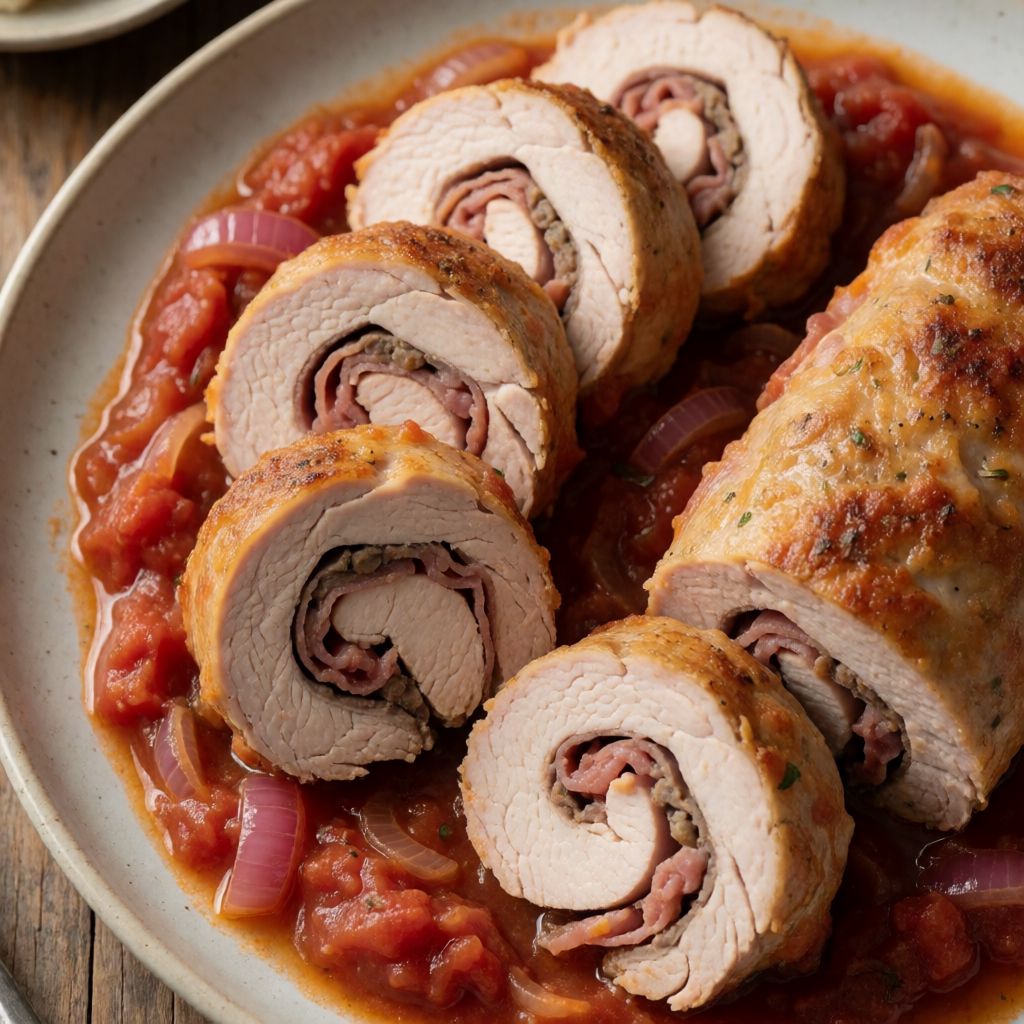
 AI photo
Turkey Breast Roulade with Prosciutto and Fontina
A turkey breast roulade stuffed with prosciutto and fontina, braised with onion, white wine and tomatoes.
Labels are worked out automatically from the ingredients and can be wrong. Check the packaging if it matters to you.
Ingredients
- 800 g Turkey breast
- 100 g Prosciutto
- 150 g Fontina
- 1 pcs Red onion
- 250 ml White wine
- 5 pcs Tinned plum tomatoes
- Vegetable stock as needed
- Olive oil to taste
- Salt to taste
- Black pepper freshly ground, to taste








Steps
Slice the fontina thinly.
Butterfly the turkey breast and lay it out on a large chopping board.
Evenly layer it with the prosciutto and fontina slices.
Season with freshly ground black pepper and carefully roll the meat into a roulade.
Tie the roulade tightly with kitchen string and set aside.
Peel the red onion and chop finely.
Fry the onion in olive oil in a large pan.
When the onion is lightly golden, add the turkey roulade and brown on all sides over low heat.
Pour in the white wine and let it evaporate.
Add the tinned plum tomatoes, lightly mashed with a fork, and a little hot vegetable stock.
Stir, cover with a lid and braise for about 30 minutes.
30 minCheck that the thickest part of the roulade has reached an internal temperature of 74°C.
If the sauce becomes too thick or dry, add a little more hot vegetable stock.
Remove the string, slice the roulade into medium-thick slices and serve with the sauce.
This is a roast dinner dressed up as a braise — a turkey breast rolled around ham and cheese, browned, then simmered in wine and tomato until it cooks itself tender from the inside out. What decides whether it works isn't the rolling, which is just fiddly, but the heat you use at every stage and whether you trust the thermometer over the clock.
Turkey breast alone is a lean, dry muscle — it has almost no fat to protect it, which is exactly why plain roast turkey breast goes to cardboard the moment you overshoot it. Wrapping it around fontina and prosciutto solves that problem from inside: the cheese melts and bastes the meat as it cooks, the prosciutto's fat and salt season the whole roll from within. So this isn't decoration, it's insuration.
Browning the roulade before it goes anywhere near liquid is not about "sealing in juices" — that's an old kitchen myth, searing doesn't seal anything, meat is not a bag. What browning does is build flavour through the Maillard reaction on the surface, which the gentle wine-and-tomato braise afterwards can't produce on its own. Skip it and the dish tastes flat, not drier.
The tomato and wine liquid isn't really a sauce you make — it's a medium that keeps the roulade from drying while the inside slowly climbs to a safe, juicy doneness, and then it reduces into a sauce as a side effect of patience.
The number that actually matters here is 74°C at the thickest part, not "about 30 minutes." Thirty minutes is a reasonable guess for how long a rolled turkey breast of this size takes over gentle heat, but roulades vary — a tightly tied, thick roll takes longer than a loose, thin one. On a domestic hob, without a kazan's steady, radiant heat, your flame will run hotter or cooler than you think, so use the thermometer as the actual test and the clock as the minimum you shouldn't rush past.
"Low heat" when you brown the roulade isn't vague for the sake of it — it means hot enough that the surface colours and the fat renders, but slow enough that the outside doesn't finish cooking while the inside, wrapped thick with cheese and ham, is still cold. A domestic ring run on full gives you scorched string marks and a raw centre. Go in cautious, you can always turn it up.
Fontina is chosen because it melts smoothly without splitting into grease and without stringing like mozzarella — any semi-firm, good-melting cheese with a bit of nuttiness does the same job: a young Gruyère, an Emmental, even a mild Taleggio if you want it funkier. What you're choosing for is meltability and a flavour that can stand next to cured ham, not a particular Italian label.
Prosciutto's job is salt and fat in thin sheets that lie flat against the meat — if you can't get it, any dry-cured ham sliced thin will do the same: Serrano, a good UK dry-cured bacon even, as long as it's sliced thin enough to roll without tearing. What you lose with substitutes is sweetness, not function.
The tinned plum tomatoes "lightly mashed with a fork" matters more than it sounds — you want broken pulp, not a smooth purée, so the sauce still has body and bite rather than becoming a soup. White wine is there to deglaze the pan — picking up the browned bits stuck to the bottom — and to add acidity that cuts through the cheese and ham's richness; any dry white does this, there's no need for anything special, you're boiling off the alcohol anyway.
Tying the roulade with string isn't ceremony, it's structural: without it the layers slide apart the moment you turn the roll in the pan, and you end up frying loose cheese instead of a roast. If string unsettles you, a few toothpicks holding the seam shut will do in a pinch, though you'll need to count them out before serving. And resting it under the lid, braising rather than roasting dry in an oven, is the one real concession to a British kitchen without a proper oven-safe pan: a wide frying pan with a lid, or a plate pressed over the top if you're short a lid, holds in enough steam to finish the job on the hob alone.