
 AI photo
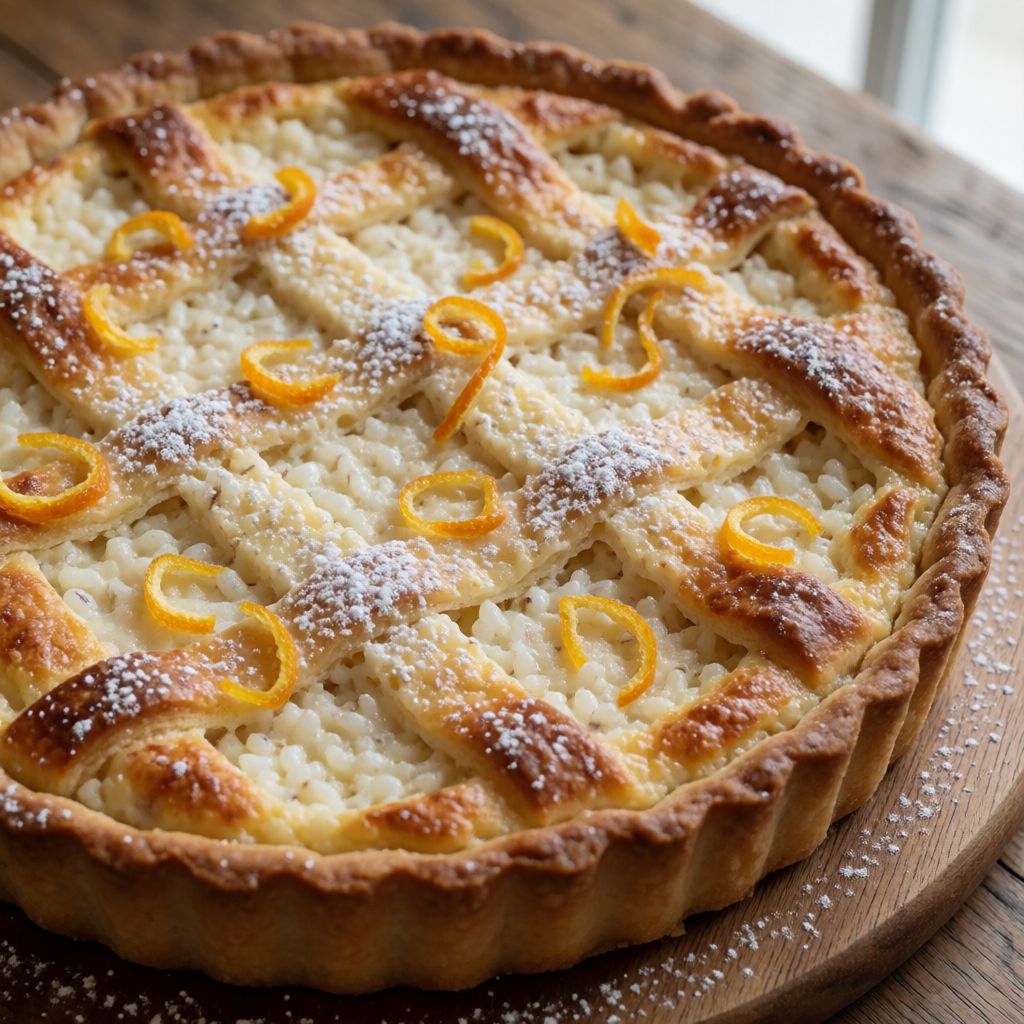
Tuscan Rice Tart
A Tuscan rice tart combining a buttery orange-scented pastry with a creamy rice and custard filling.
Labels are worked out automatically from the ingredients and can be wrong. Check the packaging if it matters to you.
Ingredients
- 1 tbsp Caster sugar for sprinkling before baking
- 1 tbsp Butter for the tins
- 1 tbsp Icing sugar for dusting



Pastry
- 50 g Wholemeal flour
- 50 g Plain flour
- 75 g Butter
- 1 pcs Eggs
- 25 g Caster sugar
- 1 pcs Orange for grated zest
- 1 pinch Salt





Rice filling
- 600 ml Milk
- 100 g Pudding rice
- 1 pcs Vanilla pod for the seeds
- 25 g Caster sugar
- 0.5 tsp Salt



Custard
- 40 g Caster sugar
- 1 pcs Egg yolk
- 25 g Plain flour
- 1 pcs Vanilla pod empty, the one left over from the rice filling
- 200 ml Milk
- 1 pcs Orange for grated zest

Steps
Mix the flour, salt and grated orange zest. Rub in the butter, then work in the egg to form a smooth dough.
5 minCover the dough and let it rest in the fridge for 1 hour.
60 minFor the rice filling, put all the ingredients in a saucepan and bring to the boil, stirring. Lower the heat and simmer until the rice is tender, stirring regularly. Remove from the heat, tip the rice into a bowl and leave to cool in the fridge. The mixture should turn out soft and tasty.
For the custard, whisk the sugar, flour, grated lemon and orange zest and egg yolk together in a bowl until smooth.
3 minBring the milk to the boil with the empty vanilla pod in a small saucepan. Once boiling, remove the pod and pour a little milk into the egg mixture while whisking with a hand mixer.
2 minGradually add the rest of the milk, then pour everything back into the saucepan and heat, stirring, until the custard thickens. Let the custard cool, then mix the cold custard with the cold rice until smooth.
Roll out the dough to a thickness of 2-3 mm and cut pieces to fit small tartlet tins or a muffin tin.
Fill the tartlets with the rice and custard mixture, sprinkle with a little sugar and bake in the oven at 175°C (fan) for about 20 minutes.
3 minRemove from the tins, leave to cool and dust with icing sugar before serving.
15 min
This is a Tuscan pastry shop staple — torta di riso — reduced to tartlet size for a muffin tin, because that is what sits in most cupboards and nobody in Tuscany owns a muffin tin either, they bake it as one big tart in a loose-based ring. The idea is simple and slightly odd if you've never met it: rice, cooked soft in milk, bound with a proper pastry-cream custard, sitting inside a short orange-zested pastry shell. Not a rice pudding tart. A custard tart that happens to have rice suspended in it.
What decides whether it works is whether you treat the rice-milk stage and the custard stage as two separate jobs and only marry them when both are cold. Rice cooked in milk is starchy and a bit gluey on its own — eaten straight from the pan it tastes of nursery food. The egg-yolk custard, on its own, is silky but thin-bodied for a filling that has to hold its shape once baked and cooled. Combine them hot and you get a split, grainy mess, because hot custard thinned further by hot rice liquid never sets properly once it's back in the oven. Combine them cold and the starch from the rice and the set egg-flour custard lock together into something that slices cleanly — soft, but not wet.
The two flours in the pastry are a compromise, not a style choice. Wholemeal alone makes a dough that's heavy and crumbly — too much bran cuts the gluten strands short, so it won't hold a tartlet shape when you unmould it. All plain flour gives you a shell with no character against a sweet, orange-scented filling. Half and half gives enough structure from the plain flour and enough texture and faint nuttiness from the wholemeal to actually taste like something next to the custard. If you've only got plain flour in the house, use it — the tart won't suffer much, it'll just be quieter.
The butter in the pastry wants to stay cold and get rubbed in, not melted and stirred in — rubbing coats the flour grains in fat before any liquid arrives, which is what keeps the dough short rather than tough. In a British kitchen this is the exact same logic as shortcrust for a jam tart; nothing exotic here, just the same mechanism dressed with orange zest instead of nothing.
Pudding rice is doing a specific job: it's a short, round-grain rice bred to release starch and go creamy under slow cooking, the same family as the rice you'd use for rice pudding on a Sunday. Basmati or long-grain will not behave the same way — the grains stay separate and the filling won't bind, it'll just be custard with grains of rice floating in it rather than a cohesive mass. If pudding rice isn't to hand, arborio (risotto rice) is close enough in starch behaviour to substitute.
The milk, split across two stages — 600ml for cooking the rice, 200ml for the custard — is simply there because rice needs a generous amount of liquid to cook through gently without catching, while the custard needs only enough to carry the egg yolk and flour into a pourable cream. Don't be tempted to use less for the rice stage; a saucepan with too little milk and a lot of starch scorches on the bottom before the rice is tender, which is the actual reason recipes tell you to stir regularly rather than walk away — not fussiness, just physics on a domestic hob where the heat isn't as evenly spread as people assume.
The vanilla pod appears twice for a reason worth noting rather than ignoring: it's infused once in the rice-milk, then — "empty," the recipe says, meaning already scraped of seeds — infused again in the custard milk. Nothing wasted. One pod, two jobs, because vanilla pods are expensive and a Tuscan pastry cook isn't going to throw out a perfectly good husk after one use. If you don't have a pod, a small spoon of vanilla extract added at the same point in each stage does the job, just less quietly.
The orange zest, going into both the pastry and the custard, is the flavour spine of the whole thing — citrus against dairy and starch, which otherwise risks tasting like not much at all. Some versions use lemon zest instead or alongside; use whichever your orange smells more interesting, because a tired supermarket orange with a thick dull skin gives you bitterness from the pith and little scent from the oil. Zest only the coloured skin, nothing white beneath it.
Resting the dough for an hour in the fridge isn't tradition for tradition's sake — it lets the gluten that did form while mixing relax, so when you roll it out to line small tins it doesn't spring back and shrink in the oven, leaving you with tartlet cases shorter than their filling. Skip the rest if you're short on time and you'll mostly notice it at the edges of the tins, where shrunk pastry means the custard overflows and catches on the metal.