
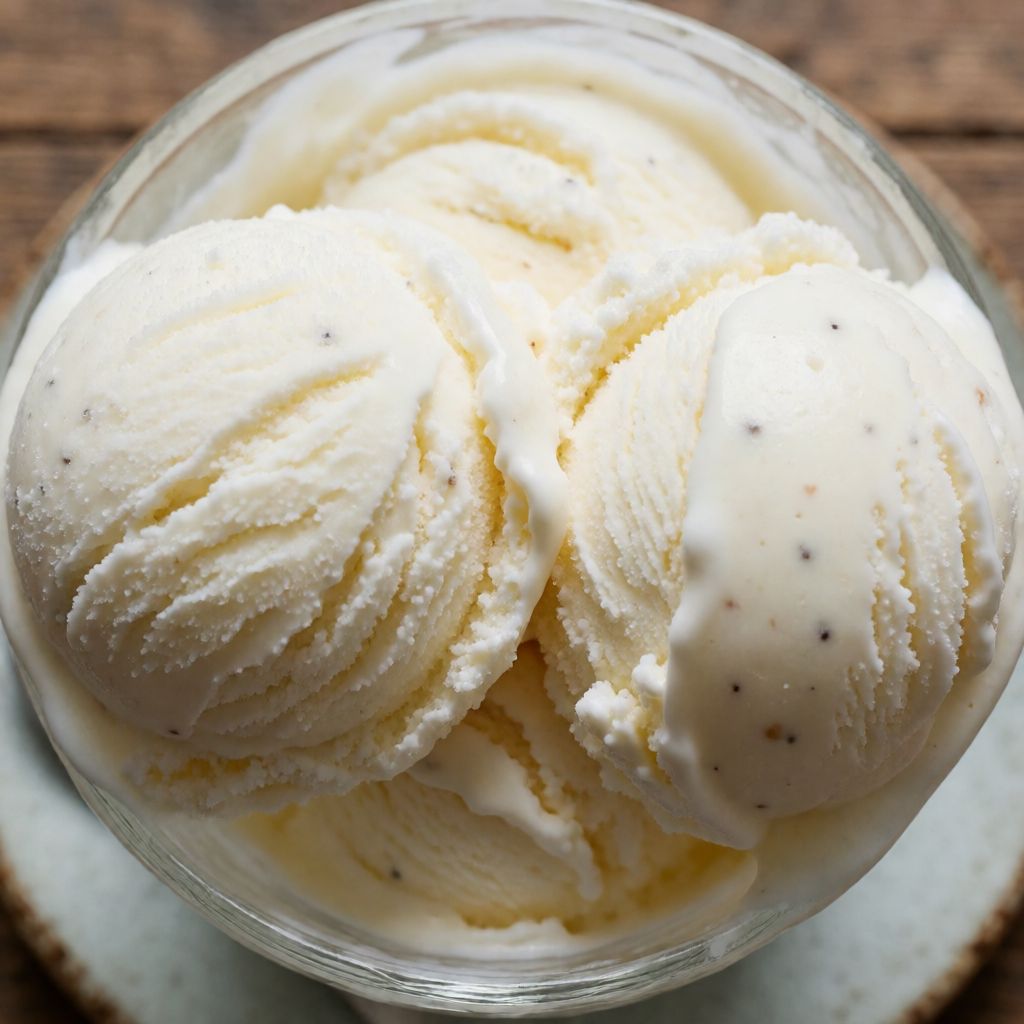
 AI photo
Vanilla Ice Cream
A classic creamy vanilla ice cream made with egg yolks, cream and a real vanilla pod.
Labels are worked out automatically from the ingredients and can be wrong. Check the packaging if it matters to you.
Ingredients
- 1 pcs vanilla pod
- 300 ml milk
- 500 ml whipping cream
- 6 pcs egg yolks
- 130 g caster sugar




Steps
Cut the vanilla pod lengthwise and scrape out the seeds. Put the empty pod in a saucepan with the milk and cream and bring to the boil, up to 90°C.
10 minWhisk the egg yolks, vanilla seeds and sugar until thick and airy.
5 minSlowly pour the hot vanilla cream into the egg mixture, whisking constantly until well combined. Pour the mixture back into the saucepan and heat gently to 80°C.
10 minTransfer the vanilla custard to a covered container and chill in the fridge for at least 1 hour.
60 minPour the vanilla custard into an ice cream maker and churn until it reaches the consistency of thick soft-serve ice cream.
15 minTransfer the ice cream to a container and freeze for at least 2 hours.
120 min
This is custard frozen while being stirred — nothing more mysterious than that. Crème anglaise, the French pouring custard you'd put over a pudding, except here it goes into a machine that keeps scraping it off its own cold walls as it hardens, so it never gets the chance to set into one solid sheet of ice. Two different jobs are happening and both have to go right: the yolks have to thicken the liquid into custard, and the churning has to keep the ice crystals too small for your tongue to notice. Fail either one and you get something that's either soup or gravel, never ice cream.
The two temperatures in this recipe, 90°C and 80°C, aren't decoration — they're the narrow gate egg proteins pass through. Below about 70°C yolks don't thicken anything, they're just yellow water. Above about 85°C they clump into curds — you've made sweet scrambled egg, and no amount of whisking brings it back. So the milk and cream get brought close to boiling (90°C, just shivering at the rim, not a rolling boil — boiling drives off the vanilla's aroma and can scorch milk sugars on the pan bottom), then poured slowly onto the yolks so the heat arrives gradually and evenly, not as one scalding shock. The custard then goes back on heat only to 80°C — hot enough to finish thickening, cool enough to stay smooth. Some people say custard curdles because you used too many yolks. No — it curdles because the heat arrived too fast or too high. Ratio has nothing to do with it; timing and temperature do.
Vanilla pod: you're buying two things from it — the seeds, which are flavour, and the empty pod, which you boil in the milk for aroma and then usually fish out. Real pods are expensive because the vanilla orchid has to be hand-pollinated (its natural pollinator lives only where it originally grew, nowhere near most of the farms now growing it) and the pods are cured for months afterward — that cost is labour, not markup. If you're not buying a pod, use good vanilla extract, the kind that lists vanilla as an ingredient rather than 'vanillin' and flavouring — stir it into the custard once it's off the heat, not into the boiling milk, so you don't cook the aroma away before it's even in the mix.
Milk and cream together, not cream alone, because fat alone doesn't make ice cream smooth — fat coats the ice crystals and slows how fast they grow, but too much of it and the custard goes heavy and churns reluctantly, almost toward butter. Whipping cream sits at the fat level that does the coating job without the machine fighting you. If you only have double cream, cut some with extra milk; if you only have single cream, expect a slightly icier result — there's less fat to do the coating.
Egg yolks are doing two jobs at once: thickening (the proteins denature and trap water, which is the whole mechanism behind that custard viscosity) and emulsifying, holding the fat and water together instead of letting them separate on freezing. This is a custard-style ice cream; there's a whole other family — cornstarch-thickened, no eggs, sometimes called Philadelphia-style — that skips the yolks and thickens with starch instead. It works, but the texture and the eggy depth you get here are a different animal, not a substitute.
Sugar isn't just sweetness — dissolved sugar lowers the freezing point of the mixture, which is the actual reason ice cream stays scoopable instead of turning into a brick. Caster sugar is chosen for its fine grain: it dissolves into the yolks with a bit of whisking, no grit left behind. Granulated sugar works the same chemically, it just needs longer whisking to vanish, and that's fine — nobody's marking you on time.
One more honest note for a UK kitchen: most home ice cream makers here use a frozen bowl, not a built-in compressor, and that bowl has a limited reserve of cold. It'll get you to soft-serve, no further — the final two hours in the freezer isn't an afterthought, it's doing the last of the actual hardening. Don't expect the machine to finish the job; it was never built to.
And patience is the one ingredient not listed with a quantity. Rush the tempering and you scramble eggs. Rush the chill and you waste the machine's cold. Rush the freeze and you'll be eating soft-serve with a spoon straight from the tub — not a tragedy, but not what you were making.