
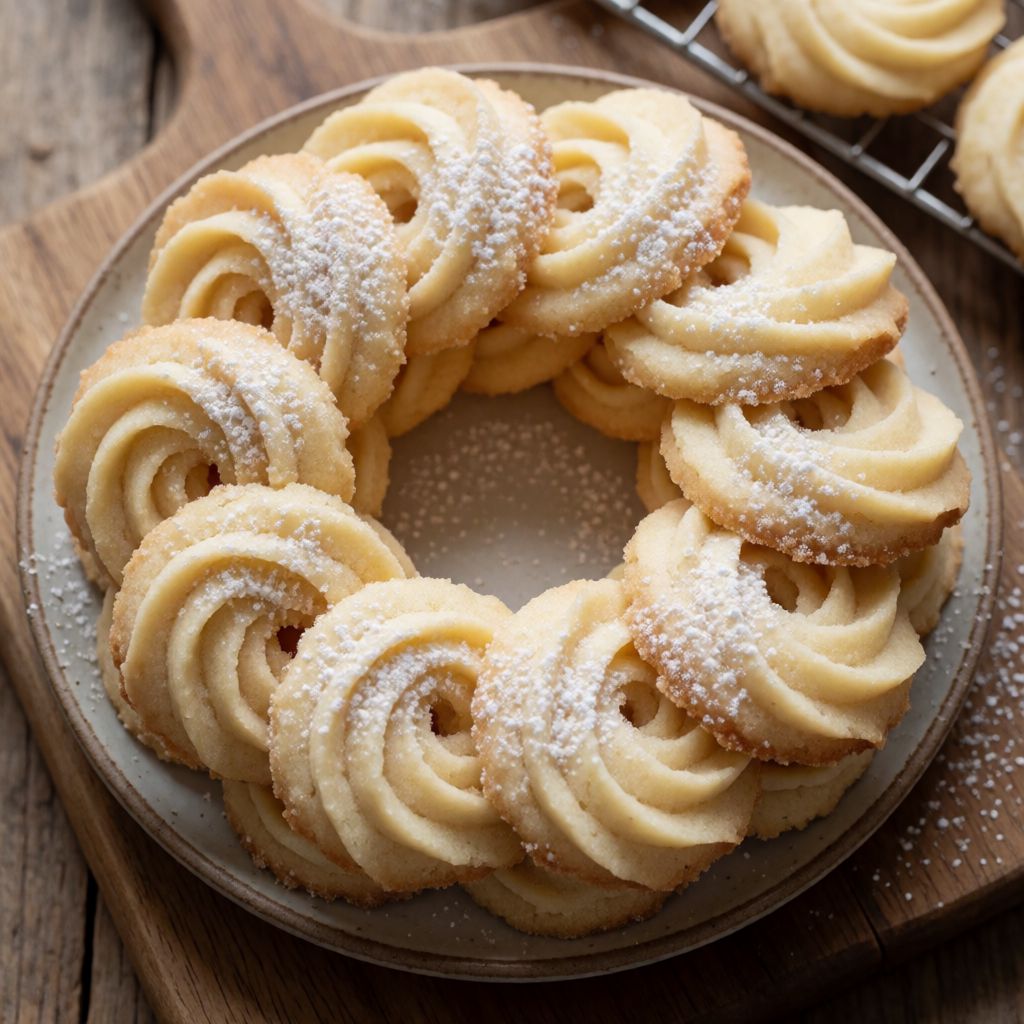
 AI photo
Vanilla Wreaths
Delicate vanilla-almond biscuits piped into wreath shapes and baked until lightly golden.
Labels are worked out automatically from the ingredients and can be wrong. Check the packaging if it matters to you.
Ingredients
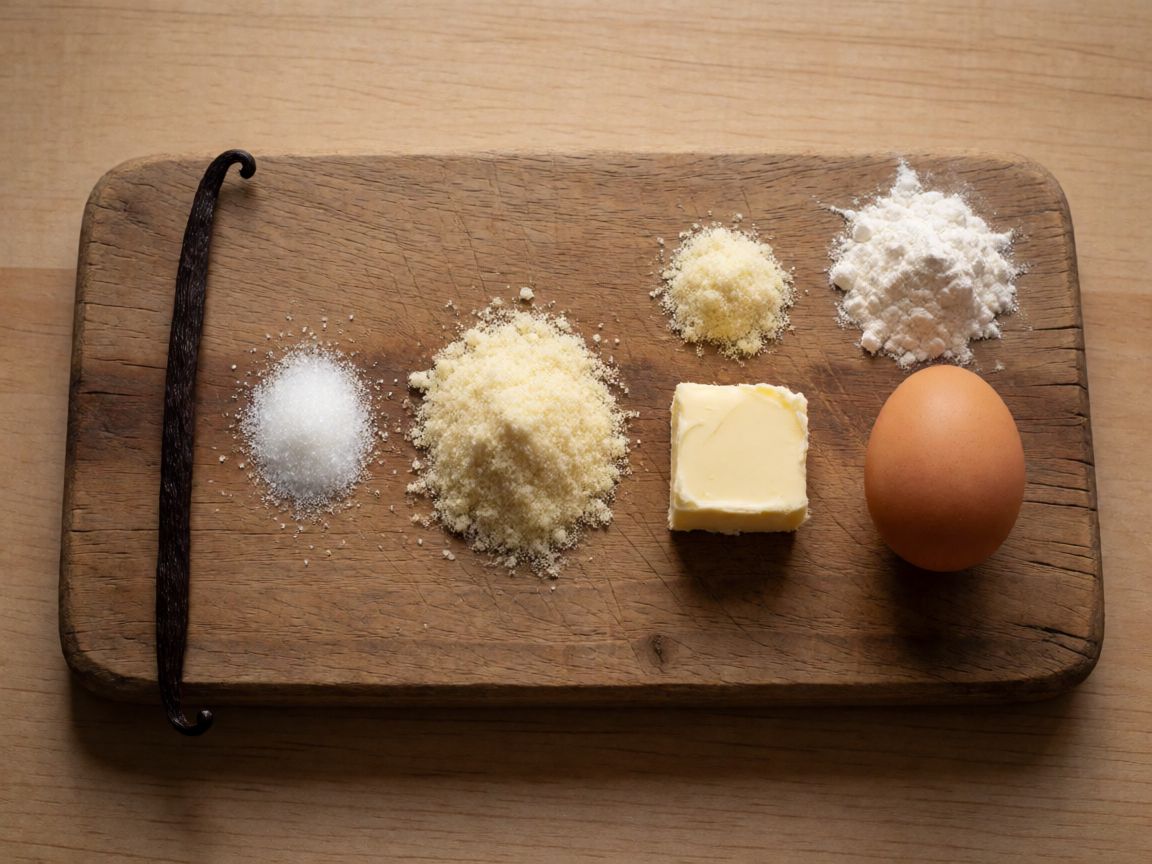
- 1 pcs Vanilla pod
- 80 g Sugar
- 75 g Almond flour
- 100 g Butter at room temperature
- 1 pcs Egg
- 100 g Plain flour






Steps
Cut the vanilla pod lengthways and scrape out the seeds. Add a spoonful of the sugar to the seeds and rub together.
Mix the vanilla sugar with the remaining sugar, the almond flour, the plain flour and the butter. Quickly bring the dough together with the beaten egg until smooth, without overworking it.
5 minSpoon the dough into a piping bag fitted with a deep-grooved star nozzle. Pipe the dough into wreath shapes onto a baking tray lined with parchment paper.
5 minBake in a fan oven preheated to 180°C for 8-10 minutes, until lightly golden.
9 minLeave the wreaths to cool completely on a wire rack.
10 min
What was changed
The oven temperature was rounded up to the nearest display step, giving instead of the original 175°C.
This is a small piped butter biscuit — a wreath shape pushed out through a deep-grooved star nozzle, from the German-Austrian family of Spritzgebäck that turns up every December on biscuit tins across Europe. Forty of them from this batch, which tells you they're meant to be small: a mouthful with tea, not a dessert.
What decides whether it works is the butter's state at the moment you pipe. It has to be soft enough to flow through those deep grooves without tearing, but firm enough that the wreath keeps its ridges once it's on the tray and for the first minutes in the oven, before the heat sets it. Butter gone too soft — melted at the edges, or warmed in a hurry — gives you a flat disc with the grooves ironed out, not a wreath. Butter too cold tears as it pushes through the nozzle, comes out in broken ribbons.
The other danger sits right after the egg goes in. "Quickly... without overworking" is the real instruction here, more important than any gram weight. Plain flour has gluten, and gluten wakes up with handling. Mix past the point where the dough is smooth and you're building a tough, chewy biscuit out of what should be a short, sandy one. Bring it together, stop.
Start with the vanilla pod and that spoonful of sugar you rub it into. The seeds alone, dropped straight into butter or dough, clump — one bite tastes of nothing, the next one is bitter and black-specked. Sugar crystals have edges; rubbing against them shears the seeds apart and spreads the vanilla oil evenly through every grain. Some say just scrape the pod straight into the batter and stir — no, because fat doesn't have the abrasive edge that sugar does, and you end up with vanilla in patches instead of vanilla throughout. If you've no pod, use a proper vanilla paste or a good extract — the criterion is real vanilla flavour, not sweetness with a vanilla label on it. Vanillin syrup gives you neither.
Almond flour is there for what it doesn't have: gluten. It's almost pure fat and protein, so it shortens the crumb and adds a nutty depth without asking for more butter. The reason almonds and not, say, breadcrumbs or more plain flour, is partly cost history — almonds travelled cheap and reliable along old Mediterranean trade routes into central European kitchens, and became the easy way to make a festive biscuit feel a little luxurious without needing meat or spice imports. Any finely ground nut flour that's mostly oil and protein will do the same job — hazelnut flour works, walnut less cleanly because of its bitterness.
Butter: unsalted, and "room temperature" means soft enough to take a thumbprint, not soft enough to pool. In a British kitchen in winter, "room temperature" on a packet is optimistic — your flat is probably colder than the lab that wrote it, so give the butter longer than you think, don't force it with ten seconds in the microwave. That melts the edges first and leaves you with a dough that's part paste, part solid, and pipes in streaks.
The egg is binder and a little lift — its proteins set in the oven heat and help the piped ridges hold their shape rather than slump. One whole egg for this quantity is already a small, precise amount; there's no good substitute at this scale that keeps the texture, so if you're avoiding egg, expect a flatter, more crumbly result rather than a true swap.
Plain flour, not self-raising, because you don't want rise here — a biscuit that puffs blurs the star nozzle's grooves into a rounder, softer shape. The small amount of flour is there purely for structure, to hold the fat and almond flour together, nothing more.
On the piping itself: if you don't own a bag with a star nozzle, a sturdy freezer bag with a notched corner will push the dough out well enough, just rougher at the edges. The deep grooves aren't decoration for its own sake — more surface area means more crisp edge and a faster, more even bake, and it lets the butter's fat escape evenly instead of pooling greasy at the base of a smooth round. That piping trick, generally, is what let bakers turn out dozens of identical pretty shapes fast without shaping each one by hand — a commercial shortcut from German festive baking, dressed up as tradition, which is exactly why it suits a tin of forty and a pot of tea with milk rather than a single showpiece on a plate.