
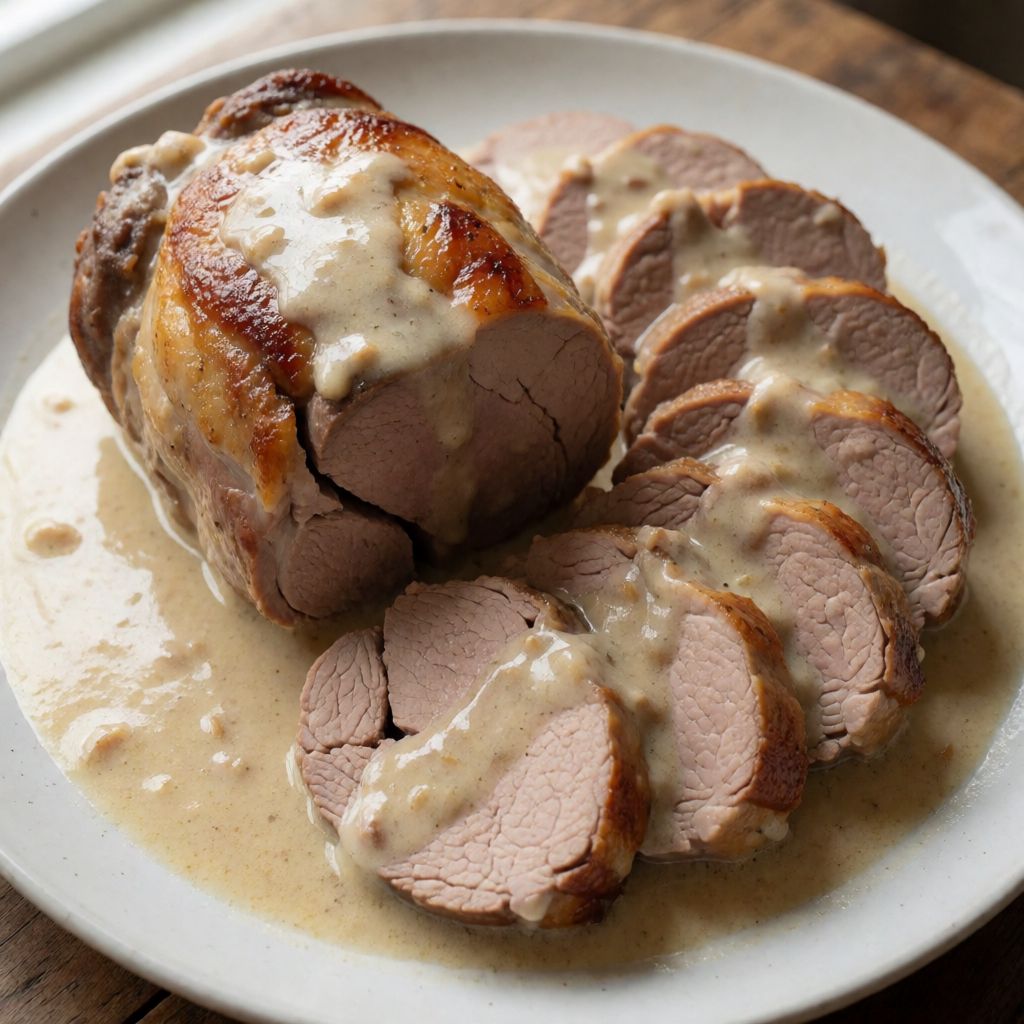
 AI photo
Veal Braised in Milk
A tender veal joint, slow-braised in milk with rosemary, sage and bay leaf until melting soft.
Labels are worked out automatically from the ingredients and can be wrong. Check the packaging if it matters to you.
Ingredients
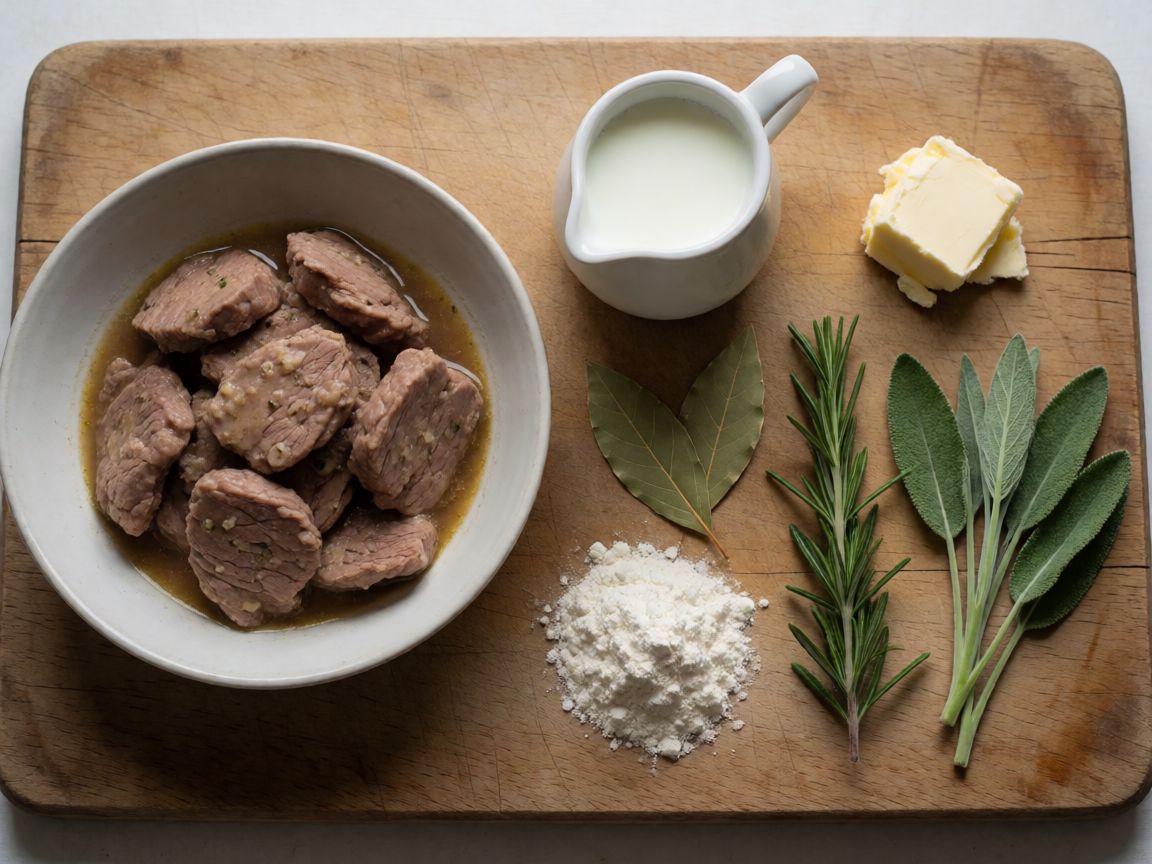
- 1 kg veal leg joint
- 1 l milk
- 50 g butter
- 3 tbsp olive oil
- 1 tbsp plain flour
- 3-4 pcs bay leaves
- 1 pcs rosemary a sprig
- 3-4 pcs sage leaves
- salt to taste
- black pepper to taste










Steps
Tie the meat with kitchen string and dust it lightly with flour.
Heat the butter together with the olive oil in a large enough pot.
Add the meat and brown it on all sides, turning often until evenly coloured.
Add salt, black pepper, rosemary and bay leaves. Pour in a cup of warm milk, then the rest.
Cover the pot with a lid and braise. Doneness: 63°C at the centre (medium).
70 minRemove the meat and keep it warm. Take out the rosemary and sage, then blend the sauce.
Pour the sauce into a small pan, add water and sifted flour, stirring over high heat.
Slice the meat thinly and serve hot, drizzled with the sauce.
Veal braised whole in a pot of milk, not water, not stock. The milk is the whole trick here — it curdles slowly around the meat as it cooks, breaks into soft curds and a thin whey, and by the end you blend that mess back into a pale, faintly sweet sauce that no stock could give you. This is an old Italian habit (vitello al latte) transplanted onto a British Sunday-roast instinct: a joint in a pot, low effort, high comfort, carved thin at the table. Six people, one hour and ten minutes, a joint the size of a small chicken.
What decides whether it works is the browning at the start and the restraint after. Dust the meat in flour before it hits the fat — that thin coat is what gives you a pale gold crust rather than grey boiled meat, and it's also what later thickens the milk slightly as it dissolves in. Butter alone would burn before the meat colours; oil alone gives you colour but no flavour underneath it — so you use both, butter for taste, oil to raise its smoke point so it doesn't blacken. Brown on all sides properly, turning it like you're rolling a log, not stabbing at it with a fork every ten seconds.
Some say milk curdles because it's "going off" or because the pot is dirty — no. It curdles because heat and the acid naturally present in milk pull the proteins together once they get warm enough; that's not a flaw, it's dinner. You are not trying to stop it. You're trying to use it: those curds are what you blend into sauce later. Fighting the curdling — low heat, careful stirring to "keep it smooth" — just gives you a thin, flavourless milk and nothing to blend.
The veal itself should be a leg joint — a cut with some structure to it, enough connective tissue to make tying worthwhile but not so much that an hour won't soften it. Tying with string isn't fussy tradition; it's what keeps a boneless joint from splaying flat in the pot and cooking unevenly, thin edges drying out while the middle lags behind. If veal isn't to hand or the price puts you off — it often does, veal's never been a budget cut in a British shop — a rolled pork loin or even a chicken crown takes the method fine; you're after pale, mild meat that won't fight the milk for flavour, not beef, which is too assertive and turns the sauce muddy and grey.
The milk wants to be full-fat, ordinary, nothing fancy — the fat is what keeps the sauce from tasting thin and watery once you've blended it. Warming it before it goes in matters more than it sounds: pour fridge-cold milk straight onto meat that's just been seared hard and you shock the pan, drop the temperature, and the fond you built while browning seizes rather than releases. The first cupful goes in slow and warm to loosen that fond gently; the rest follows once things have settled.
Butter and olive oil together solve a problem each has alone: butter alone burns at a temperature well below what you need to brown meat properly, so you'd be forced to turn the heat down and end up stewing the surface instead of searing it. Any neutral oil with no flavour of its own does the oil's job here if you've no olive oil open — sunflower, rapeseed, whatever's in the cupboard; you're not building taste with the oil, just raising the ceiling so the butter can do its job without scorching.
Bay, rosemary and sage are doing different jobs and that's why they're treated differently at the end. Bay and rosemary survive long cooking and give up their flavour slowly, so they stay in the pot the whole time and get fished out before blending — leave rosemary needles in and you'd be straining woody bits out of the sauce, or worse, biting one. Sage is more delicate and more assertive at once; too long in and it turns bitter, so it's there mainly to perfume the milk early and gets pulled the same time as the herbs rather than blended in whole, where its texture would do the sauce no favours.
The second-stage flour, sifted into water before it meets the hot sauce, is there to avoid a specific and common failure: tip dry flour straight into hot liquid and you get lumps, pockets of raw starch that never properly cook out no matter how hard you stir afterwards. Mixing it into cold water first — a loose paste, not a dough — means every grain is already surrounded by liquid, so when it hits the heat it thickens evenly instead of clumping. This is the second flour in the recipe, doing a different job from the first: the dusting on the meat barely thickens anything, it's there for the crust; this one is purely about body in the sauce.
Letting the meat rest under cover while you make the sauce isn't ceremony, it's physics — cut into it straight from the pot and the juices you spent an hour coaxing in run straight out onto the board instead of staying put. Patience here is cheap; it costs you five minutes and it's the difference between a slice that's merely cooked and one that's actually juicy. A wide domestic pan with a lid stands in for a proper braising pot without complaint — this isn't a dish that needs a kazan's slow, even heat, just something heavy enough on the bottom that the milk doesn't catch and scorch while you're not looking.