
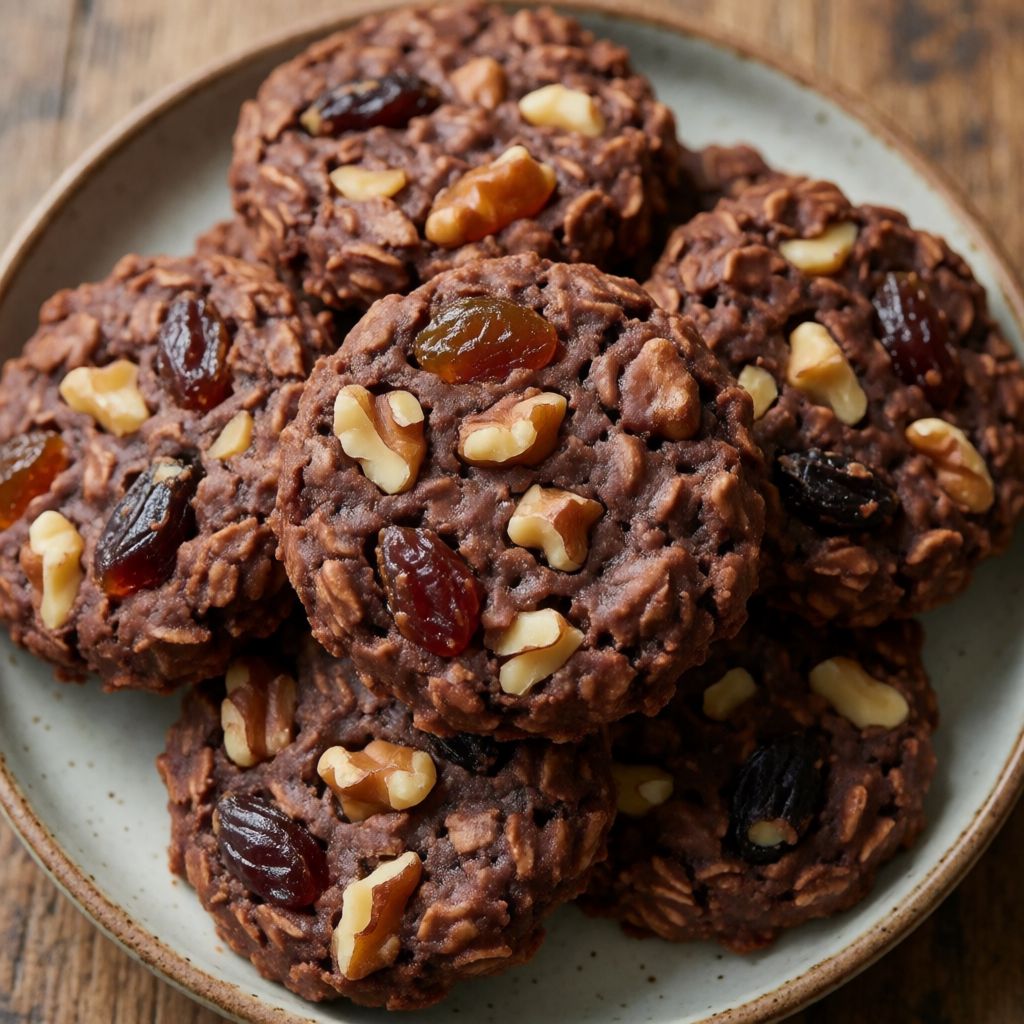
 AI photo
No-Bake Oat and Chocolate Cookies
A quick no-bake treat of oats, nuts, dried fruit and melted dark chocolate, chilled until firm.
Labels are worked out automatically from the ingredients and can be wrong. Check the packaging if it matters to you.
Ingredients
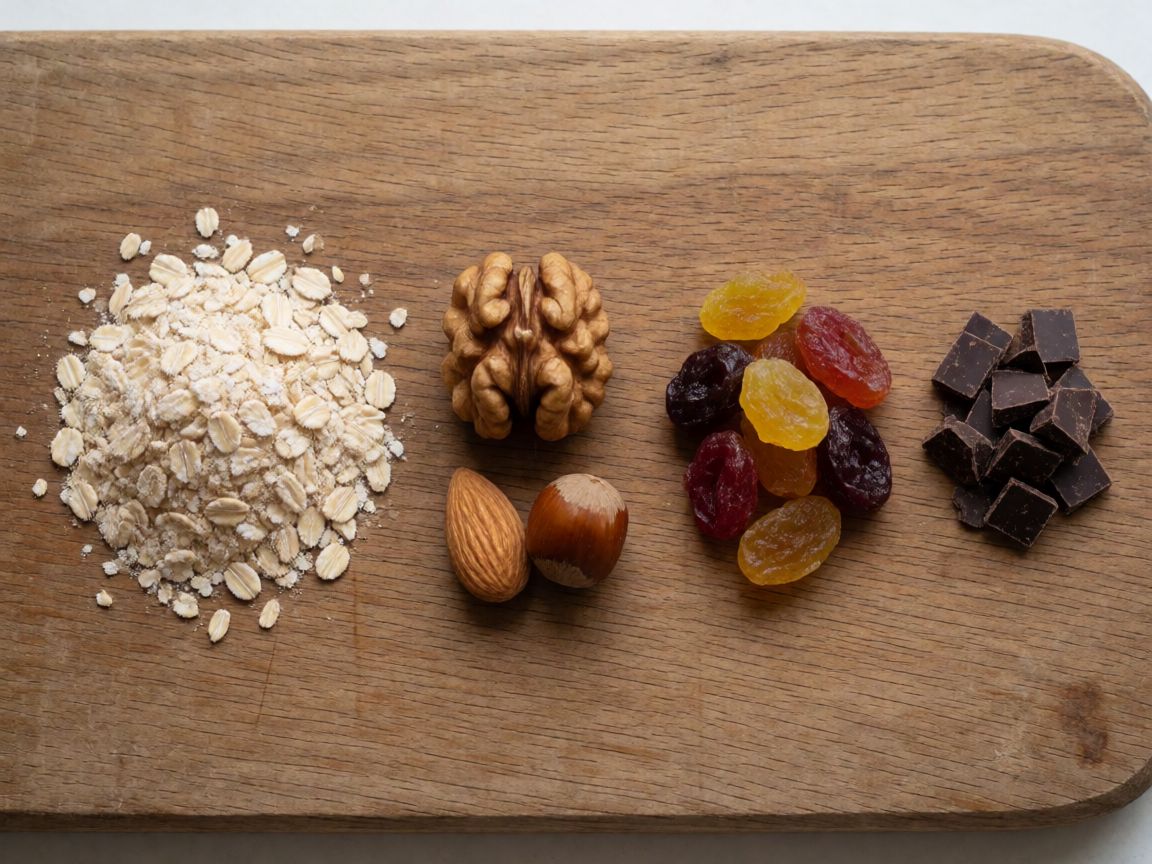
- 160 g Oats
- Walnuts
- Almonds
- Hazelnuts
- 50 g Mixed dried fruit
- 250 g Dark chocolate





Steps
Blend the walnuts, almonds, hazelnuts and dried fruit in a blender, then tip them into a bowl with the oats.
Melt the dark chocolate in a bain-marie or in the microwave, let it cool slightly, then add it to the bowl.
Mix well.
Using a pastry ring, shape the cookies, or flatten spoonfuls of the mixture with your hands.
Place the cookies in the fridge for at least two hours.
120 min
Forget the oven for this one - nothing here gets baked. What you're making is oat-and-nut rubble held together by a slab of melted chocolate, and it only turns into something you'd call a cookie once that chocolate goes hard again in the cold. The "cooking" happens backwards from usual: first you melt structure away, in the chocolate, then the fridge gives it back, as crystals. Whatever can go wrong happens in that gap between melting and setting.
Two things decide whether these hold together on a plate or fall apart in your hand. First: whether the melted chocolate actually reaches every flake of oat and shard of nut, or just pools at the bottom of the bowl. Second: whether you give the fat in that chocolate enough cold, undisturbed time to re-form its crystal lattice - because that lattice, not the oats, is what gives the bite its snap.
Some say "no-bake" means no heat at all involved. No - melting chocolate is still cooking, just stopped well short of browning. The real danger isn't heat, it's a drop of water landing in it, which seizes it, turns glossy liquid into grainy paste in seconds, because the sugar clumps around the moisture and the fat can't flow around it anymore. I've seen it happen from nothing more than condensation dripping off a lid.
The walnuts, almonds and hazelnuts blended into near-paste aren't just texture, they're a second binder working alongside the chocolate - the oil released from them helps the mass hold its shape before the chocolate even goes in. Blend too fine and you lose the bite that makes chewing this worth it; too coarse and the mixture won't hold together at the cut edges, because there's only oat touching oat there with nothing to glue it. Notice the recipe gives no weight for the nuts while everything else is in grams - that's not sloppiness, it's because the mix forgives you. A generous handful of each, three handfuls total, is about right; go a bit heavier or lighter and it still binds, because the chocolate carries most of the load. Any raw, unsalted nut works on the same logic - oil content plus a bit of crunch surviving the blender, not the species, is the test. Peanuts, cashews, pecans, whatever's cheapest that week, all pass.
The dried fruit earns its place for two unglamorous reasons: sweetness without extra sugar, and a bit of natural stickiness once blended that helps the paste cling to the oats. Raisins, dates, apricots, any mix - the rule is that it should be soft enough to blend into a tacky paste, not wet enough to turn things soggy. If it's gone leathery and hard, soak it five minutes in hot water and pat it dry, or the blender will just spin it round doing nothing.
The oats are the bulk, the thing that keeps this a cookie and not fudge. Rolled oats, not the instant kind - instant ones have already been steamed flat, so they go soft and pasty inside the chocolate instead of keeping a bit of chew. If instant is all you've got, use it, but expect something softer, closer to fudge than cookie.
Dark chocolate is doing the real engineering. The percentage on the wrapper matters more than the brand name, because higher cocoa solids means less milk fat diluting the cocoa butter, and cocoa butter is exactly what you need crystallising hard in the fridge - that is your set. Swap in milk chocolate and you get a softer, sweeter bar that slumps at room temperature, because milk fat melts at a lower point than cocoa butter and never firms up quite the same way. If milk chocolate is what's in the cupboard, fine - just keep it in the fridge until the moment it's eaten.
You don't need a kazan or a fitted bain-marie for the melting. A heatproof bowl sitting over, not in, a pan of water that's just steaming - not rolling and splashing, because a hard boil throws droplets up and one landing in the bowl is enough to seize it - does the job on any domestic hob. A microwave works too, but only in short bursts with a stir between each, because it heats unevenly and chocolate can look solid right up to the second it scorches from one hot pocket you didn't stir out.
Whether you press the mixture into a ring or flatten it by hand in your palm changes nothing about the chemistry, only the tidiness - a ring compacts it, squeezing out air pockets that would otherwise weaken the set; hands leave it looser, more rustic. This style of no-bake bar runs on the same logic as a British flapjack: a way to turn cheap cupboard stock - oats, whatever nuts are going, whatever chocolate's left in the tin - into something sweet without lighting the oven, which matters more than it sounds on a day when the oven's already full with a roast. This batch, with 160g oats and 250g chocolate, makes about five cookies' worth shaped into proper rounds, more if you cut them small. Stash them in the fridge and they'll outlast the joint on the table - good with tea, the way most things here eventually are.