
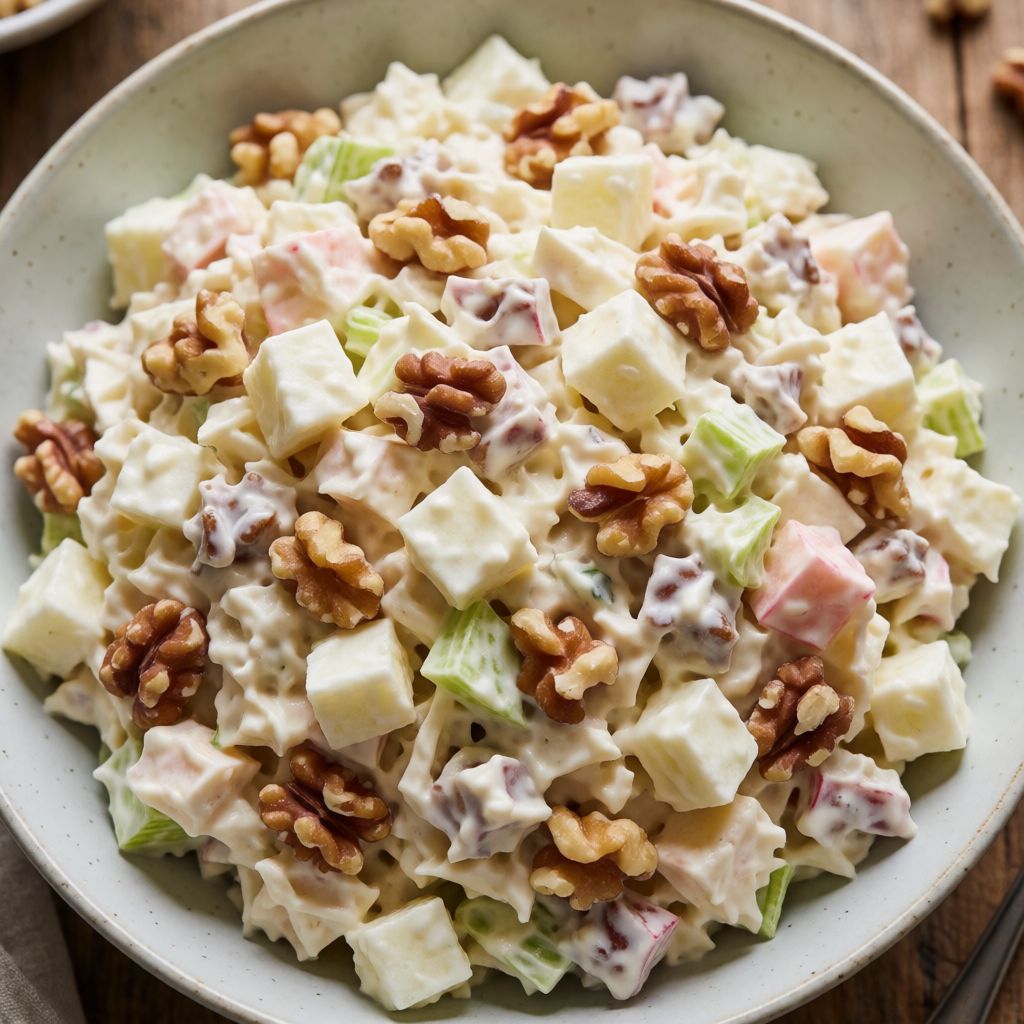
 AI photo
Waldorf Salad
A crisp celeriac and apple salad with walnuts in a creamy honey-yoghurt dressing.
Labels are worked out automatically from the ingredients and can be wrong. Check the packaging if it matters to you.
Ingredients
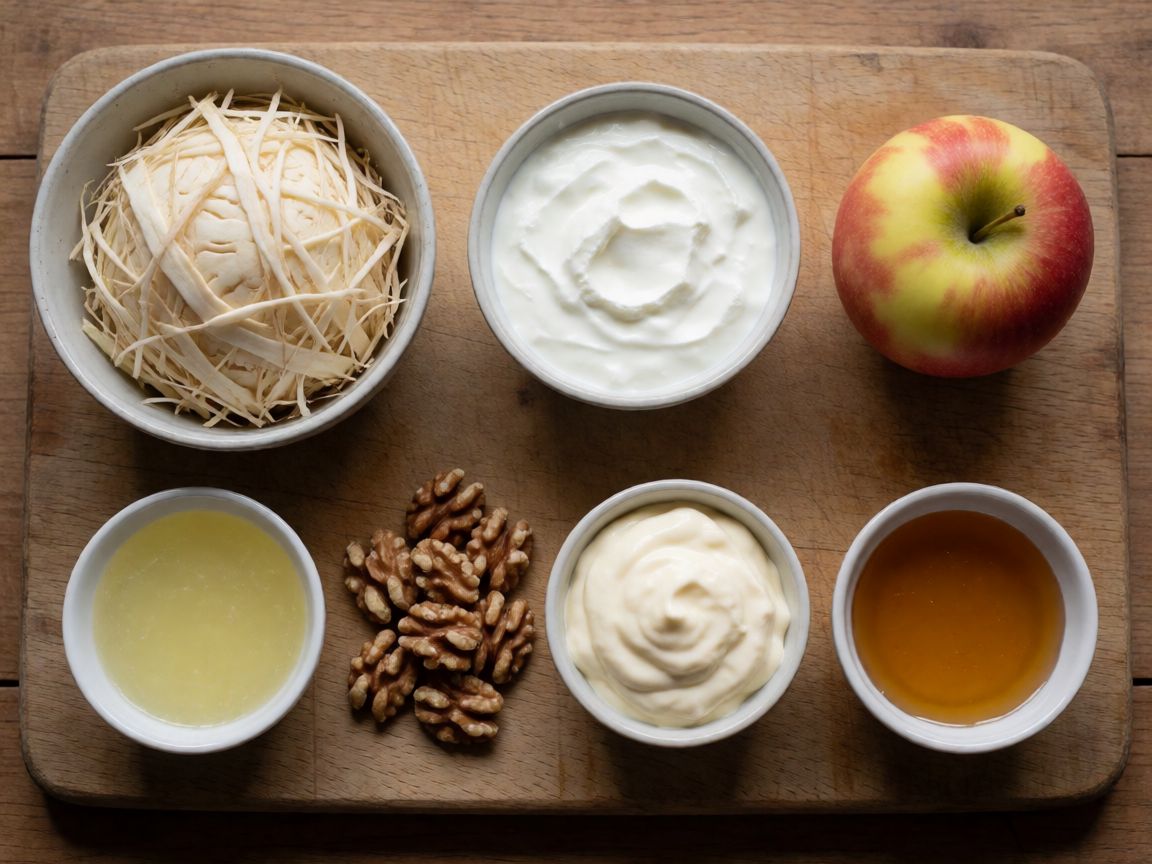
- 300 g celeriac
- 150 g Greek yoghurt
- 1 pcs green apple
- 1 pcs lemon juice
- 70 g walnuts
- 150 g mayonnaise
- 40 g honey
- salt to taste
- black pepper to taste









Steps
Peel the celeriac, rinse it and cut it into thin strips.
Bring water to the boil, add salt, put in the celeriac and cook for 3-4 minutes.
4 minDrain and spread the celeriac on a towel to dry.
Stir the yoghurt together with the mayonnaise, honey, salt and pepper until smooth.
If needed, melt the honey in a bain-marie.
Peel the apple, remove the core, cut into strips and drizzle with lemon juice.
Combine the celeriac and apple, pour over the dressing and mix.
Chop the walnuts and sprinkle over the salad.
Cover with cling film and chill in the fridge for at least 30 minutes.
30 minStir the salad and serve with bread or croutons.
Forget the version with grapes and celery sticks you get in a plastic tub from the supermarket — that's a translation error from 1896, when Oscar Tschirky first served this at the Waldorf-Astoria. He used celery root cut fine, not the stalk. Somewhere along the way "celery" in the name got read as "celery stalk" by people who never saw the original, and the whole dish turned into limp green crunch in mayonnaise. What you're making here is closer to the source: celeriac, blanched not raw, apple, walnuts, a dressing that's half yoghurt so it doesn't sit like a brick in your stomach.
The thing that decides whether this works is the celeriac texture. Raw, it's fibrous and a bit soapy-tasting — that's the compound that makes celeriac taste "green" to some people, and three or four minutes in salted boiling water breaks it down without cooking the vegetable through. You want it still crisp, just rounded off at the edges. Bite one strand: it should give slightly, not snap, not go to mush. If it collapses when you press it with a spoon, you've gone too far and you'll know for next time — there's no fixing it going back in the pan.
The apple is the other half of the texture game, and it stays raw, so the lemon juice isn't there for flavour — it's there so the cut flesh doesn't brown while you're busy with everything else. Skip it and in twenty minutes your clean white salad has grey edges. Nobody died from oxidised apple, but it looks like you don't know what you're doing.
Celeriac: buy it heavy for its size, no soft patches, and don't be put off by the look of it — it's the ugliest vegetable in the shop and also one of the cheapest root vegetables going, which is half of why a dish built around it became a hotel classic rather than a luxury one. Peel it properly, right down past the knobbly skin layer, because that's where the bitterness sits. If you genuinely can't get it — unusual in the UK, it's in most greengrocers from autumn through winter — a firm white turnip blanched the same way gets you closer than celery ever will, because it's the crunch-under-dressing you're after, not a flavour match.
Green apple: something tart and firm — Granny Smith is the obvious one here and does the job without any fuss. The point of tart is contrast against the honey and mayonnaise, which are both sweet in their own way; a soft, sugary eating apple just adds more sweetness to a bowl that already has plenty, and goes mealy under the dressing within the hour.
Walnuts: chop them by hand just before you use them, not days ahead. The oil in walnuts turns rancid faster than almost any other nut once the surface is exposed to air, so pre-chopped walnuts from a bag sitting in your cupboard for a month will taste faintly of cardboard, and you'll blame the recipe rather than the nut. Toast them for a minute in a dry pan first if you want more depth — not in the recipe, but it costs you nothing and wakes them up, especially if they've been in a packet a while.
Yoghurt and mayonnaise together: this is the one real update on the 1896 original, which was just mayonnaise, full stop. Pure mayonnaise on cooked celeriac is heavy and a bit relentless by the second forkful; Greek yoghurt — thick, strained, not the drinking kind — cuts the fat and brings acidity so the dressing doesn't just coat, it seasons. If you want it lighter still, push the ratio further toward yoghurt; if you want it closer to the old New York version, go the other way. Either is honest.
Honey: melt it in a bain-marie only if it's set hard in the jar — cold honey straight from a crystallised jar won't fold smoothly into a dressing, you'll get little sugar lumps that don't dissolve, so warming it gently until it pours is the fix, not a stylistic flourish. A clear runny honey needs none of this.
No kazan needed here, no open flame theatre — this is a pan of salted water, a colander, a mixing bowl, and a fridge, which is exactly the kit a British kitchen has lying around already. Serve it with bread or croutons the way the recipe says, and it earns its place next to a Sunday roast as the thing that isn't meat and isn't potatoes but still feels like it belongs on the table.