
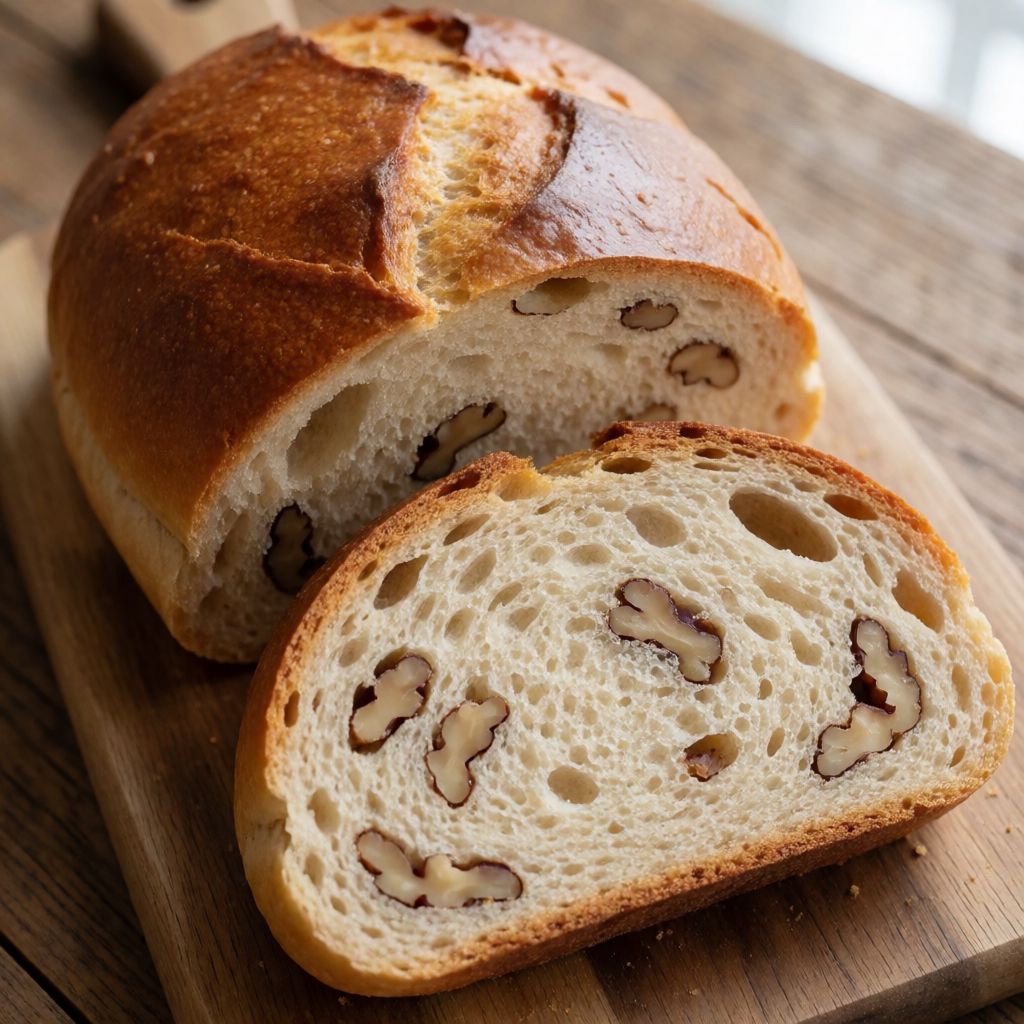
 AI photo
Walnut Bread
A soft yeasted bread enriched with eggs and butter, studded with chopped walnuts.
Labels are worked out automatically from the ingredients and can be wrong. Check the packaging if it matters to you.
Ingredients
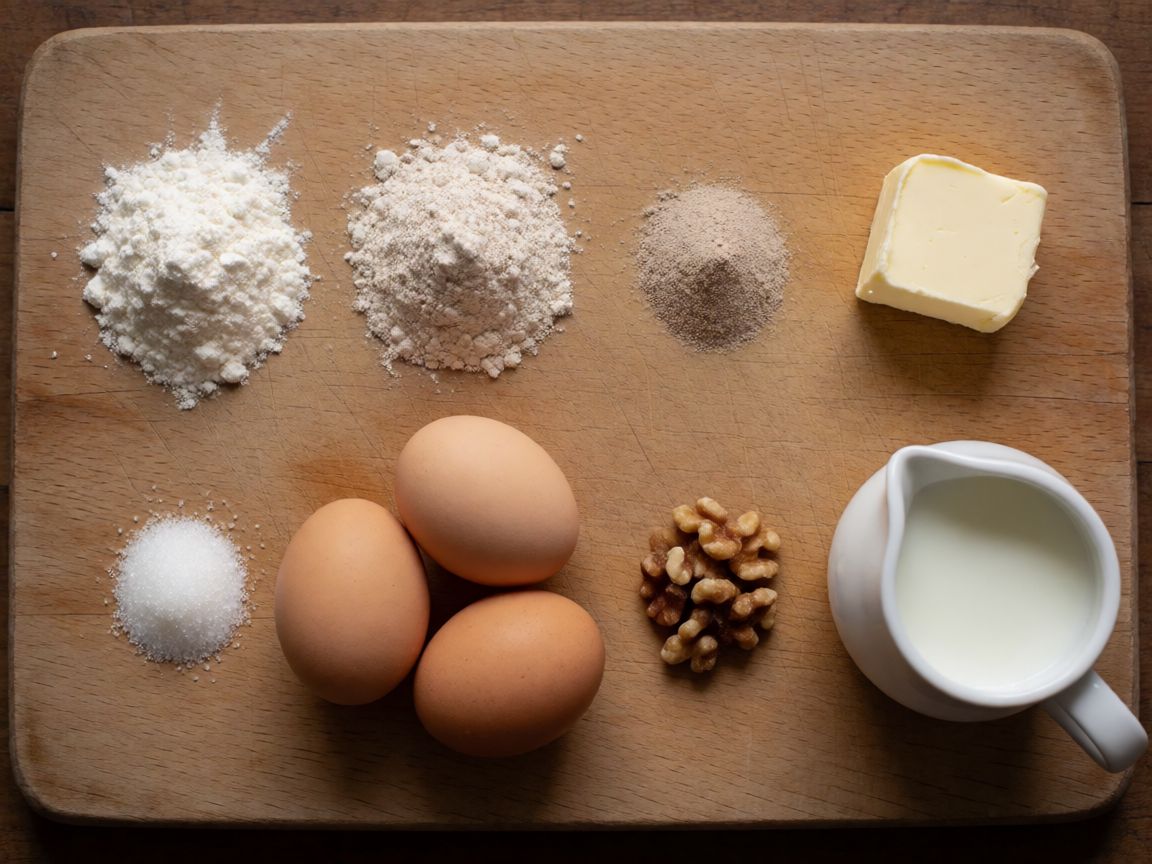
- 400 g Plain flour
- 100 g Wholemeal flour
- 35 g Fresh yeast
- 100 g Butter
- 3 pcs Eggs
- 30 g Caster sugar
- 250 ml Milk
- 10 g Salt
- 100 g Walnuts







Steps
Dissolve the yeast in warm milk until foamy. Roughly chop the walnuts.
Melt the butter in a bain-marie. In a separate bowl, beat the eggs.
Tip the flour onto a work surface, shape it into a mound with a well in the centre and pour in the yeast mixture.
Mix lightly with the flour, then gradually add the milk.
Add the salt, sugar, butter, walnuts and eggs. Combine all the ingredients, kneading the dough.
Coat the dough in flour, cover with a cloth and leave to rise in a warm place.
Knock back the dough with your hands. Divide it into pieces and shape into round buns.
Place the buns on a greased baking tray, cover with a towel and let them rise again.
Bake in the oven at 220°C for about 25 minutes.
25 min
This is a bread that borrows its manners from a brioche and its texture from a loaf of mixed-grain bread — fresh yeast, eggs, butter and milk all go into the dough, so what comes out isn't austere crusty bread but something closer to a soft, rich bun with walnuts knocked through it. Two flours, wholemeal and plain, tell you what's going on: the wholemeal carries flavour and a little grit, the plain carries gluten strength. All plain and you lose the nuttiness that's the whole point of a walnut bread; all wholemeal and the dough won't rise properly because wholemeal's bran cuts the gluten strands short.
What decides whether this works is the yeast and what you do to it, twice over. Fresh yeast dissolved in warm milk needs to actually foam — that's not decoration, that's your proof the yeast is alive and the milk wasn't hot enough to kill it. Some say you can just stir yeast into flour and hope; no, because fresh yeast needs activating in liquid first, and if the milk's too hot you've cooked it before it's done any work, and the dough simply won't rise, however long you leave it.
Flour first, because this is where people go wrong without noticing. Plain flour (400 g) gives you the gluten backbone — enough protein to trap the gas the yeast makes, enough stretch to hold a bun shape. Wholemeal (100 g) is there for flavour and a slight chew, not structure; its bran particles physically cut some gluten strands, which is why it's the minority flour here, not the majority. If you've only got strong white bread flour, use it in place of the plain — it'll give you an even better rise, since that's what it's bred for. If you've only got plain all-purpose and no wholemeal, use all plain; you'll lose a bit of character but not the bread itself.
Fresh yeast (35 g) is the traditional choice because it was simply what bakers had before dried yeast existed in sachets — it's not spiritually superior, it's just stronger and faster-acting gram for gram, which matters when you're working by hand and feel rather than a packet's instructions. If you can only get dried active yeast, use roughly half the weight; if it's instant yeast, you can skip dissolving it in the milk altogether and just work it into the flour dry. Either way, the "foamy" cue in the first step is your real test, not a stopwatch — no foam after a reasonable wait means dead yeast, start again, don't bake hope into a loaf.
Butter (100 g), melted gently in a bain-marie rather than blasted in a pan, is there so it doesn't scorch and so it's liquid enough to fold into the dough evenly rather than sitting in lumps. Butter's job in an enriched dough like this is to coat gluten strands and soften the crumb — more fat means a more tender, slower-staling bread, which is exactly why this isn't a hard, chewy loaf. Any neutral fat with no flavour of its own will do the structural job, but butter is doing a flavour job too here, so margarine is a worse-but-workable stand-in, not an equal one.
Eggs (3) and milk (250 ml) are both enrichment and both liquid — eggs add structure through their protein as well as richness and colour, milk adds moisture and a touch of sugar (lactose) that helps the crust brown. Caster sugar (30 g) is a small amount, mostly there to feed the yeast quickly in the early stages and to round off the flavour — it's not meant to make this a sweet bread. Salt (10 g) does the opposite job to sugar: it tightens gluten and controls how fast the yeast works, which is also why salt and yeast don't want to meet directly before the dough's mixed — the step order of adding salt after the initial yeast-flour contact isn't fussiness, it's keeping the yeast from getting a concentrated hit of salt that would slow it down unevenly.
Walnuts (100 g), roughly chopped rather than ground, are the one ingredient that's purely there for itself — texture and bitterness-against-sweetness. Any nut with a similar oil content and a bit of bitterness will substitute honestly: pecan, hazelnut toasted first. What you want to avoid is anything too oily and soft, like cashew, which will just disappear into the crumb instead of giving you something to bite against.
For the oven itself: 220°C is hot enough to set the crust and get proper oven-spring before the inside overcooks, but a domestic oven runs less evenly than a kazan or a commercial deck oven — rotate the tray partway through if your oven browns one side faster, and judge doneness the honest way, by sound and feel: a baked bun sounds hollow when you tap its base, not golden colour alone, because an enriched dough with milk and egg will brown early from the sugars in it, well before the inside is actually cooked through.