
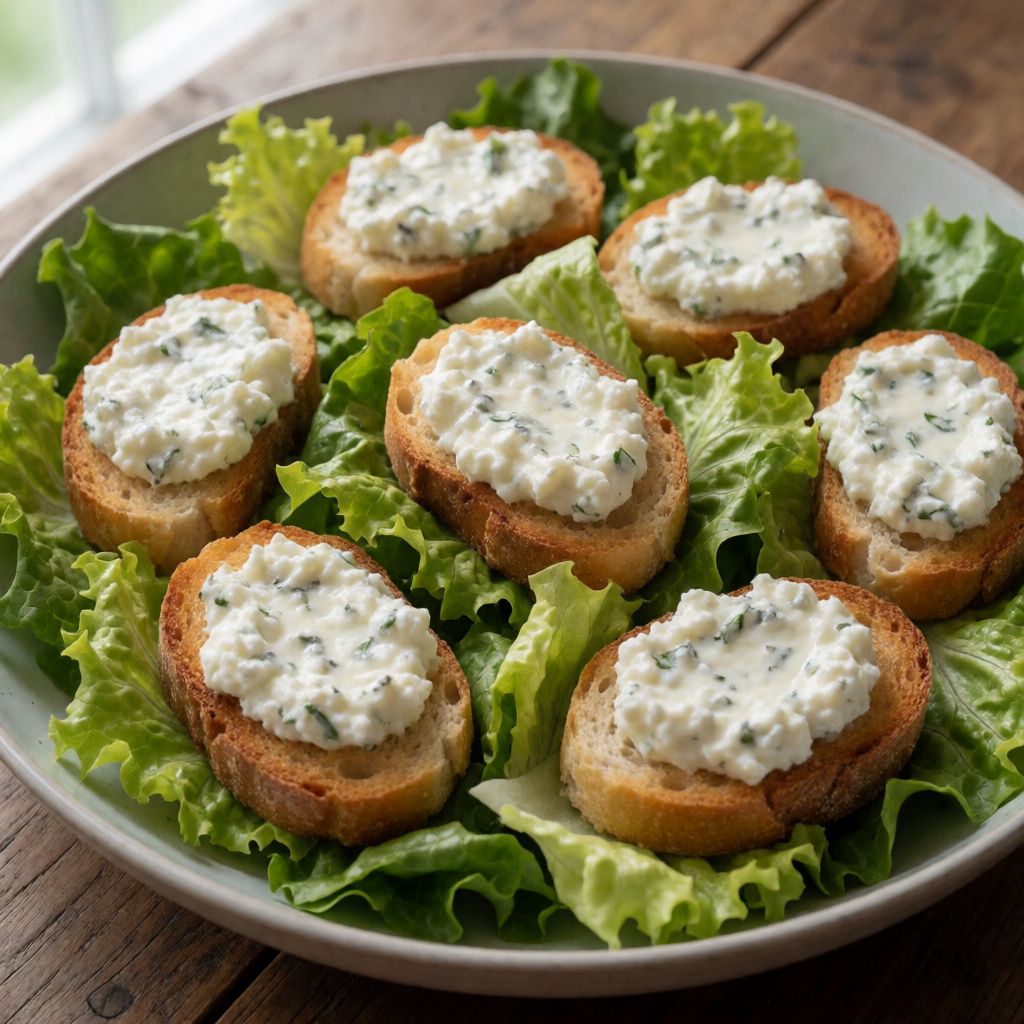
 AI photo
Warm Goat's Cheese Salad
A warm salad of toasted bread with goat's cheese, blueberries and walnuts, finished with a classic vinaigrette.
Labels are worked out automatically from the ingredients and can be wrong. Check the packaging if it matters to you.
Ingredients
- 4 pcs Bread slices, e.g. a sandwich loaf
- 2 package Goat's cheese
- 10 pcs Walnuts
- 250 g Lettuce leaves
- 2 tsp Honey
- 100 ml Blueberries
- Salt
- 1 tbsp Apple cider vinegar
- 1 tsp Honey
- 1 tsp Dijon mustard
- 3 tbsp Olive oil
- Black pepper freshly ground







Steps
Cut 16 small rounds from the bread and top each with goat's cheese.
Place the bread on a baking tray lined with parchment and bake in a preheated oven at 180°C (fan) for 10 minutes.
10 minMeanwhile, toast the walnuts in a dry hot pan for a few minutes, stirring.
Arrange the lettuce on a large platter or plates and drizzle with the vinaigrette.
Scatter the crisp baked bread slices with goat's cheese over the salad.
Drizzle with honey and sprinkle with blueberries, walnuts, salt and freshly ground pepper.
Classic vinaigrette: mix the apple cider vinegar, honey, Dijon mustard, olive oil, salt and black pepper, whisk well and adjust the seasoning.
This is a warm-cold salad, and the whole trick sits in that contrast. You pull the goat's cheese out of the oven just as it starts to slump and brown at the edges, and you drop it onto cold leaves that have already been dressed. The leaves wilt a little where the cheese touches them, stay crisp everywhere else. That's the dish — not the cheese, not the leaves, the meeting of the two temperatures.
What decides whether it works is the oven, not the salad. 180°C fan is hot enough to melt the cheese and colour the bread's edge before the inside goes soggy, but not so hot that the cheese splits and weeps fat onto the tray. Watch the cheese, not the clock: when it's gone glossy and just starting to slip at the rim, it's ready. Ten minutes is a floor, not a deadline — ovens lie about their own number by ten degrees in either direction, more so if yours doubles as the place you keep the roasting tins.
Some say you should put the bread under a hot broiler for speed — no, because a broiler browns the top crust and leaves the cheese cold in the middle; you want the heat to come from underneath and around, which an oven shelf gives you and a grill element doesn't.
The vinaigrette goes on the leaves before anything warm touches them, not after. Dress cold leaves with a cold vinaigrette, then land the hot cheese on top — do it the other way round and the heat cooks the mustard's sharpness out of the dressing and you've wasted the whisking.
Goat's cheese is the only cheese that behaves this way under heat — it softens and browns without turning into a puddle, because it has almost no stretch-forming proteins the way mozzarella does and comparatively little moisture to boil off violently. That's not a mystical property, it's just a drier curd with a different protein structure. If you can't get goat's cheese, a firm sheep's cheese like a young feta does something similar; a cow's milk cheese like brie will just run everywhere and burn at the edges, so don't substitute it and expect the same result.
The bread underneath isn't a garnish, it's a plate that happens to be edible and it stops the cheese from sliding straight through the rack onto the tray. Any close-crumbed white loaf works — the point is a crumb tight enough to hold a disc of cheese without collapsing when it goes soft in the oven. A baguette slice does the job better than a soft supermarket sandwich loaf because the crust gives it a rim; if your bread is very soft, toast it dry for a minute first so it has some backbone before the cheese goes on.
The walnuts get toasted in a dry pan, no oil, because oil here would just be dead weight — nuts carry enough fat of their own, and a dry pan lets you actually smell when they're ready: a faint toasted, slightly resinous smell, and a shade darker than raw. Go past that point and the oil inside them turns bitter; walnuts have more natural tannin than, say, almonds, so they tip from "toasted" to "burnt" faster than you'd expect, and there's no bending or snapping test for a nut — your nose is the test here.
Blueberries and honey are doing the same job from opposite directions — sweetness against the saltiness of the cheese and the sharp mustard vinaigrette. If blueberries aren't around, any soft, slightly tart fruit that won't bleed too much juice works — a few halved grapes, or dried cranberries if you want to skip the fruit stall altogether. Don't reach for strawberries; too much water, and they'll turn the leaves soggy under the warm cheese before you've even got the plate to the table.
The vinaigrette is the "classic" one by name because it's the ratio every French kitchen taught its apprentices before bottled dressings existed — roughly three parts oil to one part acid, with mustard as the thing that holds oil and vinegar together instead of them splitting into two puddles on the plate. Dijon mustard works because of its own acidity and a trace of mucilage from the seed that acts like a weak emulsifier; a milder English mustard won't hold the dressing together the same way, so if that's what's in the cupboard, use a touch more of it than the recipe says. Apple cider vinegar is chosen for being mild and a little fruity rather than sharp — malt vinegar, which is more of a British habit from the chip-shop shelf, will fight the honey and the blueberries instead of sitting quietly under them; if you only have malt vinegar, cut the quantity and add a touch more honey to balance it.
Olive oil here just needs to be an oil with no flavour loud enough to compete with mustard and goat's cheese — it doesn't have to be your good bottle. Any neutral vegetable oil works if that's what's open; you lose nothing essential, you just lose the faint bitterness olive oil adds at the back of the throat, which some people miss and most don't notice. This isn't a dish where the oil needs to announce itself, it needs to carry the mustard and vinegar evenly over the leaves, nothing more.
This feeds four as a starter, less as the main event — it's built as a first course before something heavier, not a replacement for your Sunday roast. Patience here is mostly about not rushing the oven stage: pull the tray too early and you've got warm bread with cold cheese sitting on top of it, which isn't the same dish at all.