
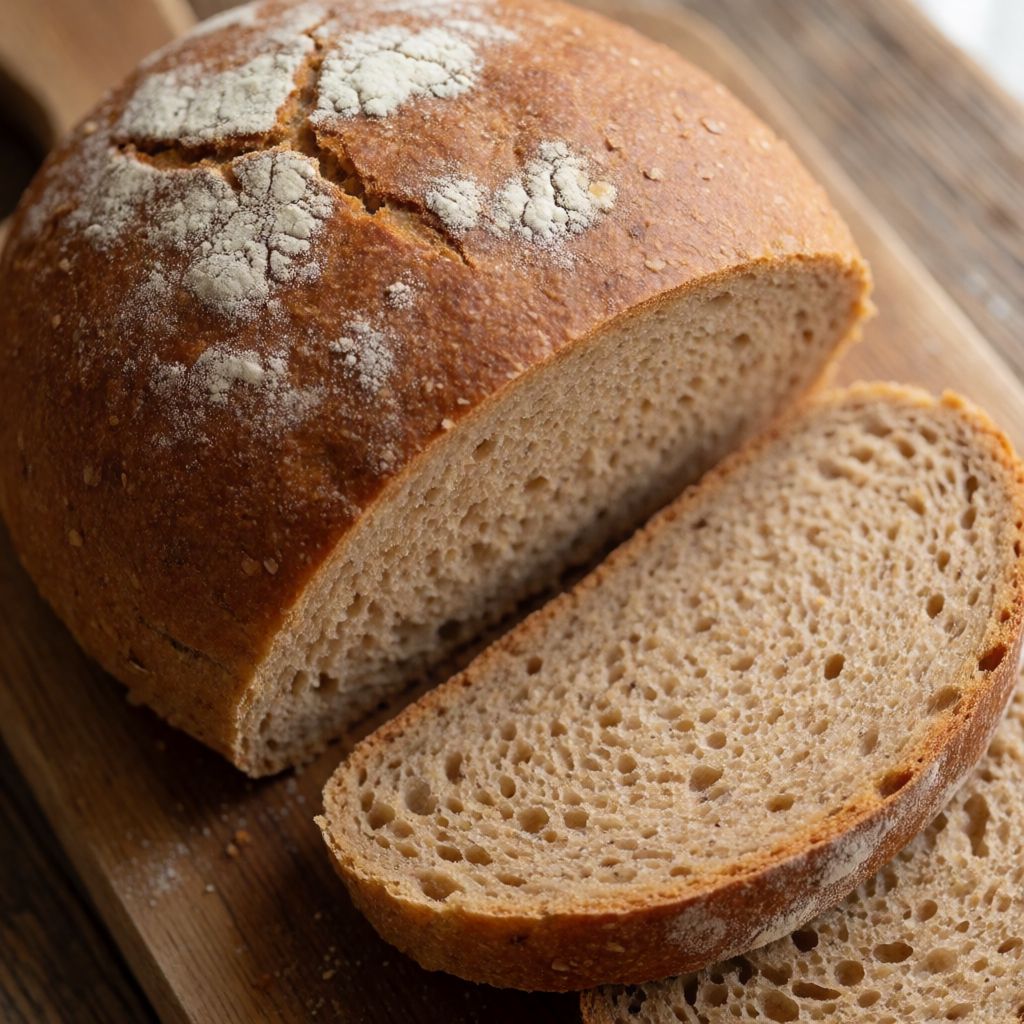
 AI photo
Wholemeal Bread
A simple home-style loaf made with wholemeal flour, olive oil and yeast.
Labels are worked out automatically from the ingredients and can be wrong. Check the packaging if it matters to you.
Ingredients
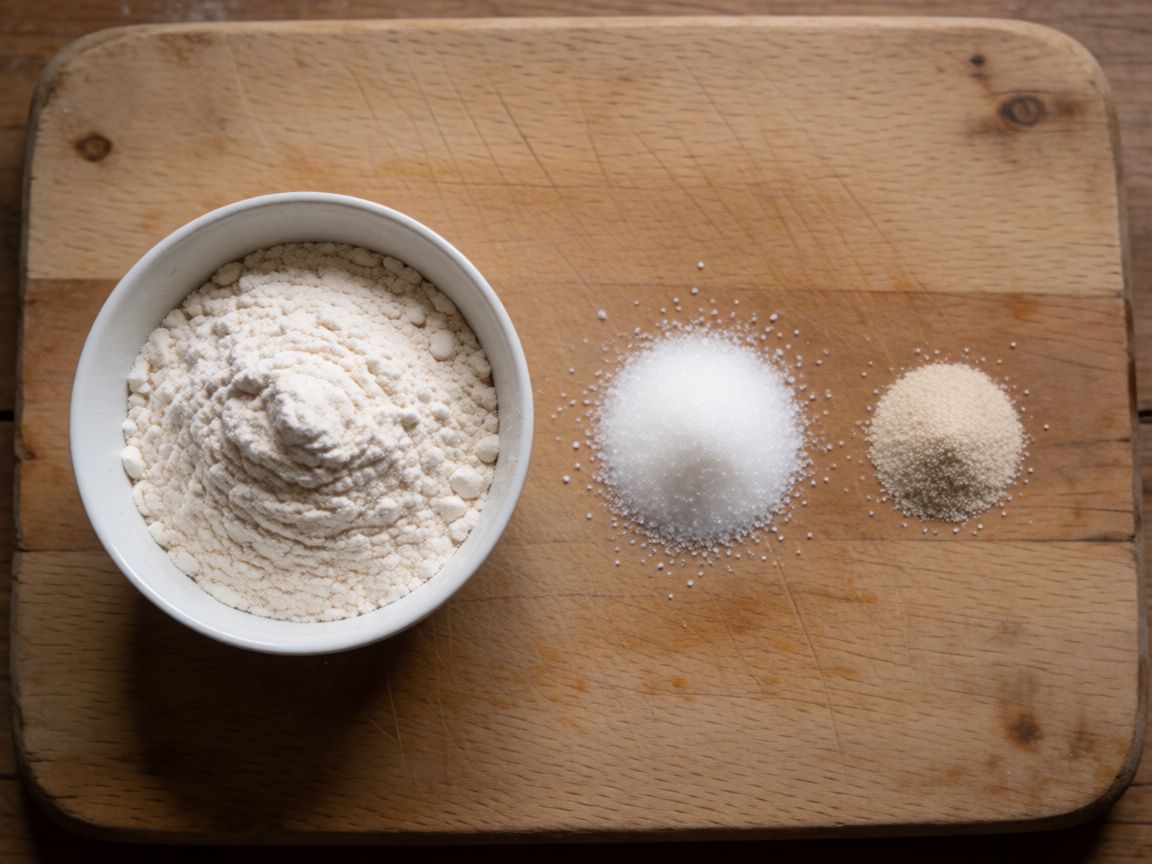






Steps
Dissolve the yeast in 50 ml of the water, add the sugar and leave for five minutes.
5 minStir the olive oil and salt into the remaining 300 ml of water.
Tip the flour into a bowl, pour in the yeast mixture and mix briefly, then add the oil mixture.
Knead the dough on a floured surface for five to six minutes until you have a springy ball.
6 minPlace the dough in an oiled bowl, cover with cling film and leave to rise in the oven with the light on for 2 hours.
120 minKnock back the dough and shape it into a loaf.
Place on baking parchment and leave to rise a second time until doubled in size.
Using a sharp knife, make a few slashes on the surface of the loaf.
Preheat the oven to 180°C and bake the bread until golden brown.
Cool the bread on a wire rack before serving.
This is the plain, everyday loaf — the one that goes in the bread bin, not the one you photograph. Wholemeal, so it's heavier and browner than a white tin loaf, with a close, slightly grainy crumb. One batch of 500 g flour makes a loaf that gives you four honest, thick-cut servings — toast for breakfast, something under the Sunday roast gravy, a sandwich the next day if it lasts that long.
What decides whether it works is almost entirely about heat and patience, not about any clever trick. Yeast is a living thing: too cold and it sits there doing nothing, too hot and you've killed it before it started. That's why the yeast goes into just 50 ml of water on its own first — warm it like bathwater, not like tea — and why you wait to see foam on top, not just five minutes on a clock. No foam, dead yeast, start again with a fresh sachet; no amount of extra kneading will fix that.
Some people think wholemeal bread is naturally dense because "that's just what wholemeal is." No — it's dense when it's dense, and the reason is mechanical. The bran in wholemeal flour is sharp-edged at a microscopic level, and as you knead, those edges slice through the gluten strands that would otherwise stretch and trap gas. White flour has none of that interference, which is why it rises taller. You can't knead your way past this; past five or six minutes you're not building more structure, you're just tiring your arm and warming the dough with your hands, which speeds the yeast up unevenly. Five to six minutes to a springy ball is the ceiling, not a minimum you're aiming to beat.
Wholemeal flour is the whole point here, and it's worth knowing why it behaves the way it does. White flour is wholemeal with the bran and germ sifted out — historically that sifting was expensive, so white bread was for people with money and wholemeal, or worse, was what everyone else ate. The modern reversal, where wholemeal is sold as the virtuous, pricier option, is marketing catching up with nutrition, not tradition reasserting itself. If you want a lighter crumb without losing the flavour, swap in a third of the weight for a strong white bread flour — more usable gluten, less bran cutting it up — but then it isn't really a wholemeal loaf any more, just a compromise, and that's fine too.
Yeast at 12 g fresh is a fair bit for 500 g of flour, which tells you the baker wanted a reliable, fairly quick rise rather than leaving it to slow fermentation overnight. If you only have dried yeast, use roughly half the weight — it's more concentrated — and the same foam test applies: no bubbling after five minutes in the warm, sugared water means it's spent, not slow. The teaspoon of sugar isn't there to sweeten the bread; it's a head start, glucose the yeast can use immediately before it has to wait for its own enzymes to break down starch into sugar it can feed on. Skip it and the dough still rises, just more sluggishly at the start.
Salt does two jobs that look like they're fighting each other. It tightens the gluten network, which is why the dough gets noticeably less sticky once it's in, and it slows the yeast down, because salt pulls water out of the yeast cells by osmosis. That's exactly why it's dissolved into the oil and water separately rather than tipped straight onto the yeast — dump salt directly onto yeast and you stall it before it's properly woken up. 15 g for 500 g flour is a normal, not heavy, hand.
Olive oil at 30 ml is doing a tenderising job rather than a flavouring one in a loaf this plain — it coats the gluten strands, which keeps the crumb from drying out as fast, since wholemeal bread stales quicker than white because the bran soaks up moisture and then lets it go again. Any oil with no smell of its own — sunflower, a neutral vegetable oil — will do the same mechanical job if olive oil isn't to hand or isn't to your taste; butter also works but behaves differently, since it's solid at room temperature and will change the texture slightly, giving a softer, richer crumb rather than this loaf's plainer bite.
The water split — 50 ml warm for the yeast, 300 ml mixed with oil and salt — is just about control: you need to know the yeast is alive before you commit the rest of the liquid to the dough. Total hydration here is moderate for a wholemeal, which absorbs more water than white flour because the bran is thirstier; if your dough feels dry and tears rather than stretches during kneading, a tablespoon more water worked in is a fix, not a deviation.
The slashes before baking aren't decoration. The loaf is still expanding when it first goes into a hot oven — oven spring, from the last of the yeast's gas and the water turning to steam — and if the crust has already set with no weak points, it tears wherever it likes, usually somewhere ugly on the side. A few decisive cuts give the steam somewhere intended to go. As for doneness in the oven: colour is your main cue, a proper gold-brown, not pale — but the reliable check is sound, tip the loaf out and knock the base with a knuckle; hollow means it's done, dull and dense means back in a few minutes more. And don't cut it hot off the rack no matter how good it smells — the crumb is still finishing its set as it cools, and a hot knife through it just gives you a gummy slice and a loaf that looks like it was never baked properly, when the fault was really yours, not the oven's.