
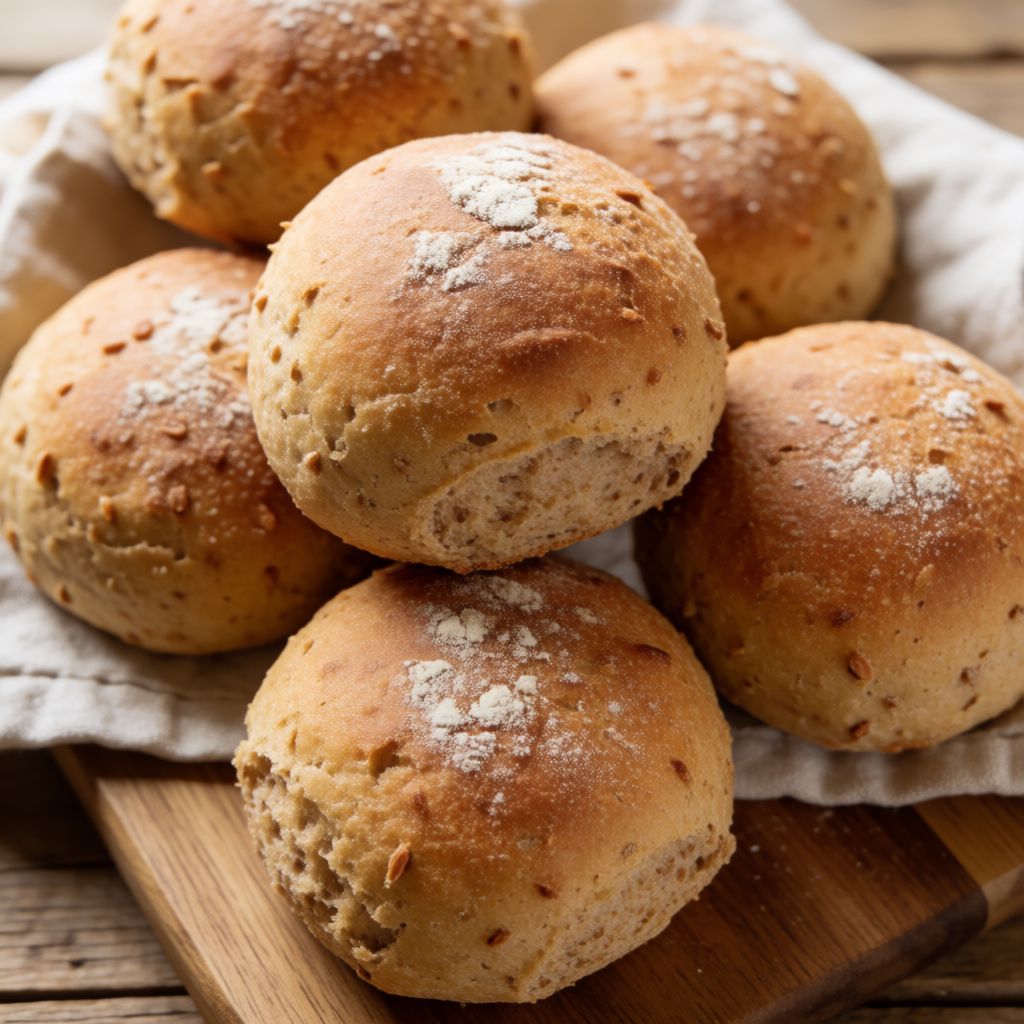
 AI photo
Wholemeal Rolls
Soft rolls made with cracked wheat berries and wholemeal flour, left to rise overnight for extra flavour.
Labels are worked out automatically from the ingredients and can be wrong. Check the packaging if it matters to you.
Ingredients
- 75 g Cracked Wheat Berries
- 300 ml Water
- 15 g Yeast
- 100 ml Water at room temperature
- 100 ml Yogurt
- 1 tsp Salt
- 350 g Plain Flour
- 150 g Wholemeal Flour






Steps
Rinse the wheat berries in a sieve under running water, put them in a bowl and pour over boiling water. Leave to stand for at least 1 hour, until the water has completely cooled to room temperature, without draining it.
60 minDissolve the yeast in a small bowl with the room-temperature water and add it to the bowl with the wheat berries along with the yogurt, salt, flour and wholemeal flour. Mix with a wooden spoon.
5 minLet the dough rise on the counter for 30 minutes, then put the bowl with the dough in the fridge overnight.
30 minTurn the dough out onto a floured surface and cut into rolls using a dough scraper.
10 minPlace the rolls on a baking tray lined with baking paper and let them rise for another 30 minutes.
30 minBake in a preheated fan oven at 180°C for about 20 minutes.
20 minLet the rolls cool on a wire rack.
This is a soda-quick-bread cousin masquerading as a yeast roll: real yeast, real rise, but half the character comes from a bowl of cracked wheat sitting in just-boiled water for an hour before the dough is even started. That's not a soak for softness alone — it's starch gelatinising and bran swelling to its full size while it still has free water to drink. Do that step properly and the crumb stays moist with little nutty flecks running through it. Skip it, or cut it short, and those same bits of bran keep absorbing moisture right through proving and baking, pulling water out of the crumb around them — which is exactly how you get rolls that look fine and bite dense and slightly gummy near the centre.
The second thing that decides whether these work is restraint. You are not making a strong white loaf here. Wholemeal flour brings bran, and bran is full of sharp little edges that slice through gluten strands as you work the dough. Some say you have to knead wholemeal doughs hard and long to "build strength" — no, because that bran will just keep cutting whatever strands you build, and all the extra kneading gets you is a tighter, tougher roll. This dough is mixed with a wooden spoon and barely touched again until it's cut into pieces. The gluten it needs, it gets from the plain flour sitting alongside the wholemeal, and from time, not muscle.
Cracked wheat berries are the one ingredient you can't swap for flour and expect the same result, because their whole job is to hold water that the rest of the dough doesn't have to fight for. Pouring boiling water over them, not warm, matters: that heat is what gelatinises the starch inside each cracked grain and softens the outer bran so it swells fully rather than staying brittle and thirsty. If you have no cracked wheat, reach for anything in the same family that will do the same trick — bulgur, kibbled rye, even a coarse porridge oat in a pinch — the criterion is a grain broken open enough to drink water and swell, not any particular grain by name.
Yeast gets dissolved in its own small bowl of room-temperature water before it meets the rest of the dough, and this isn't superstition about yeast and salt being deadly enemies. Quick contact does no harm; it's prolonged, undiluted contact with salt or a very sugary mix that slows yeast down. Dissolving it separately is really about getting it evenly spread through a stiff, lumpy dough with wet grain sitting in it — uneven yeast means patches that rise and patches that don't, and a roll with one dense side and one airy one.
Yogurt isn't there for tang alone, though you will taste it. Its acidity gently loosens the gluten network as the dough sits, which is useful here precisely because wholemeal bran is already working against gluten strength — the yogurt's softening effect and the bran's cutting effect roughly balance out, instead of leaving you with a dough too tough to shape. Any cultured dairy with a similar acidity does the same job: buttermilk, kefir, even yogurt loosened with a splash of milk if yours is very thick. Salt, meanwhile, is doing double duty as usual — flavour, yes, but also a brake on fermentation speed, which is part of why this dough can sit overnight without over-proving into a sour, collapsed mess.
The two flours are not interchangeable with each other, and the ratio here is the point, not an afterthought. Plain flour supplies the gluten backbone the dough needs to hold gas and rise into something light rather than a dense little puck. Wholemeal flour supplies the bran and germ — flavour, fibre, that slightly rough, honest crumb — but every gram of it is a gram less of pure gluten-forming protein in the mix. Push the ratio too far toward wholemeal and you get rolls that refuse to rise properly and sit flat and heavy; that's not a fridge problem or a yeast problem, it's a flour-ratio problem, and the fix is in the bag, not in the oven.
A fan oven at 180°C is a drier, faster-moving heat than the same number on a conventional setting, because the fan is actively pushing hot air across the surface of the dough rather than letting it sit still. That's exactly what you want on rolls this size: the crust sets quickly, before the inside has a chance to dry out chasing it, which is also why the time given is a floor and not a deadline — look for a top that's gone from pale and doughy to a proper gold-brown, and a roll that sounds a little hollow when you tap its base, rather than counting minutes on the oven door. Let them cool on a wire rack, not flat on the tray: a roll resting on a solid surface traps its own steam underneath and softens exactly where you don't want it, on the bottom crust that should stay crisp.