
 AI photo
Wine Biscuits
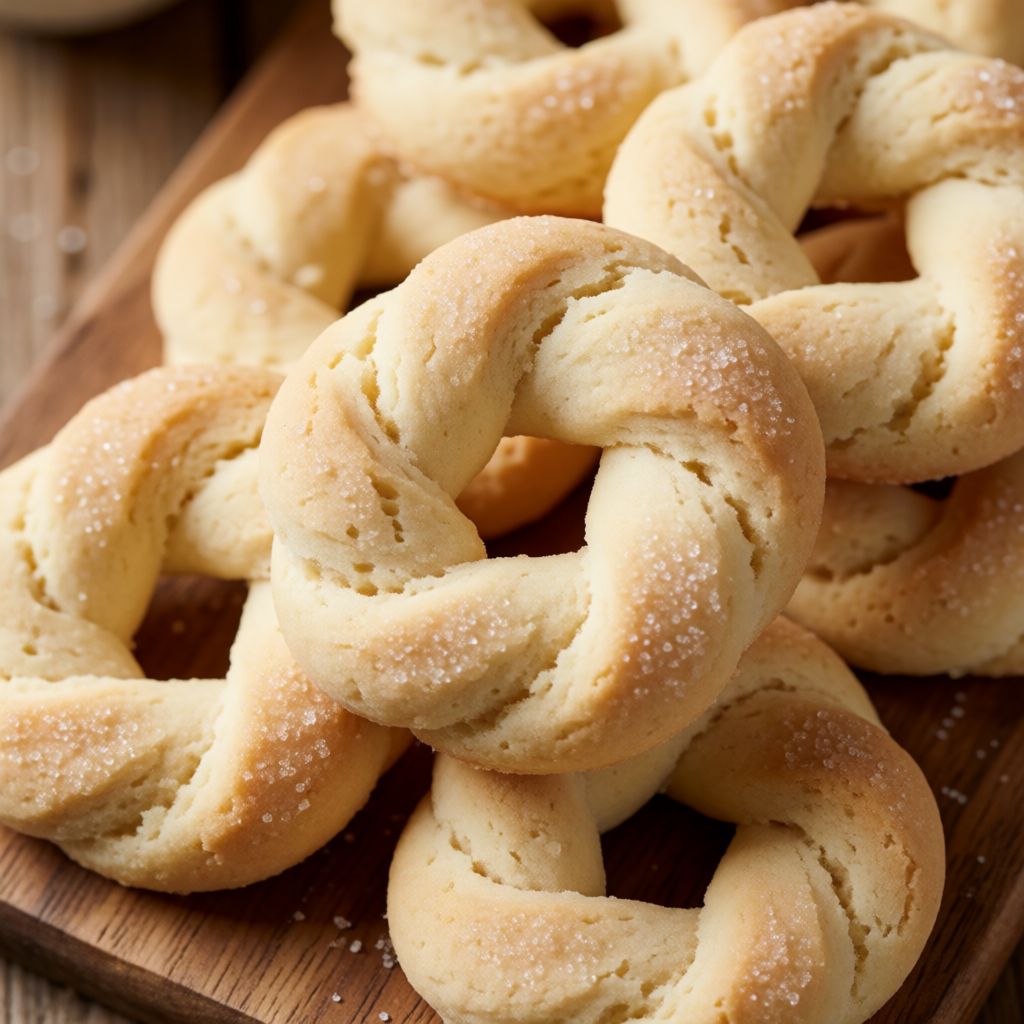
Crisp little ring-shaped biscuits flavoured with white wine and anise liqueur, finished with a dusting of sugar.
Labels are worked out automatically from the ingredients and can be wrong. Check the packaging if it matters to you.
Ingredients
- 250 g Plain flour
- 50 ml Vegetable oil
- 75 ml White wine
- 100 g Sugar
- Sugar to taste, for coating
- 1 tbsp Anise liqueur
- 1 pinch Salt
- 0.5 tsp Ammonium carbonate (hartshorn salt)







Steps
Put the flour, sugar, salt and ammonium carbonate into the bowl of a stand mixer. Add the vegetable oil and anise liqueur. Pour in the white wine and beat until smooth.
Knead the dough by hand on a work surface until it is smooth, soft and easy to shape.
Shape the dough into little ropes about the thickness of your little finger and 12–15 cm long.
Join the ends of each rope to form rings, pinching the edges firmly together.
Roll the biscuits in sugar on one side only.
Place the biscuits on a baking tray lined with parchment, leaving a few centimetres between them.
Bake at 200°C.
3 minReduce the temperature to 190°C and bake for a further 20 minutes, until the biscuits have risen and turned golden.
20 min
What was changed
The deer horn listed in the original has been swapped for Ammonium carbonate (hartshorn salt), the real baking ingredient it traditionally refers to, since UK shops don't sell deer horn as a food item.
This is a ring biscuit, not a cake pretending to be one — a village sweet from the wine country of southern Italy and Greece, where there was always a jug of white wine going flat and a tin of plain flour, but eggs and butter were for Sunday, not for Tuesday biscuits. You roll the dough into little ropes, finger-thick, and close them into rings. No butter, no eggs. What holds the dough together and makes it rise is wine, oil, and a pinch of a chemical that used to be scraped from antler and hoof — ammonium carbonate, sold now as hartshorn.
What decides whether these come out right isn't the minute count, it's two things you control with your hands before the oven even gets involved. First, the rope has to be an even thickness all the way along — not thick in the middle, thin at the ends — because the gas that puffs these up has to escape evenly through the whole ring. Second, the seam where you join the ends has to be pinched shut properly. A weak seam doesn't fail quietly; the gas finds it and the ring splits open there instead of rising all over. That's the defect you're preventing, not decoration.
The oven does two different jobs at two different heats, and that's not fussiness. The hot start sets a crust fast enough to trap the gas that's starting to come off the ammonium carbonate — if you went in low from the start, the gas would just wander out before the dough had anything to hold it in, and you'd get a flat, pale ring. The drop afterwards lets the inside dry and firm without the sugar on top scorching before the crumb is actually baked through.
Flour here is plain, and that's deliberate — you're not after chew or structure, you're after a biscuit that snaps. Strong flour would fight you, building gluten you then have to knead out again; plain flour gives in easily and holds the ring shape without springing back. Knead it only until it's smooth and obedient — overworking it is how you end up with something closer to bread than biscuit.
Ammonium carbonate is the part people stumble over, because they can't buy it at the supermarket and it smells faintly of ammonia straight out of the tin. That smell is not a warning, it's the whole mechanism announcing itself — unlike bicarbonate of soda, which only half breaks down and leaves an alkaline, slightly soapy taste behind, ammonium carbonate decomposes completely under heat into carbon dioxide, water vapour and ammonia gas, all of which leave the biscuit while it bakes. Nothing stays behind but the lift. That only works, though, if the biscuit is thin and gets hot enough, long enough — a thick cake made with the same stuff would trap the ammonia inside and you'd taste it. Look for it under the name hartshorn in home-baking suppliers, it's the same thing speculaas and some German biscuits use. If you genuinely can't find it, baking powder will lift the dough, but you lose the clean snap and pick up a faint cakey softness instead — it's a different biscuit wearing this one's clothes.
The wine and the oil are doing the job butter and egg usually do, and that's the real history here, not a mystery. This was a biscuit built to use what a household always had — a bottle going flat, oil in the cupboard — and nothing that needed buying specially or keeping cold. Any dry, light white wine works; it doesn't need to be good, it needs to be dry and not oaked, because oak brings a bitterness that has nothing to do with biscuits. The oil's only requirement is that it has no opinion of its own — a light sunflower or rapeseed oil, nothing that tastes of itself, because here oil isn't flavour, it's just what keeps the dough short instead of tough.
Anise liqueur gives the biscuit its character, the thing that makes you go back for another one without quite knowing why. Any clear anise spirit does the same job — ouzo, sambuca, pastis, raki — the sugar content and strength vary a little, but the anise note is what matters. If you'd rather not use alcohol at all, crush a teaspoon of anise seed and let it sit in the wine for a few minutes before mixing; you lose a little lift and some of the rounded warmth alcohol brings, but you keep the flavour.
Rolling one side only in sugar isn't fussiness either — it's practical. The side touching sugar and air crisps and catches a little colour; the side touching hot metal would just burn the sugar onto the tray if you coated it too. Use ordinary granulated sugar, not icing sugar, which melts flat and loses the bite you actually want on the tongue.
One honest note for a UK kitchen: if your oven is a fan oven, it runs hotter than the dial says, so treat 200°C and 190°C as upper limits and watch the biscuits, not the display. And give the shaping a moment of patience — a seam pinched in a rush comes apart in the oven, and no amount of correct temperature saves a ring that's already split.