
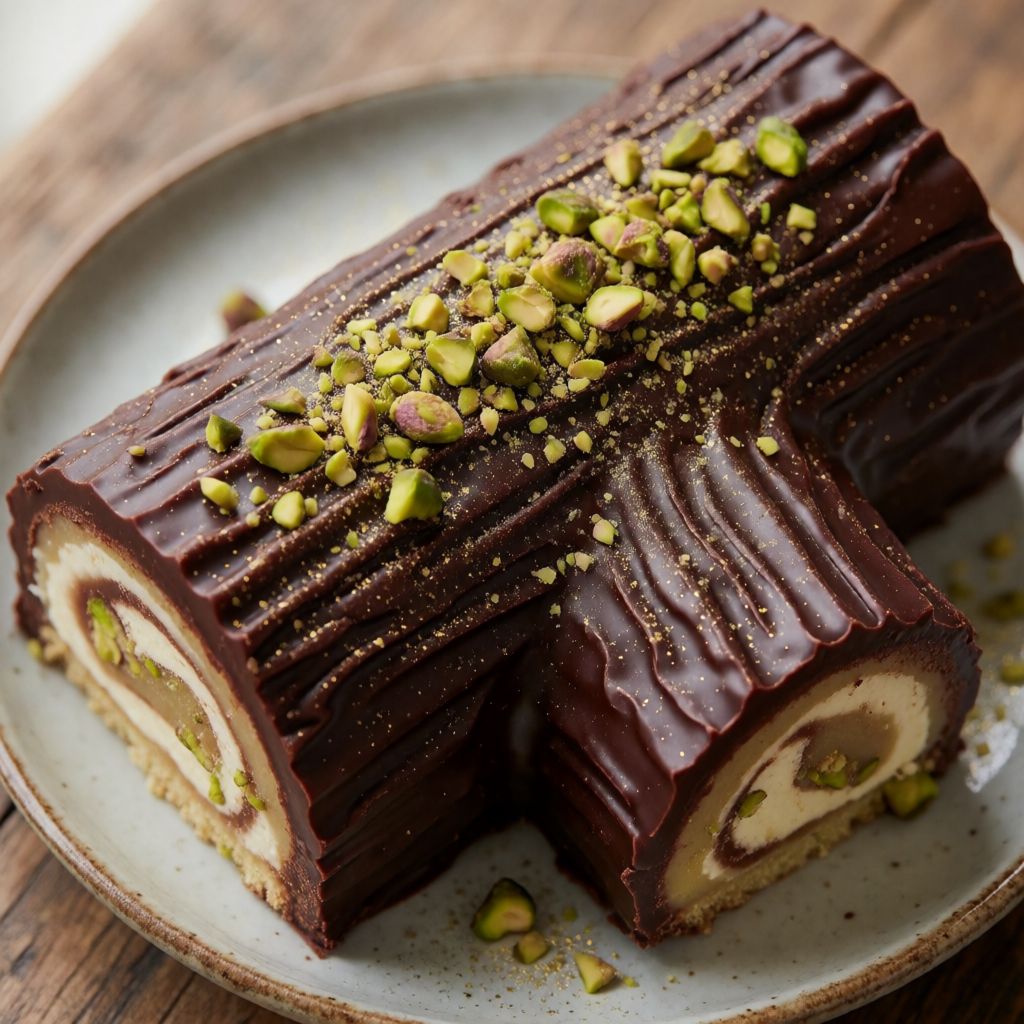
 AI photo
Yule Log with Marzipan and Nougat
A festive Yule log made with marzipan, nougat and pistachios, finished in dark chocolate.
Labels are worked out automatically from the ingredients and can be wrong. Check the packaging if it matters to you.
Ingredients
- 200 g Marzipan
- 100 g Nougat
- 40 g Pistachios finely chopped
- 200 g Dark Chocolate
- 1 tbsp Pistachios finely chopped
- 1 pinch Edible Gold Dust
- 1 tsp Dried Flowers


Steps
Roll out the marzipan on a sheet of baking paper. Cut the nougat into thin slices and arrange them over the marzipan, then smooth gently with a hot knife — just dipped in boiling water and wiped dry — to warm the nougat and make it easier to work with.
10 minSprinkle the nougat slices with the finely chopped pistachios, then roll the marzipan into a log. Trim the ends.
10 minCoat the log with tempered dark chocolate and leave to set before decorating.
Before serving, cut into slices.
5 minDecorate with the dried flowers, edible gold dust and finely chopped pistachios.
5 min
This isn't baked, and that's the whole point. A Yule log usually means sponge rolled around cream — this one is built from paste: marzipan wrapped round nougat, rolled in pistachios, dipped in chocolate. No oven, no cook time, because nothing here needs heat to become what it is. It only needs to be shaped while it's warm enough to bend, and then left alone to set.
That word 'bûche' has an older meaning than cake. The custom was to burn an actual log at midwinter — the edible log came later, as a joke bakers made on the custom. In the south of France that joke never involved sponge at all: marzipan-and-nougat logs were the bûche long before Parisian pâtissiers turned it into a chocolate-buttercream roll with a bark pattern dragged through with a fork. What you're making here is closer to the older, plainer version. Some say a Yule log has to be cake. No — because the name points at a shape burned in a hearth, not at a crumb.
Two moments decide whether this works, and neither is about minutes. First: is the nougat pliable enough to lie flat against the marzipan and fold without splitting its surface? That's why you warm the knife in boiling water and press it against the slices — not to cook the nougat, just to soften the sugar-fat matrix at the surface so it gives instead of cracking, the way a cold bar of toffee cracks but a warm one bends. Dry the knife first. Water dragged into the nougat or marzipan will later sit there, and sugar paste with wet spots sweats and goes sticky days on.
Marzipan is the only reason you can build this shape at all. It's ground almonds bound by their own oil and a good deal of sugar — no gluten, no water to evaporate, nothing that needs to relax or rest. Press it and it stays pressed; roll it and it stays rolled. That's why marzipan is a sculptor's material more than a baker's. If it cracks instead of rolling, the cause is almost always temperature — fridge-cold marzipan loses its give, the fat stiffens, and it tears at the fold instead of bending. Bring it fully to room warmth before you touch it. If you have no marzipan, any almond paste with enough sugar to be moldable will do, though pure almond paste is coarser and less sweet — add a little icing sugar and knead until it stops crumbling at the edge.
Nougat here needs to be the soft kind — the honey-and-egg-white nougat that gives under thumb pressure, not the brittle nut brittle some shops also call nougat. Soft nougat is a meringue stabilised with honey and whipped to trap air, which is exactly why it's forgiving when warmed slightly and unforgiving when cold: the air cells are rigid until heat loosens the sugar around them. If all you can find is the hard, glassy kind, the hot-knife trick matters even more — warm it longer, work faster, and don't expect the same ease.
Pistachios between the layers aren't decoration at that stage — they're texture. Without them the roll is soft all the way through, paste against paste, and a slice gives nothing to the teeth. Any lightly toasted nut with a clean bite would do the same job; pistachio earns its place here because it keeps its green under the chocolate, which matters once you cut the log and the cross-section shows at the table.
The chocolate is where the whole thing either holds or fails. Tempering means persuading the cocoa butter in it to set as one specific, stable crystal form instead of several competing ones. Melt it fully — that erases every crystal memory it had. Cool it to the point where the stable form starts to seed, then nurse it back up just enough to melt off the unstable ones and no more. Get that band right and the coat sets glossy, snaps clean under a knife, and stays that way for days. Get it wrong and it sets soft, dull, and marks with a fingerprint at room temperature — not a flavour fault, a physical one, and no amount of good chocolate fixes a bad temper. Use a couverture with real cocoa butter in it, not a bar padded out with other fats; those won't crystallise the same way no matter how carefully you cool them. You don't need a marble slab in an ordinary flat — a bowl, a thermometer or just the back of your hand against the melted chocolate, and patience, will do it.
Once coated, let the log set somewhere cool and still, not in a cold fridge straight off — cold air against warm chocolate pulls moisture out of the air onto the surface, and that moisture is what fogs the shine you worked for. A cool room, or a brief turn in the fridge followed by rest at room temperature, is the honest version of what a professional chiller does in one step.
Gold dust and dried flowers add nothing to taste — say that plainly, because it's true. They're theatre, the same theatre that put gold leaf on medieval banquet food to announce that the host could afford to waste something valuable on the inedible. Skip them and the log is exactly as good to eat. Use real culinary-grade dried flowers if you do — not ones from a florist, which carry whatever was sprayed on them for looks, not for eating.
The servings line says one, but that's the yield of a single log, not a single plate. Two hundred grams of marzipan and the same of chocolate, wrapped round a hundred of nougat, makes one log that slices into ten or so thin rounds — plenty for a table of eight to ten after a heavy meal, because it's rich and a small slice is the right amount. Cut it only just before serving, with a knife warmed and dried the same way you softened the nougat; a cold knife through a well-tempered coat doesn't cut, it shatters. Pour tea with milk alongside it — something plain to cut the sweetness is not a bad idea at all.