
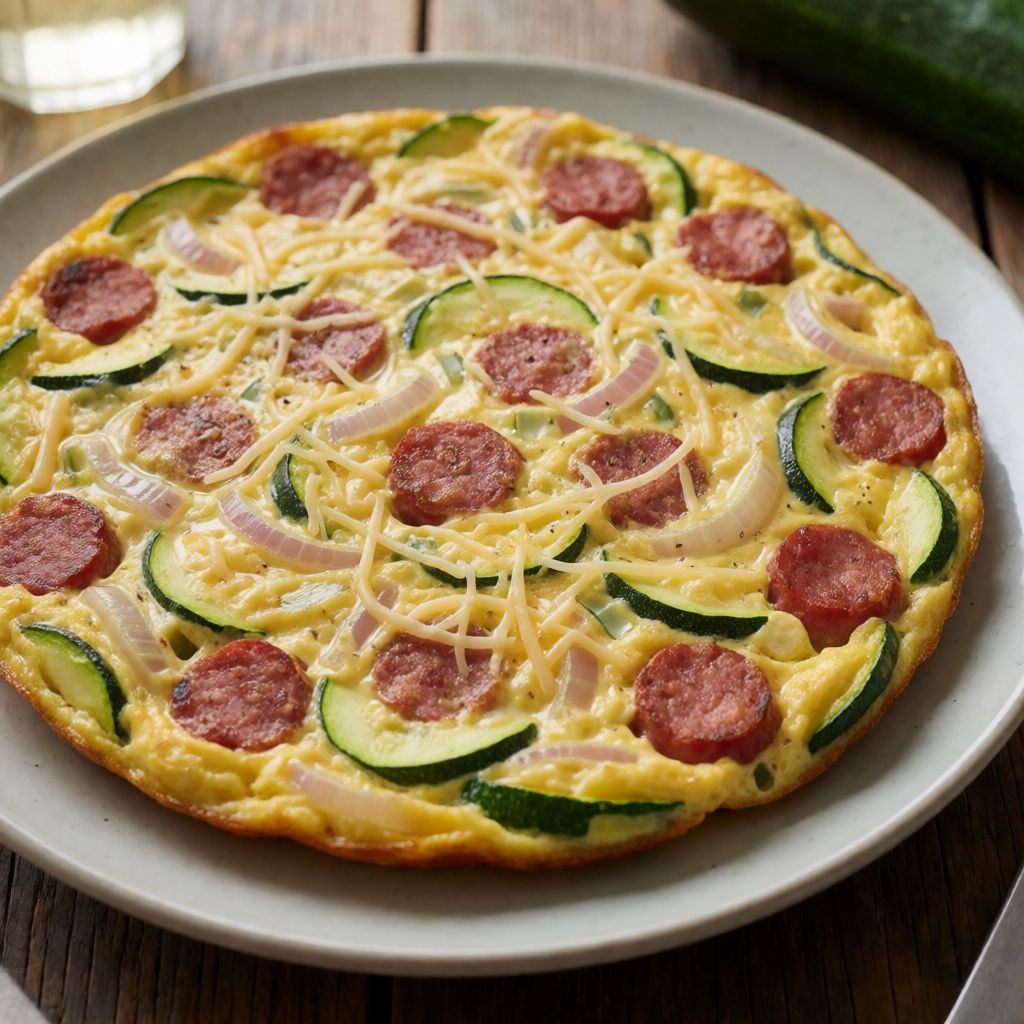
 AI photo
Courgette and Chorizo Frittata
A simple frittata with courgette and chorizo, finished in the oven and topped with fresh herbs.
Labels are worked out automatically from the ingredients and can be wrong. Check the packaging if it matters to you.
Ingredients
- 2 pcs Onion finely chopped
- 50 g Chorizo diced small
- 8 pcs Eggs
- 100 ml Milk
- 50 g Hard cheese coarsely grated, such as Gruyère or Cheddar
- 2 pcs Courgette coarsely grated
- 1 tsp Olive oil
- Salt
- Black pepper freshly ground
- 1 bunch Fresh herbs fresh, such as chives, chervil, or watercress









Steps
Fry the onion and chorizo in a saucepan or frying pan with a little olive oil until the onion has softened.
Beat the eggs with the milk and mix in the cheese, salt and black pepper until smooth.
Squeeze the liquid well out of the grated courgette, add it to the egg mixture, and pour everything into the pan.
Cover with a lid and cook over medium heat for about 5 minutes.
5 minCheck that the pan is oven-safe, then place it in a preheated oven at 180°C for 10–15 minutes, or until the eggs have set.
12 minServe with fresh herbs.
What was changed
The oven temperature was rounded to to match the display step used for ovens here.
This isn't a fat omelette, whatever people tell you. An omelette is cooked fast, high heat, folded over itself in under a minute. A frittata is a baked custard — egg and milk set slowly, together, into a flat disc you can slice into wedges and still eat cold the next day without wincing. That slowness is the whole point, and it's why the pan goes from hob to oven instead of staying on the heat throughout.
What decides whether this works is water, mostly. Courgette is almost all water held inside cell walls that grating has just broken open. If you skip squeezing it, that water pours straight into your egg mixture and the frittata never properly sets — it stays wet in the middle no matter how long you leave it in the oven, because you're not cooking eggs anymore, you're trying to evaporate a swamp. Squeeze it hard, with your hands or through a cloth, until it stops dripping. That's not fussiness, that's the difference between a custard and a soup.
The cover-then-oven move solves a different problem: a hob only heats from below. Leave the pan there and the bottom turns leathery while the top is still raw egg. The lid traps enough steam to start setting the top gently; the oven then finishes the job from all sides at once, evenly, so you get a uniform set rather than a burnt base under a liquid centre.
Onion first, because it's the sweetness underneath everything else. Chop it fine and cook it only until it softens and turns translucent — the cell walls breaking down, nothing more. Keep going past that into deep gold and you're adding a caramel sweetness this dish doesn't ask for and will fight with the chorizo.
Chorizo in a British kitchen needs a second look at the packet. There's cured, sliced chorizo meant for a sandwich, and there's "cooking chorizo" sold raw, meant for the pan — you want the second kind here, diced small so it melts into the mixture rather than sitting in lumps. As it cooks it renders out its own red, paprika-stained fat, which is why you only need a token teaspoon of olive oil to stop the first few seconds sticking — the chorizo brings its own cooking fat after that. If you can't get it, any cured, fatty, well-seasoned meat does the same job — pancetta or smoked bacon, with a pinch of smoked paprika added for the colour and warmth chorizo would have given you.
Eight eggs is the structure of the whole dish — egg protein is what sets into a solid shape once it reaches a certain warmth, which is also why a gentle 180°C oven is the right tool and a hot grill is not: too much heat too fast and the proteins clump tight instead of setting softly, and you get the rubber texture nobody asks for twice. The milk is there to get in between those proteins and loosen them, so the set stays tender rather than tightened like a rubber ball. Use cream if you want it richer, or any dairy at all — the point is fat and liquid, not milk specifically.
Cheese does two jobs: salt and binding fat. Gruyère or a mature cheddar both melt cleanly without weeping oil everywhere, which is the real criterion for a "melting" cheese — grate coarse rather than fine so it stays in visible pockets rather than disappearing into the mix.
Courgette you already know about — squeeze it properly, don't rush that step, patience here is the difference between a set frittata and a wet one. The pan matters more than people in a British kitchen expect: plenty of nonstick frying pans here have a plastic or rubber-coated handle built for the hob only, and that will not survive an oven. Check the handle before you start, not after the pan's full of egg — cast iron, stainless steel, or anything explicitly ovenproof is what you need.
The herbs go on raw, at the very end, uncooked on purpose — chives, chervil, watercress, whatever's fresh — because their job is to be the one cold, sharp, crunchy thing against a dish that's otherwise warm and soft all the way through. This is, at heart, a use-up-what's-in-the-fridge dish — eggs were always the cheapest reliable protein in a kitchen, and a frittata is simply what you make when you've got a bit of cured meat, a vegetable going soft, and some cheese, rather than a dish with any fixed ceremony attached to it. Four people, one pan — don't overthink the proportions beyond that.