
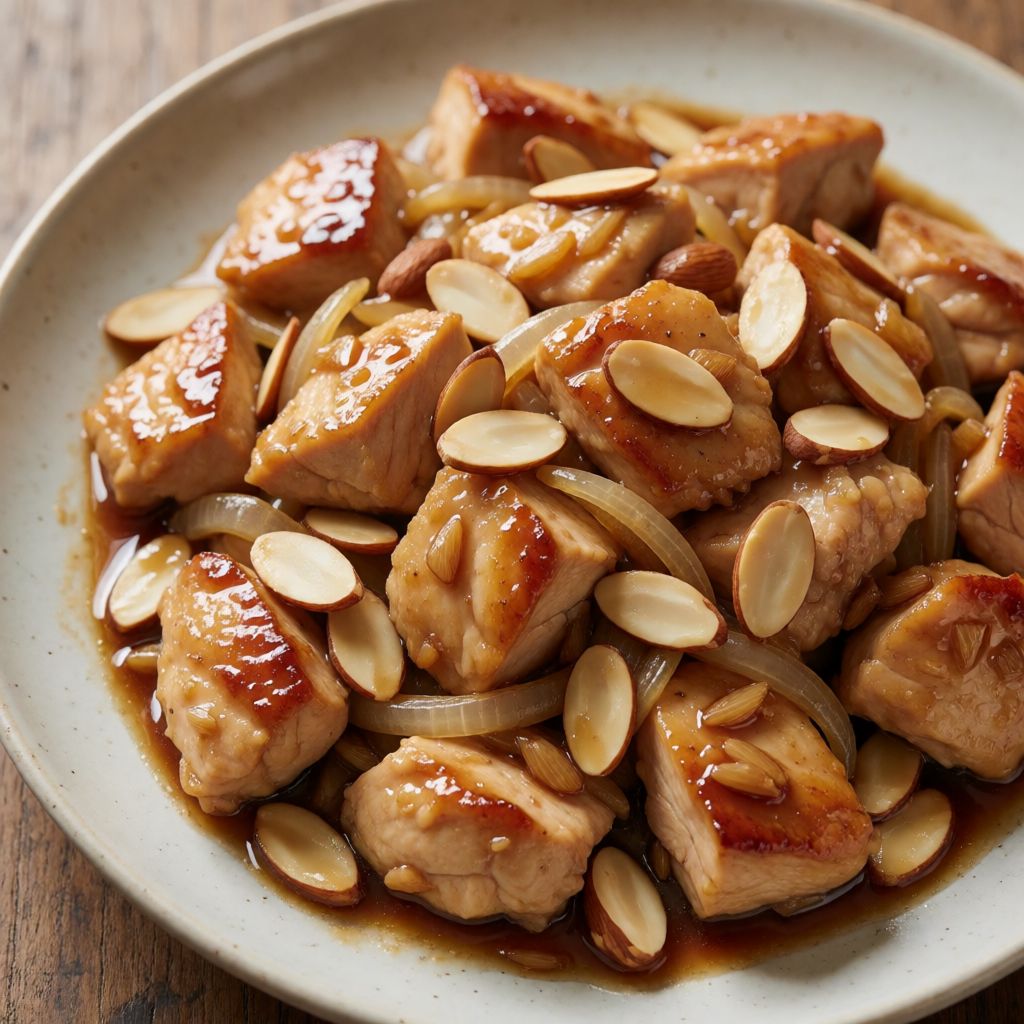
 AI photo
Chicken with Almonds
A quick stir-fried chicken breast and almond dish with ginger and soy sauce.
Labels are worked out automatically from the ingredients and can be wrong. Check the packaging if it matters to you.
Ingredients
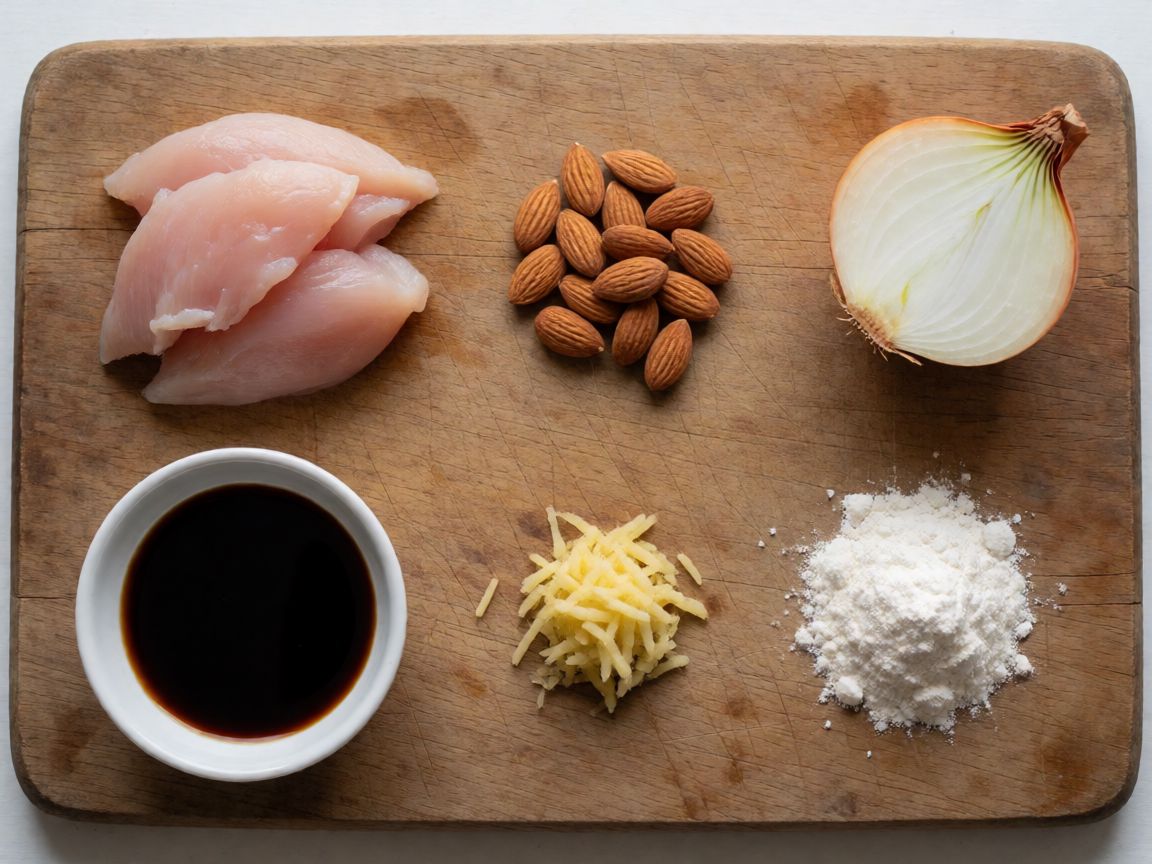
- 400 g Chicken breast
- 100 g Almonds
- 70 g Soy sauce
- 30 ml Water
- 1/2 pcs Onion
- 30 g Fresh ginger grated fresh
- 30 g Vegetable oil
- Plain flour as needed
- 1 pinch Salt to taste








Steps
Scatter the almonds on a non-stick pan and toast for a few minutes, stirring often, or roast in the oven at 180°C for 10 minutes.
10 minCut the chicken breast into cubes and coat them in plain flour.
Finely chop half the onion and put it into a large pan with the vegetable oil.
Add the grated fresh ginger.
Add the chicken cubes and fry for a few minutes over high heat until lightly golden.
Cook the chicken until fully done (internal temperature 74°C).
Lower the heat, add the soy sauce and water, season with salt to taste and stir.
Add the toasted almonds and, stirring occasionally, cook until the dish is ready.
Serve hot.
This is a stir-fry wearing a slightly Chinese coat but built like any good kitchen compromise: cheap chicken breast, soy, ginger, and almonds standing in for cashews because somebody once had almonds in the cupboard and no cashews. Nothing exotic happens here — it's a flour-dusted sauté finished in its own reduced soy liquor. What decides whether it works is almost entirely about two things: whether the chicken is cooked through without turning into rubber, and whether the almonds stay crisp against the softness of the meat.
The flour coating is doing real work, not just tradition. A thin dusting on the cubes means that when they hit the hot oil, the starch gelatinises almost instantly and seals the surface. That seal is what gives you "lightly golden" rather than grey, weeping chicken — without it the meat releases its own moisture straight into the oil, the temperature in the pan drops, and you poach instead of fry. Some say you brown meat "to lock in juices" — no, that's not how it works, nothing gets locked anywhere; what browning actually does is build flavour on the surface through the Maillard reaction and give you textural contrast. The juice-locking myth survives because the result looks similar enough that nobody questions it.
Chicken breast is the right cut for this, not because it's "healthier" in some noble sense, but because it cooks fast and cubes cleanly — a thigh would need longer and release more fat, fighting the quick stir-fry logic of the dish. If you only have thigh, trim it well and expect slightly more liquid in the pan; it's forgiving, just not the cut this recipe was built around.
The almonds are there for crunch and a faint bitterness that cuts the soy's saltiness — the actual nut barely matters beyond that. The real criterion for a substitute is: a raw nut firm enough to survive dry toasting without burning and oily enough to toast rather than just dry out. Cashews are the usual swap and arguably the more traditional choice in the dish this one echoes, but peanuts or even sunflower seeds in a pinch will do the same job of contrast, just with a different personality.
Soy sauce here isn't a seasoning you sprinkle — it's the entire sauce, so its quality matters more than in a marinade you'll discard. A dark, cheap soy will push the dish towards flat saltiness with no backbone; something with a bit of fermented depth earns its place. If you are avoiding soy specifically, you need a liquid with its three jobs covered: salt, savoury depth (umami), and dark colour — a mushroom-based seasoning sauce, or tamari for the coeliac version, gets closer than any "soy-free" blend that just tastes of salt water.
Fresh ginger grated, not powdered, is non-negotiable in spirit if not in letter — dried ginger is a different spice entirely, sharper and more one-note, lacking the citrus-green top notes that fresh ginger loses within minutes of grating. If you truly have no fresh ginger, a thumb-sized amount of the jarred paste is closer than the dried powder, though neither beats peeling and grating it yourself, which takes under a minute and costs you nothing but a bit of patience you already need for the chicken.
The oil should carry no flavour of its own — its job is heat transfer, not taste, so a neutral vegetable or sunflower oil does exactly what's asked. Olive oil would compete with the ginger and soy rather than support them, and it also smokes at a lower point than you want for that initial high-heat sear.
On a domestic hob, "high heat" for step 5 means the hottest setting your biggest ring gives you — a British gas hob rarely reaches the output of a wok burner, and an induction ring, for all its speed, still can't replicate the direct flame licking up the sides of a kazan-shaped pan. The honest fix is a wide, heavy-based frying pan rather than a tall saucepan, giving the chicken room to actually fry in a thin layer rather than steam in a crowded pile — crowding the pan is the single most common reason a stir-fry turns grey and sad instead of golden. Do the chicken in batches if your pan isn't wide enough rather than tip it all in at once; that patience at the start saves the whole dish.