
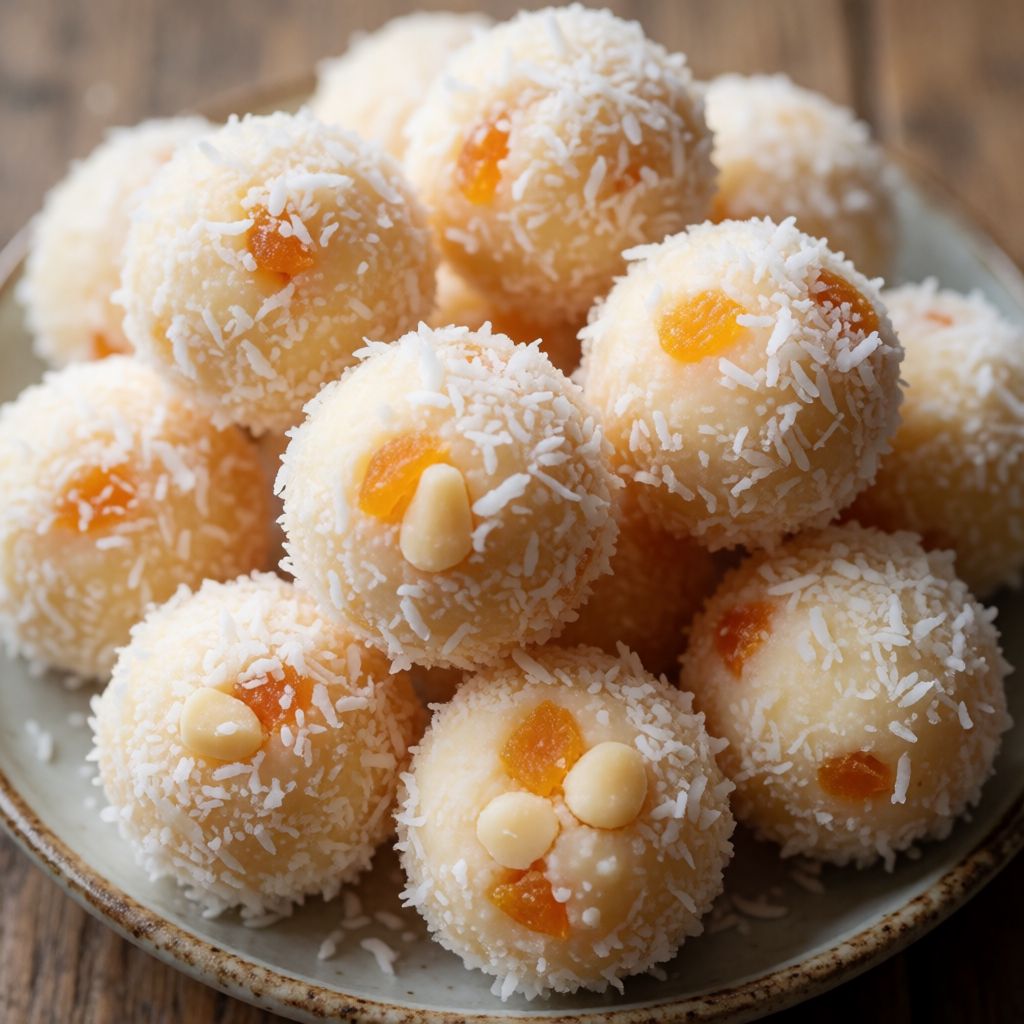
 AI photo
Apricot and Coconut Balls
No-bake apricot and coconut energy balls, quick to make and great for snacking.
Labels are worked out automatically from the ingredients and can be wrong. Check the packaging if it matters to you.
Ingredients
- 150 g Dried apricots
- 100 g Desiccated coconut
- 1 tbsp Coconut oil
- 10 pcs Macadamia nuts salted
- 1 pinch Salt
- 100 ml Desiccated coconut for coating the balls



Steps
Chop the dried apricots on a board.
Put them in a mini chopper together with the desiccated coconut, coconut oil, macadamia nuts and a small pinch of salt.
Blend thoroughly until the mixture becomes smooth.
Shape into 15–20 small apricot and coconut balls and roll them in the desiccated coconut.
What was changed
Coconut flour was replaced with desiccated coconut Desiccated coconut, which gives the right texture for UK kitchens.
These are not a dessert you cook — they're a dessert you build. No heat, no kazan, not even your hob gets a look-in, and that's worth saying plainly before anyone goes hunting for a frying step that isn't there.
What decides whether it works isn't the flavour — apricot and coconut always get along, that part is cheap and reliable. What decides it is the bind. The paste has to be sticky enough to hold a shape pressed in your palm, but not so wet that it smears across your fingers. You judge this by touch, not by the clock: press a small lump of the mixture — if it holds a dent and keeps its shape, you're done; if it slumps, give it another ten seconds in the chopper.
Some say these balls need egg white or honey to bind them. No — the apricot does that job on its own. Dried apricot is dense with natural sugar and a trace of pectin, the same substance that sets jam; blend it hard enough and it turns sticky by itself. Honey only adds more sweetness and more mess to your hands.
Patience here isn't about standing over anything — it's about letting the coconut oil firm back up before you roll. Warm palms melt it in seconds, and a mixture that's too soft just coats your hands instead of shaping. A few minutes resting in a cool kitchen, or a short spell in the fridge if your flat runs warm, is what actually gives you a ball you can roll clean.
Dried apricots are doing two jobs, flavour and glue, so choose with both in mind. The darker, almost brown ones (unsulfured) are drier and firmer — less moisture means a surer bind. The bright orange ones (treated with sulphur dioxide to keep that colour) are sweeter and softer, which can leave your mixture slightly looser; if that's what you've got, let the ball rest longer before rolling, or add a touch more desiccated coconut to take up the extra moisture.
Desiccated coconut is in the recipe twice, and the two jobs are different. Inside the mix it's bulk and a bit of fat, soaking up the apricot's stickiness so the paste isn't gluey. On the outside it's armour — it stops the ball sticking to your hand or the plate, and it's the first thing your tongue meets, so go for the finer, drier shred rather than big flaked coconut, which won't press on evenly.
Coconut oil is chosen for one physical fact: it's solid at room temperature and melts at hand-warmth, which is exactly the behaviour you want for a no-cook binder. Any fat that's firm at room temperature and carries no smell of its own would do the same mechanical job — cocoa butter is the obvious stand-in — but coconut oil also quietly repeats the coconut flavour already in the bowl, so swapping it changes the taste, not just the texture.
Macadamia nuts bring fat and a soft crunch that breaks up what would otherwise be a uniform paste — without them the balls are smooth all the way through, pleasant but a bit dull on the tooth. They're salted here on purpose, not by habit: salt in a sweet mixture doesn't fight the sweetness, it sharpens how your tongue reads it, the same trick as a pinch of salt in caramel. If your nuts are unsalted, don't skip the extra pinch of salt the recipe calls for separately — it's not decoration, it's doing real work. Cashews or almonds will stand in for macadamia well enough; they're less buttery, so expect a slightly firmer bite.
You don't need a kazan or even a saucepan for any of this — a mini chopper or a small food processor is the one piece of equipment that matters, and most UK kitchens already have one tucked behind the kettle. Fifteen to twenty balls from this amount feeds a tea tray for a good-sized gathering, or quietly disappears over a few days of tea with milk, which is really the best test any no-cook sweet can pass.