
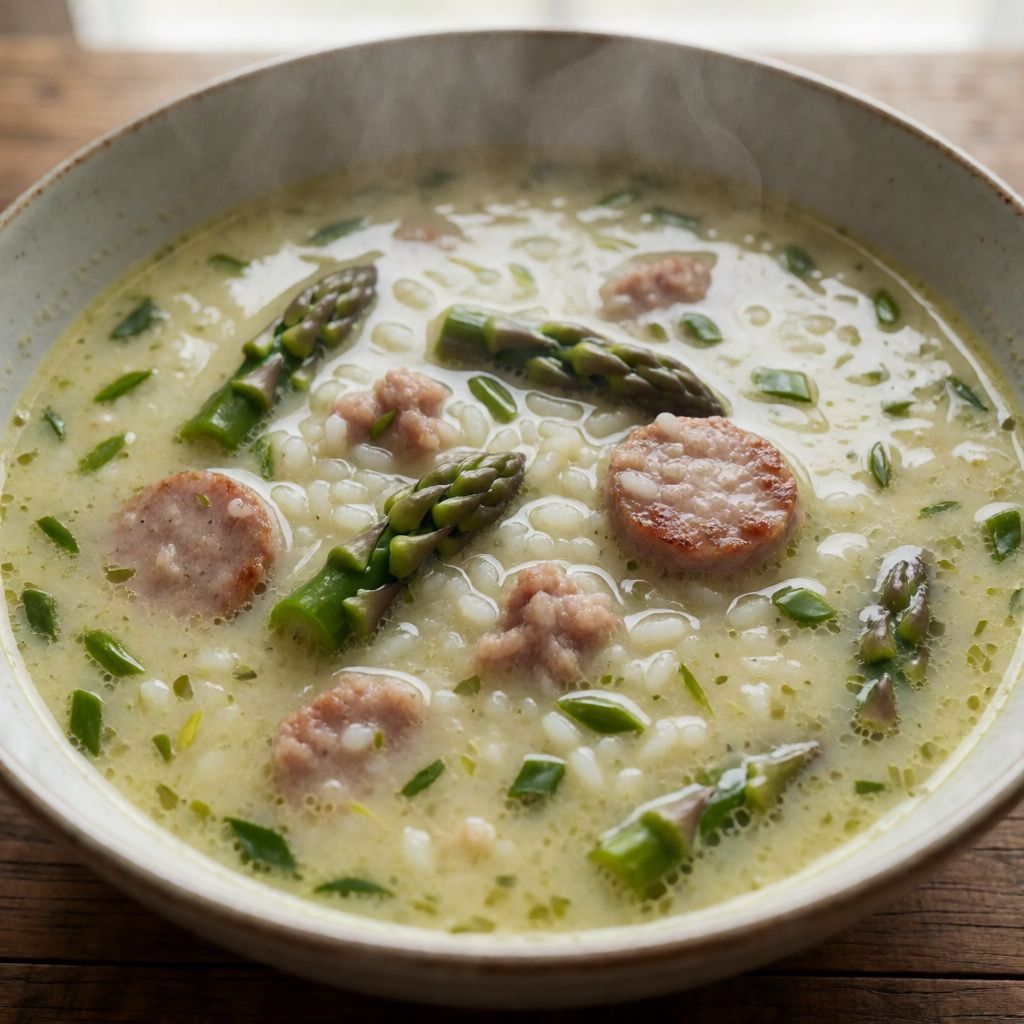
 AI photo
Asparagus and Sausage Soup
A comforting soup of asparagus, rice and sausage meat, finished with Parmesan.
Labels are worked out automatically from the ingredients and can be wrong. Check the packaging if it matters to you.
Ingredients
- 650 g Asparagus
- 225 g Rice
- 1 pcs Onion
- 150 g Sausage meat
- Parmesan to taste
- 3 tbsp Olive oil
- White wine to taste
- Salt to taste
- Black pepper to taste
- 1.5 l Vegetable stock










Steps
Bring the vegetable stock to the boil and keep it hot over a low heat.
Wash the asparagus under running water and trim off the woody ends. Cut into medium pieces, setting the tips aside separately.
Heat the olive oil in a large non-stick pan, add the finely chopped onion and gently fry until golden.
Add the sausage meat and fry for a few minutes, stirring with a wooden spoon. It is ready when the centre reaches 71°C.
Pour in the white wine and let it reduce slightly, then add the chopped asparagus (not the tips). Season with salt and pepper and cook for about 5 more minutes.
5 minAdd the rice to the hot vegetable stock and cook for 10 minutes.
10 minAdd the asparagus and sausage mixture to the rice and stir together.
Add the reserved asparagus tips and finish cooking the soup.
Before serving, sprinkle the soup generously with Parmesan.
What was changed
The sausage filling has been replaced with Sausage meat, a product commonly found in UK shops.
This is a risotto-style soup that pretends to be simple and isn't, quite — it's rice cooked directly in stock rather than boiled separately, so the starch it sheds thickens the broth instead of washing down the drain. That's the whole mechanism. Skip it and you get rice floating in clear stock, technically correct, missing the point.
What decides whether it works is two separate timings that have nothing to do with each other: the rice needs enough time submerged in hot stock to swell and give up starch, and the asparagus needs almost none, because asparagus goes from crisp to grey mush in the time it takes to answer the phone. That's why the tips are held back and dropped in right at the end — they're the thinnest, most fragile part of the stalk, cooked by residual heat more than by boiling.
The sausage meat is there for fat and savour, not bulk. Frying it after the onion rather than with it matters: onion needs gentle, steady heat to go gold without catching; sausage meat thrown in alongside would seize and toughen before the onion's even translucent. Two different jobs, two different moments.
Some say asparagus soup must be made with the asparagus pureed smooth — no, that's a different dish entirely (a velouté), and if you puree this one you lose the texture contrast that's actually the point: soft rice, tender stalk pieces, and tips that still have a bit of bite.
Asparagus: 650 g sounds generous until you remember you're throwing away the woody bottom third of every stalk. Snap-test it rather than guess with a knife — bend the stalk and it breaks naturally where the fibrous part ends; cut there, not where you think looks tidy. The tips get cut off and saved because they're done in under a minute of heat, while the lower pieces need the full simmer to soften from "vegetable" to "spoonable." If you can't get good asparagus — out of season, limp, going grey at the cut end — don't force it; courgette or green beans cut small will give you a vegetable soup with body, just not this one.
Rice: 225 g for four people is a soup ratio, not a pilaf ratio — it's meant to swell and partly dissolve, releasing starch into the stock the way risotto rice does, so use a short-grain variety (arborio, carnaroli, or at a pinch pudding rice) rather than basmati or long-grain, which stay separate and starve the broth of body. Ten minutes in the stock is a minimum, not a clock to trust blindly — bite one grain; if the centre's still chalky, give it more time before the asparagus goes in, because once that's added you're racing the vegetable, not the rice.
Sausage meat: 150 g is seasoning as much as protein — it's what stops this tasting like virtuous vegetable water. Buy it loose from a butcher, or skin a few decent pork sausages yourself if your supermarket only sells it that way wrapped. The 71°C centre temperature in the recipe is the actual food-safety mark for pork mince — colour change ("no longer pink") is not reliable, a thermometer is cheap and removes the guesswork.
Onion: finely chopped and fried until golden — not browned, not caramelised, just the point where it's gone sweet and translucent and lost its raw bite. This is the one stage with real time to spare, which is also why rushing it is the most common way people burn a soup base. Low, steady heat, stir it occasionally, and don't walk off for long.
White wine: it's there to deglaze whatever's stuck to the pan from the sausage and lift that flavour back into the pot, and the alcohol cooks off in the few minutes it's given to reduce. If you don't cook with wine, a splash of stock with a little lemon juice does the acid-lifting job instead, though it won't taste identical.
Stock: 1.5 litres kept hot on a low flame, not cold and not boiling hard — adding cold stock to rice stops the cooking dead and adding it off the boil constantly is just slower cooking with extra steps. Vegetable stock keeps this dish vegetable-forward; a good stock cube dissolved properly is a perfectly honest shortcut, tradition here is really just "use what simmers well," not scripture.
Parmesan at the end, generously, off the heat — it's a finishing salt-and-umami hit, not an ingredient that wants to be boiled, which is why it goes on the plate rather than in the pot. Grana Padano is the honest substitute if Parmesan's not in the fridge; pre-grated sawdust in a tub is not — melt it and you'll see why, it clumps instead of dissolving.
On equipment: a wide pan does this better than a narrow, tall one, because the asparagus pieces need to sit in a shallow layer of stock to cook evenly rather than stewing at the bottom while the top steams. No kazan required, no claim that you need one — this is a one-pan soup built for an ordinary hob, and patience with the onion and restraint with the asparagus are the only two things that actually matter.