
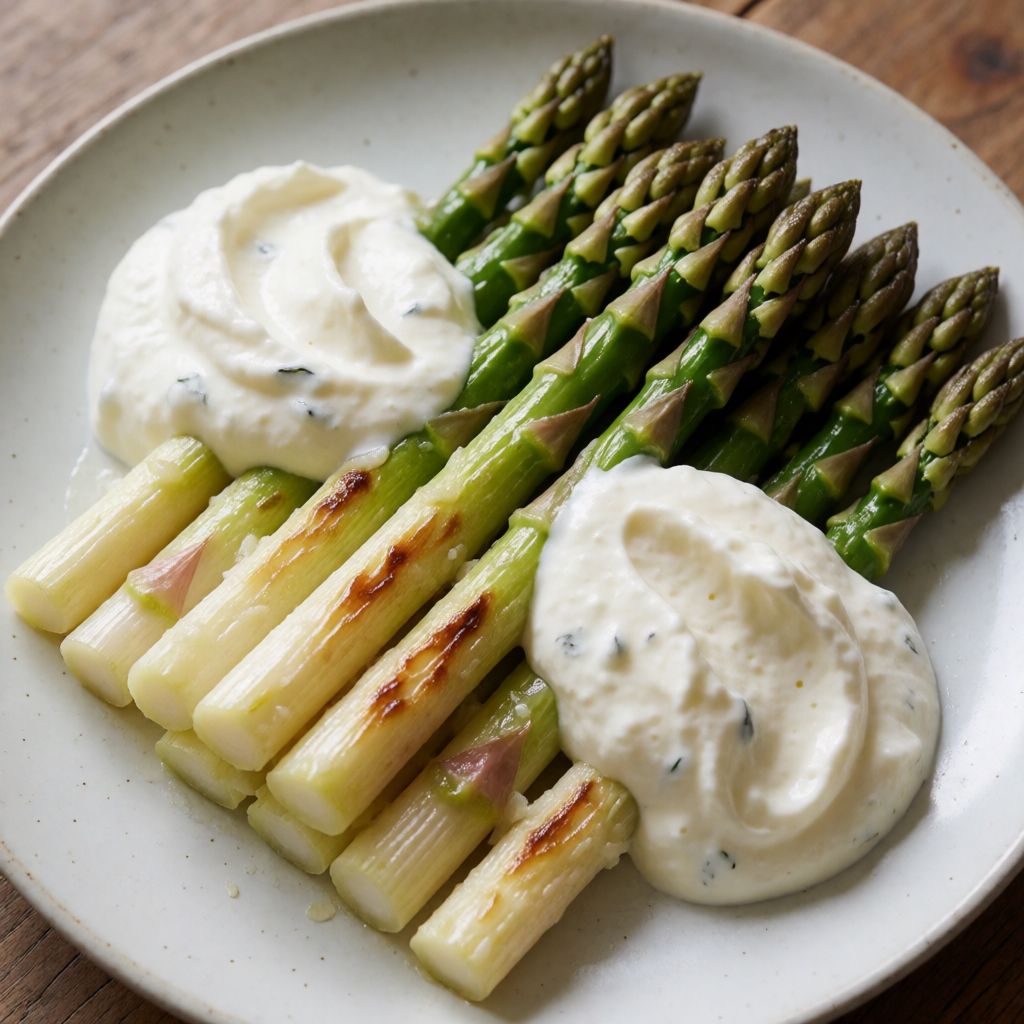
 AI photo
Asparagus with Wild Garlic and Whipped Lumpfish Roe
A spring side pairing white and green asparagus with wild garlic oil and crème fraîche whipped with lumpfish roe.
Labels are worked out automatically from the ingredients and can be wrong. Check the packaging if it matters to you.
Ingredients
- 12 pcs White asparagus
- 12 pcs Green asparagus
- 1 tsp Butter
- 10 pcs Wild garlic
- 50 ml Olive oil
- 100 ml Crème fraîche 38%
- 100 ml Lumpfish roe optional
- 1 bunch Dill fresh
- Salt
- Black pepper freshly ground









Steps
Put the wild garlic and oil into a blender or mini chopper and blitz into a green wild garlic oil.
1 minPeel the white asparagus and snap off the lowest fibrous part.
3 minSteam the white asparagus over lightly salted boiling water for 3-4 minutes.
3 minSnap off the lowest fibrous part of the green asparagus and quickly fry it in butter in a hot pan for 1 minute.
1 minPlace the lumpfish roe on a piece of kitchen towel to remove excess moisture, then mix it with crème fraîche and, if liked, 1 tsp of finely chopped dill.
3 minIf lumpfish roe is out of season, simply serve with crème fraîche mixed with dill, salt and pepper.
Cut the asparagus in half into two equal parts and arrange, alternating white and green, as shown in the photo.
2 minTop with 1 tbsp of crème fraîche or the crème fraîche with roe, drizzle with wild garlic oil and sprinkle with flaked salt and freshly ground pepper.
1 min
This is two asparagus, cooked two different ways, meeting on a plate with a green oil and something creamy. That's the whole dish. What decides whether it works isn't a clever step — it's restraint. White asparagus wants to be gently boiled into submission because it's fibrous and bitter under the skin; green asparagus wants the opposite, a hot pan and almost no time, because it's already tender and will turn grey and sad if you treat it like its white cousin.
Some say white and green asparagus are the same vegetable at different ages of cutting — true, in a sense: green is harvested once it breaks the soil and photosynthesises, white is kept under mounded earth the whole time and never sees light, so it stays pale and develops a tougher skin and a slightly bitter edge that needs peeling and a longer cook to soften. That's not snobbery, that's physiology — a plant denied light makes different cell walls.
The wild garlic oil is doing more work than its one line suggests: raw leaves, blitzed cold into oil, keep their sharp green smell instead of cooking it away. That smell is the point — it's the thing that makes this plate taste like spring instead of "vegetables with cream." Whip the oil in short bursts, not one long grind, or the blade heats it and the leaves start to taste boiled rather than bruised.
Buy white asparagus by the feel of the spear, not the look of the packet: it should be firm all the way to the tip, heavy for its size, with no give. A spear that bends before it snaps has been sitting too long and the sugars have already started turning starchy and dull — that's the real reason "fresh is best" isn't sentiment, it's chemistry. Peel it because the skin is the toughest, most bitter layer on a plant that grew its defences underground with no sun to soften them; snap off the base rather than cutting it, because the fibrous end breaks at the exact point where tenderness stops and woodiness begins — your hands find that line better than a knife does.
Green asparagus doesn't need peeling at all — thinner skin, grown in light, no need to armour itself the same way. Snap the base the same way, then into butter in a hot pan for barely a minute: butter here isn't for flavour so much as for a fast, even contact that colours the spear without boiling moisture out of it. Steam, by contrast, is the right tool for the white spears because it's gentle and even — a wide pan with an inch of lightly salted water and a plate balanced over it as a makeshift lid will do the job just as well as a proper steamer basket; the asparagus doesn't know the difference, only that it's surrounded by moist heat rather than sitting in boiling water losing its minerals and flavour into the pot.
Wild garlic — ramson, if you want the English hedgerow name — is a short-season leaf, roughly March to May in Britain, smelling of garlic without the bite. If it's out of season, don't reach for garlic cloves; raw garlic blitzed into oil is harsh and lingers all evening. Better: young spinach or rocket leaves with a small crushed garlic clove, blitzed the same way, gives you the green colour and a milder garlic note without the raw punch. The oil itself should have no character of its own — a flavourless olive oil or a plain rapeseed oil, so the wild garlic is the only thing you taste; a heavily peppery extra virgin will argue with it.
Crème fraîche at 38% is chosen for fat, not fashion — that fat is what lets it sit thick on top of warm asparagus without melting into a puddle. If you can't find it that rich, strained Greek yoghurt or full-fat soured cream gets you close, though it'll be sharper and thinner — add a touch more and expect it to slump a little, that's just physics, not failure. Lumpfish roe gives salt and a small pop of texture rather than any deep flavour — that's precisely why it's listed as optional and why the fallback of plain crème fraîche with dill works: the dish was never built around the roe, only decorated with it.
Patience here isn't about long cooking — there's barely twenty minutes of heat in the whole thing — it's about not rushing the plating. Let the steamed white asparagus drain a moment so it doesn't bleed water into the cream; let the oil rest after blitzing so any bubbles settle and it pours in a clean thread rather than a foam. Small pauses, but they're the difference between a plate that looks composed and one that looks like it was thrown together on the way out the door — and for a dish this plain in its parts, composure is most of the dish.