
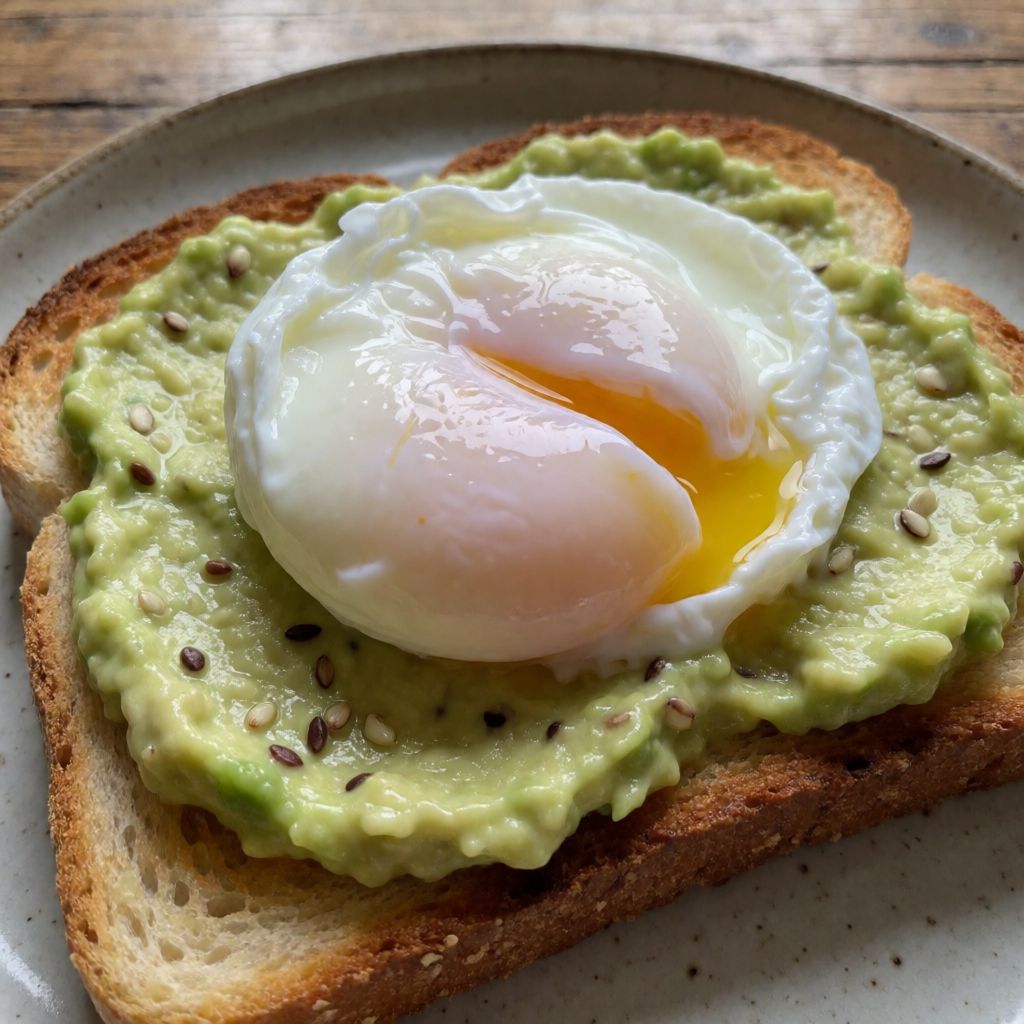
 AI photo
Avocado Toast with Poached Egg and Smoked Salmon
A bright brunch toast layering smashed avocado, smoked salmon and a poached egg.
Labels are worked out automatically from the ingredients and can be wrong. Check the packaging if it matters to you.
Ingredients
- 2 pcs Avocado
- ½ pcs Lemon finely grated zest and a little juice
- 4 pcs Bread slices
- 1 tbsp Butter
- 75 g Smoked Salmon thinly sliced
- 1 tbsp Hemp Seeds
- 0.5 tsp Chilli Flakes
- 0.5 bunch Chives
- Salt
- Black Pepper freshly ground
- 4 pcs Eggs
- 1 tbsp Apple Cider Vinegar



Steps
Mash the avocado flesh on a plate with a fork and season with lemon juice, half the finely grated lemon zest, salt and freshly ground black pepper.
Toast the bread and spread it with butter.
Spread the avocado mixture over the toast slices.
Top with a poached egg and thin slices of smoked salmon.
Sprinkle with hemp seeds, chilli flakes, chives, the remaining lemon zest, flaky salt and freshly ground black pepper.
Bring a saucepan of water to the boil.
Crack each egg into a separate small bowl.
When the water boils, add the apple cider vinegar and take the pan off direct heat.
Stir the water with a spoon or whisk to create a swirling vortex with a dip in the centre.
Slide the egg into the centre of the vortex and return the pan to the heat.
Poach the egg for about 3 minutes, then carefully lift it out with a slotted spoon onto a plate.
3 minContinue poaching the remaining eggs the same way.
Trim the eggs with a sharp knife so they have a neat, smooth edge.
This isn't really a toast recipe. It's an egg recipe that happens to need a platform. Everything else — the avocado, the salmon, the hemp seeds — is there to give the poached egg something to sit on and something to talk to when you cut into it. So the whole dish stands or falls on one thing: can you hold an egg together in open water without a mould, without cling film, without any of the tricks.
The avocado mash isn't decoration, it's glue and ballast. Mashed avocado on its own is slippery — a fork can't get purchase on it, and a poached egg wants to roll straight off a smooth toast. The lemon juice does two jobs at once: it stops the avocado browning (the flesh oxidises the second it meets air — that grey-green tinge isn't spoilage, it's just oxygen doing what oxygen does), and it cuts the fat so the whole thing doesn't sit heavy on the tongue. Salt goes in here, not after, because avocado needs time to actually taste of salt rather than just carry grains of it.
The egg itself is the test. A proper poach has a white that's fully set but not rubbery, wrapped tight around a yolk that still moves when you nudge the plate. Some say you need a perfect whirlpool and total silence in the kitchen — no, you need acid and heat working together, because vinegar tightens egg white protein almost on contact, which is what stops it feathering into threads the moment it hits water. The swirl just keeps the white gathered toward the yolk while that happens; it's a current, not a ritual.
Start with the eggs, because age matters more than brand. An egg a week old poaches cleaner than one laid yesterday — as an egg sits, its white loosens and thins, and thin white is exactly what scatters into feathers in the pan. A fresh egg from a box with yesterday's date, oddly, behaves worse here than one that's been in your fridge five or six days. If you only have very fresh eggs, strain the loose watery white off into a sieve before you crack them into the water — you lose a bit of volume but you gain a tight shape.
The vinegar: any clear vinegar with real acidity does the same job — cider vinegar, white wine vinegar, even a squeeze more lemon juice in a pinch. What you're after is pH, not flavour, since a tablespoon in a full pan of water barely registers on the tongue. Skip malt vinegar though — it's heavier and will leave a shadow of its own taste and colour in the white.
Avocado: ripe means it gives gently under a thumb at the stalk end, not that it's soft all over — soft all over usually means bruised or turning, and you'll taste a bitterness at the edges. If your avocados are still hard, there's no shortcut that doesn't compromise the texture; a few days in a paper bag with a banana is the honest fix, not a microwave. Lemon zest goes in twice on purpose — once worked into the mash where it flavours quietly, once scattered on top raw where you actually smell it as you lift the toast to your mouth. That's the whole reason behind splitting an ingredient between "inside" and "on top" in any dish: cooked-in and raw-on-top are two different flavours from one plant.
Bread: this wants a slice sturdy enough to hold weight without going soft under the avocado — a dense white or a seeded sourdough rather than a soft supermarket sandwich loaf, which will go damp the second butter and avocado meet it. Butter the toast while it's hot, not after it cools, because hot bread takes butter into itself rather than leaving it sitting as a slick on top — that's the difference between toast that tastes buttered and toast that's merely wet.
Smoked salmon wants to go on last and barely warmed by the egg's own heat, never anywhere near the pan — cooking it even slightly turns the texture chalky and kills the cure flavour you paid for. If you're doing without it, a few anchovy fillets or just extra flaky salt will give you the savoury hit that the salmon is really there for; this dish works as well without fish as a well-dressed salad works without its star vegetable, which is to say — it changes, it doesn't collapse.
Hemp seeds, chilli flakes and chives at the end are seasoning by texture as much as taste: the seeds for a bit of bite against all that softness, the chilli for a flash of heat, the chives for green freshness that cuts through the fat of avocado, butter and salmon together. None of them are structural — swap hemp seeds for toasted sesame or pumpkin seeds and nothing is lost, because their job is crunch, and plenty of things crunch.
A word on patience, since this looks like a five-minute breakfast and isn't quite: the eggs poach one at a time if you're not confident, which means the first toast sits waiting while the fourth egg cooks. Make your avocado mash and toast the bread before you touch the eggs, so when each one comes out of the water it's going straight onto a plate that's ready, not making the egg wait on you. Four eggs, four toasts, four people — this isn't a dish that scales well beyond a small table anyway, since poaching six or eight eggs in sequence while the early ones go cold defeats the entire point of the exercise.