
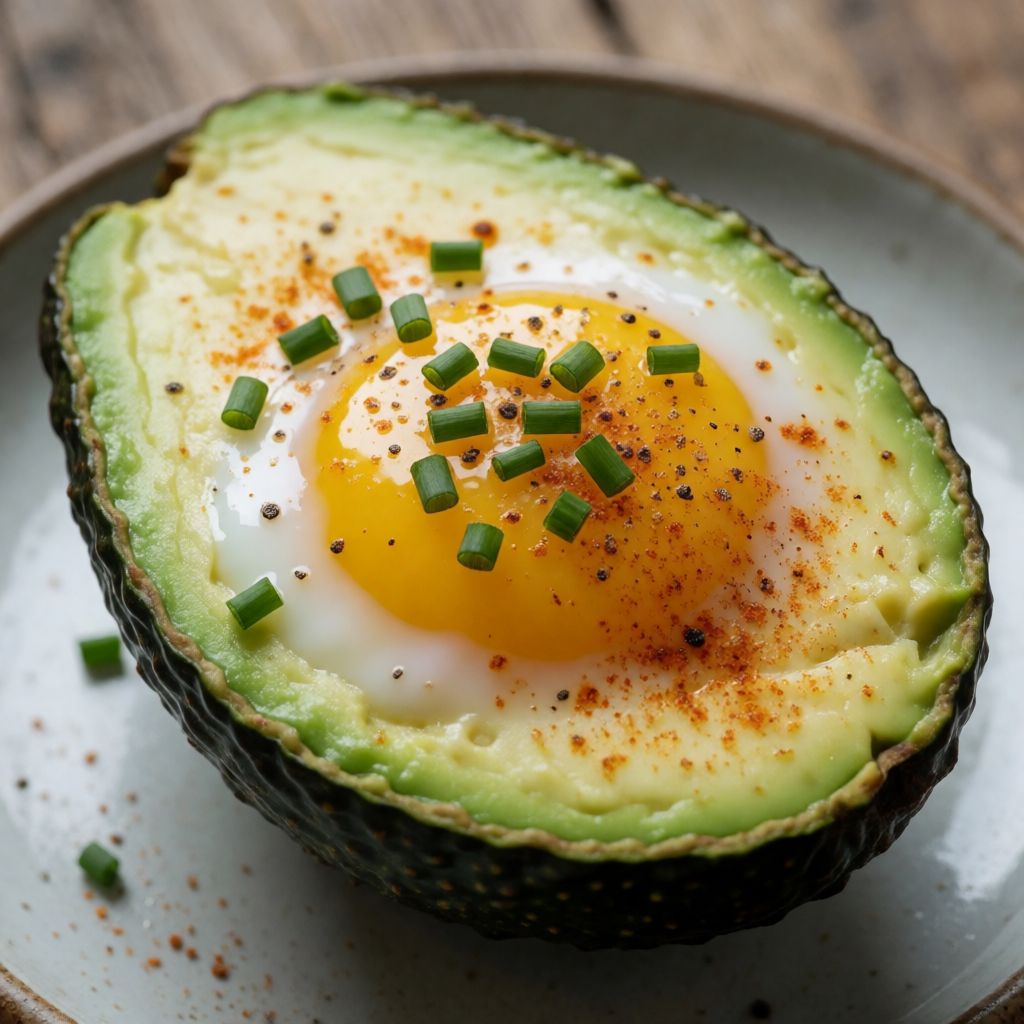
 AI photo
Baked Avocado with Egg
Avocado halves baked with an egg nestled in each, finished with chives and a touch of chilli.
Labels are worked out automatically from the ingredients and can be wrong. Check the packaging if it matters to you.
Ingredients
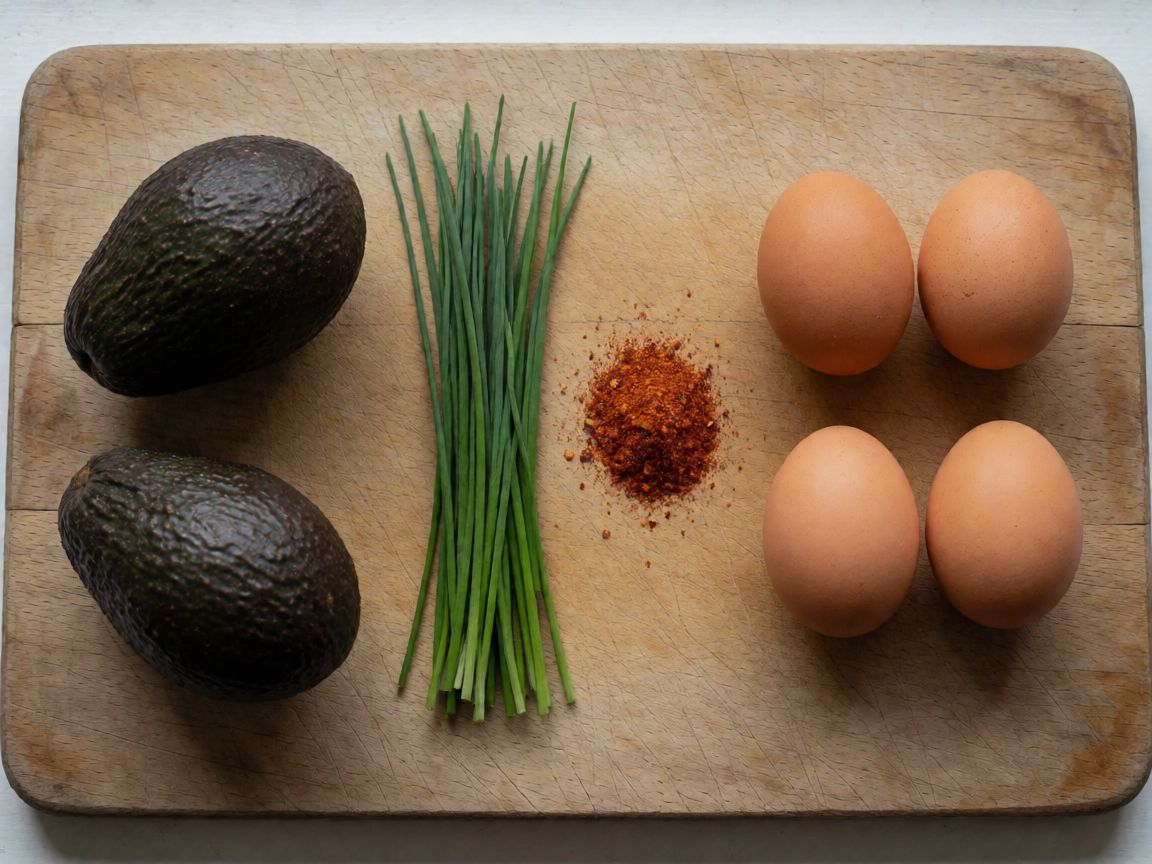
- 2 pcs Avocado
- Chives to taste
- 4 pcs Eggs
- 0.5 tsp Chilli powder
- Salt to taste
- Black pepper to taste




Steps
Preheat the oven to 180°C.
Rinse the chives, pat dry and chop finely.
Wash the avocados, pat dry, halve them and remove the stone.
Scoop out a little flesh from each avocado half to make room for the egg.
Line a baking tray with parchment, place the 4 avocado halves cut-side up, and season with salt and pepper.
Bake at 180°C for 5 minutes.
5 minRemove the tray, carefully crack the eggs and place one into each avocado half.
Sprinkle the eggs with chives, chilli powder and salt, then bake for a further 10 minutes.
10 minServe hot.
This is not a fried egg and not a boiled one — it's an egg set by surrounding warmth, cradled inside a bowl that happens to be edible. The avocado gives the egg a vessel with walls thick enough to hold heat and shape, so the white firms from the outside in while the yolk, protected by that cushion of fat, stays soft. Think of the avocado half as a tiny clay pot that you eat afterwards — except it was never fired, so it has limits.
What decides whether this works has nothing to do with chilli powder or chives. It's the avocado itself: ripe enough to taste of something, firm enough to keep its hollow when you crack an egg into it. Too soft and the walls collapse, the egg runs over the tray, and you've made scrambled egg with avocado flavouring. Too hard and it won't warm through in the time the egg needs — you'll bite into cold green wood around a cooked egg. And the egg has to be sized to the hole: a large egg in a small hollow floods the tray; a small egg in a deep one looks lonely and overcooks before the white at the rim even sets.
Some say avocado turns bitter the moment it meets heat — no, because it's not heat that does that, it's too much heat for too long, the kind that breaks the fat down and leaves it tasting of old oil. Fifteen minutes at a gentle oven temperature is nowhere near that line. The short pre-bake before the egg goes in isn't about cooking the avocado — it's about warming the shell so it doesn't shock the egg with cold walls and slow its setting unevenly.
Avocado: buy for ripeness the way you'd choose one for guacamole, not for slicing into a salad — it should give slightly under a thumb's pressure at the stem end but not feel hollow or squashy. A hard one won't warm through; a soft one won't hold the egg. Figure roughly 200g a fruit, two avocados giving four halves for four people — one half, one egg, one person. When you scoop out flesh to make room, take only a spoonful from the centre of the hollow left by the stone. Scoop more and you thin the walls near the skin, and that's exactly where a baked avocado splits and leaks. Your domestic oven tray is flat, and avocado halves are round-bottomed — they'll tip and spill their egg the second you shut the door. A muffin tin solves this for nothing: sit each half in a cup, and it can't roll. No muffin tin, a loose ring of foil under each half does the same job.
Eggs: use whatever size fits the hollow you've made rather than the biggest in the box — a UK large egg usually needs a reasonably generous avocado, so if yours are small, go medium. Freshness matters more here than anywhere else: a fresh egg holds its yolk centred and its white close to the yolk, which is exactly the shape you need when you're pouring it into a bowl with no lid on top. An older egg spreads thin and runny the moment it meets the hollow, and a good third of it ends up on the tray rather than in the avocado.
Chives: their job is a clean, faint oniony sharpness that doesn't fight the richness of the avocado or the egg. Any soft green onion top does this — spring onion greens, even a scrap of parsley if that's genuinely what's in the fridge, though it won't taste the same. What you don't want is raw bulb onion — too sharp, too wet, it'll weep and dilute everything around it.
Chilli powder: half a teaspoon between four eggs is not heat, it's a nudge and a bit of colour against the pale yolk. Any ground dried chilli does the same work; smoked paprika gives you the colour and a different, smokier warmth if you want the dish milder. If all you have is fresh chilli, mince it fine and use less — fresh brings moisture as well as heat, and moisture is the one thing you're trying to keep out of that hollow.
Salt goes in twice for a reason, not out of habit: first on the empty avocado, before the pre-bake, which seasons the flesh itself — otherwise you're only ever seasoning the egg, and the avocado underneath stays flat and bland. Second, lightly, on the egg once it's in, because the white needs its own seasoning; salt doesn't travel far through a set white once it's cooked.
This isn't an old dish wearing new clothes — it's a brunch-era invention, built for the economics of a kitchen that has five minutes, one tray, and wants something that photographs well before anyone's finished their tea. There's no ancestral method to defer to here, which is freeing: you're not breaking a rule if you swap the chilli for paprika or the chives for spring onion, you're just cooking. The only patience this one genuinely demands is during that last stretch in the oven — resist opening the door every two minutes to check, because each check lets heat out and makes the yolk's setting even less predictable than it already is.