
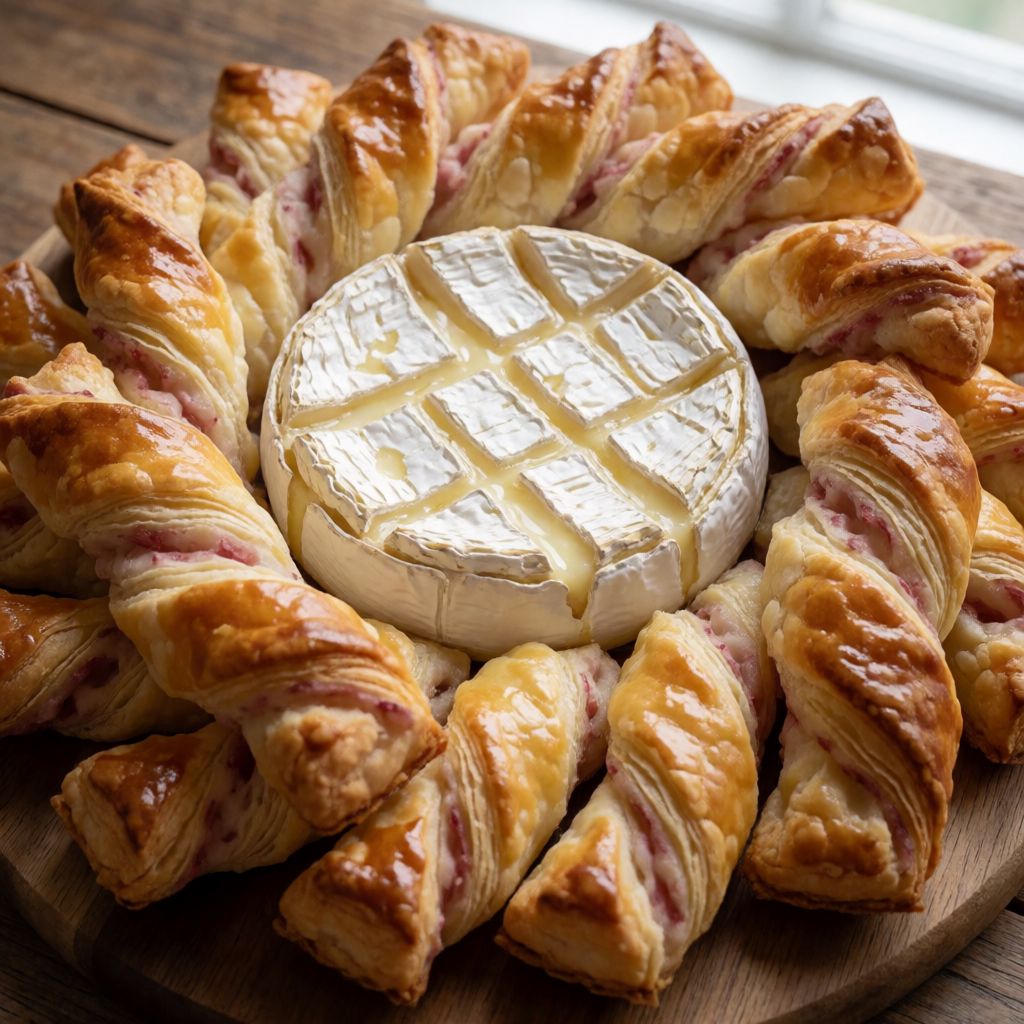
 AI photo
Baked Camembert with Crispy Puff Pastry Twists
A warm camembert surrounded by twisted puff pastry strips, baked until golden and gooey.
Labels are worked out automatically from the ingredients and can be wrong. Check the packaging if it matters to you.
Ingredients
- 250 g Ready-rolled puff pastry
- 80 g Serrano ham thinly sliced
- 2 tbsp Dijon mustard
- 1 pcs Egg beaten
- 250 g Camembert
- 2 clove Garlic lightly crushed with a knife
- 2 pcs Rosemary fresh sprigs
- 1 tbsp Olive oil
- pinch Black pepper freshly ground






Steps
Roll out the puff pastry and spread it with Dijon mustard. Lay the Serrano ham slices over the surface of the pastry and fold one half of the pastry over the other.
Using scissors, cut the pastry into strips about 1 cm wide. Brush all the strips with the beaten egg, twist them and place them on a baking tray lined with parchment paper. Sprinkle with freshly ground black pepper. Leave space for the cheese.
Place the camembert (or Mont d'Or) in the middle of the parchment, surrounded by the twisted pastry strips.
Score the cheese, drizzle with a little olive oil, add a few sprigs of rosemary and a few garlic cloves, lightly crushed with a knife.
Bake in a preheated fan oven at 200°C for 12–14 minutes. Enjoy freshly baked, while still warm.
13 min
This is a one-tray job: thin puff pastry folded around mustard and ham, cut into ribbons, twisted into little screws, and baked in a ring around a whole soft cheese that you eat with a spoon once it slumps. Good for the hour before the roast goes on, when people are standing in the kitchen with a glass and need something to pick at that isn't crisps.
What decides whether it works is that two very different objects are sharing the same tray, the same heat, the same twelve to fourteen minutes. The pastry wants maximum surface facing the hot air, which is the whole reason you twist the strips rather than leave them flat — a flat strip of puff just puffs and sits there pale underneath; a twisted one exposes every edge, so it goes properly crisp and gold rather than merely cooked through. The cheese, meanwhile, only needs that same stretch of time to go soft at the edges and warm in the centre, held together the whole time by its own rind, which is why you score it with a knife rather than peel it off.
Some say you need the wooden box the camembert came in, otherwise it runs everywhere on the tray — no, because at this heat and in under fifteen minutes, with the rind nicked rather than breached, it holds its shape fine. The box matters for a slower, longer melt where the cheese has time to properly collapse; this isn't that. What you're doing here is closer to warming a sealed parcel than melting a sauce.
Puff pastry, whatever brand, is layers of fat and dough rolled and folded until the fat sits between dozens of thin dough sheets. In the oven the fat melts and turns to steam, and the steam has nowhere to go but up, pushing the layers apart — that's the whole mechanism, there's no air pump involved and no magic in it. All-butter puff smells of butter as it does this; the cheaper fat-blend kind puffs exactly the same, it just smells of less. Either is fine here because the ham and mustard are doing the flavour work, not the pastry.
The mustard isn't there for its own sake. Spread thin, it does two jobs: it's sharp enough to cut against the fat of the ham so the whole thing doesn't taste purely of salt and grease, and it glues the ham to the pastry so the slices don't slide when you fold and twist. Dijon is the right heat for this — English mustard is fiercer and will shout over the ham if you use the same amount; wholegrain works too, you just get little pops of seed instead of a smooth layer.
Serrano ham is dry-cured, which means firm and salty rather than wet. Folded inside the pastry, its fat renders gently as it bakes and bastes the inner layers from within — that's the point of folding the pastry over it rather than laying it on top exposed, it protects the ham from direct heat (which would just crisp it to a curl) and feeds its fat back into the dough instead. Any other dry-cured ham does the same job — prosciutto, Serrano's Italian cousin. If all you have is streaky bacon, pat it properly dry first; bacon carries brine and moisture that cured ham doesn't, and that extra moisture is exactly what turns a pastry layer soggy instead of crisp.
The egg wash isn't holding anything together — it's there purely for colour, the Maillard browning that turns raw dough pale blond into deep gold, and for shine. Skip it and the pastry can look underdone even when it's cooked through, which is the trap: don't judge doneness by the clock alone, judge it by colour, and egg wash is what gives you an honest colour to judge by. No egg in the house, a brush of milk does a weaker version of the same thing.
The camembert's rind is a living skin — a mould culture that's firmed into a wall holding the runny interior in. You score it, not strip it, because the cuts let heat, the oil, the garlic and the rosemary oil get into the middle faster without opening the wall up completely. Crush the garlic rather than mince it — a lightly crushed clove releases its oil slowly over twelve minutes; minced garlic on a dry pastry surface burns in that same time and turns bitter, which is the actual reason recipes tell you to crush rather than chop, not tradition for its own sake. Rosemary is woody and resinous, so it survives the oven without wilting the way a soft herb like basil would in the same few minutes — thyme would behave the same way if that's what's in the fridge.
On the oil: this is one of the few places where you actually want the oil to taste of something, because nothing else in the dish is loud enough to hide behind. Don't reach for your best bottle — oven heat flattens the fine top notes of a really good extra virgin anyway — but do use one you'd be happy dipping bread into, not a flavourless refined oil bought for frying. And once it's out of the oven, give it a minute before you cut into the cheese. That minute is the difference between a wedge that holds together on the spoon and one that just runs straight off the tray — patience here isn't virtue, it's structural.